ARTICLES

Managing a Multigenerational Workforce
In one Sydney IT services company, a 32-year-old project manager complained that her 58-year-old senior developer “couldn’t communicate.” He thought she “made decisions without proper process.” Meanwhile, the two 24-year-old graduates were frustrated that nobody used Slack properly and kept calling meetings that could have been messages. All three complaints were valid. None of them were actually about age.
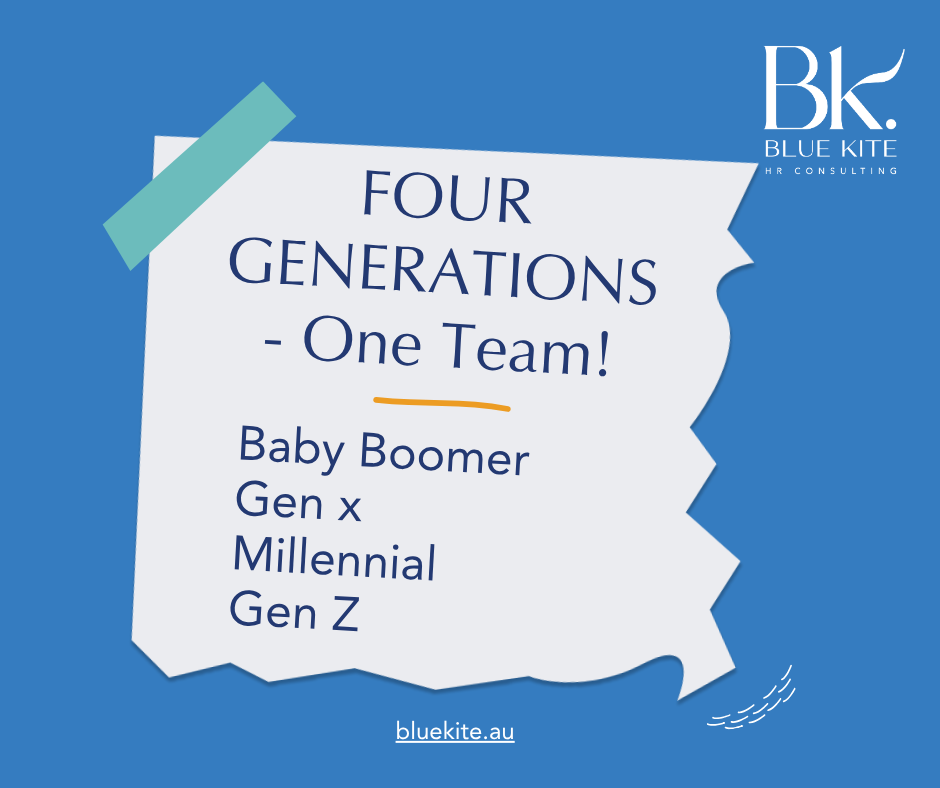
Australia’s workforce spans more generations than at any point in history. Baby Boomers are working longer. Gen X leads a significant portion of management. Millennials now make up the largest cohort in most organisations. Gen Z is entering the workforce fast. For small and medium businesses, that range of experience, expectation, and working style shows up in the day-to-day in ways that can either be a real asset — or a persistent friction point.
What the Research Actually Says
There’s a lot of noise about generational differences — and a lot of it is oversimplified. The evidence is clearer than the stereotypes suggest: people’s work preferences are shaped far more by their life stage, personal circumstances, and individual personality than by their birth year.
That said, there are some patterns worth noting. Older workers often bring institutional knowledge, stability, and a preference for face-to-face communication and structured processes. Younger workers frequently prioritise flexibility, feedback, purpose-driven work, and digital-first communication. Neither is better. Both are useful. And both exist on a spectrum.
Where the research does land consistently is that mixed-age teams, when managed well, outperform homogeneous ones. The combination of experience and fresh thinking, of process knowledge and innovation, produces better outcomes. The challenge is in the “managed well” part.
Where Generational Friction Comes From
Most generational conflict at work isn’t really about values. It’s about unspoken expectations that haven’t been surfaced or negotiated.
Different expectations about communication are a common trigger. One person expects a response within the hour; another considers same-day a reasonable timeframe. One team member writes brief, informal messages; another interprets that as dismissive. These aren’t generational problems — they’re communication norm problems, and they’re solvable.
Feedback preferences are another flashpoint. Older workers may have grown up in environments where feedback was rare and formal. Younger workers often expect regular, informal input. When a manager doesn’t naturally give either type, both groups feel unsupported — just for different reasons.
Building a Team That Uses the Difference
The practical move is to stop trying to manage generational differences and start managing individual preferences. Don’t assume what someone wants based on their age. Ask. Make it a normal part of how you get people set up in a role — “what does good communication look like to you?” and “how do you prefer to get feedback?” are questions that work for everyone.
Create conditions where different working styles are respected, not ranked. Flexibility for a 28-year-old managing childcare looks the same as flexibility for a 55-year-old managing an ageing parent. Don’t assign virtue to one and reluctance to the other.
And invest in creating genuine connection across the team. Mixed-age mentoring — in both directions — is one of the most underused tools in Australian SMEs. The reverse mentoring model, where younger workers share digital and emerging-trend knowledge with senior staff, is increasingly valuable and costs nothing but time.
Ready to build a better workplace? Book your free 30-minute consultation at Blue Kite HR Consulting
Blue Kite specialises in providing
HR services to support businesses
to create better workplaces.