
ARTICLES

Quiet Quitting: What’s Really Behind It and How to Reverse It
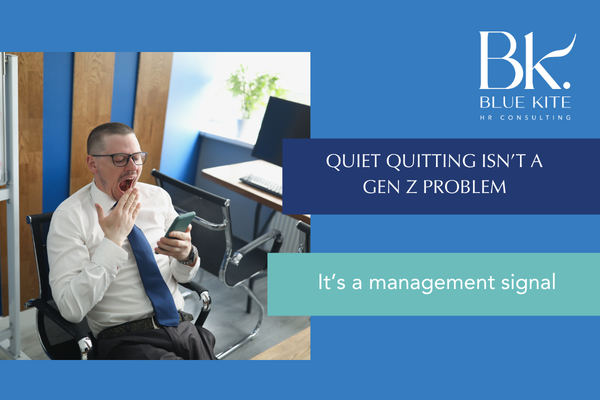
The term “quiet quitting” went viral in 2022 and generated an enormous amount of commentary, most of it missing the point. Half the discourse treated it as a generational problem — laziness, entitlement, the death of the work ethic. The other half treated it as a rational response to exploitation — workers reclaiming their time from unreasonable expectations.
Neither framing is particularly useful for a business owner trying to understand why a previously engaged employee is now doing the minimum and waiting for five o’clock.
Quiet quitting — the practice of doing exactly what your job requires and nothing more, of withdrawing the discretionary effort that engaged employees naturally contribute — is almost always a signal of something specific. Finding out what that something is tends to be far more productive than deciding which cultural narrative you agree with.
What’s usually behind it
The most common forerunner is a perceived breach of the psychological contract — the unwritten expectations we covered earlier in this series. An employee who consistently went above and beyond, believed that doing so would be recognised, and then found that it wasn’t, doesn’t just feel underappreciated. They recalibrate. Why contribute more than the contract requires when extra contribution doesn’t change anything?
Management relationships are the second most common driver. An employee who finds their manager unsupportive, who feels micromanaged, whose ideas are ignored, or who doesn’t feel they’re being treated fairly will withdraw investment from the relationship — and with it, the discretionary effort that often made them valuable.
Burnout is the third. Employees who are chronically overloaded, who have been asked to absorb the work of unfilled roles, or who have been operating at unsustainable capacity for an extended period often reach a point where working to minimum expectation is a survival strategy, not a character flaw.
The warning signs
The shift from engaged to quietly quit usually doesn’t happen overnight. Watch for the transition from proactive to reactive communication — someone who used to initiate ideas stopping doing so. The withdrawal from optional activities they previously participated in enthusiastically. The shift from raising problems to simply delivering work without comment on what could be improved.
These are early signals. By the time an employee is consistently doing the minimum, the underlying issue has usually been present for months.
How to reverse it
The starting point is a genuine individual conversation — not a performance management one. “I’ve noticed you seem less engaged lately” or “Is everything okay? I want to understand what you’re experiencing” opens the door. It requires the manager to actually want to hear the honest answer, which means being prepared for feedback about themselves or the business.
From there, the path forward depends on what’s driving the behaviour. A recognition issue has a different solution from a management relationship issue, which is different again from burnout. Cookie-cutter engagement initiatives rarely work because they address the average rather than the specific.
The cost of a genuinely engaged employee to a quietly quit one is real — in productivity, in quality, in their effect on team morale. It’s worth the conversation.
Ready to build a better workplace? Book your free 30-minute consultation at Blue Kite HR Consulting

Blue Kite specialises in providing
HR services to support businesses
to create better workplaces.