ARTICLES

The Hybrid Workforce: What the New Working From Home Laws Actually Mean
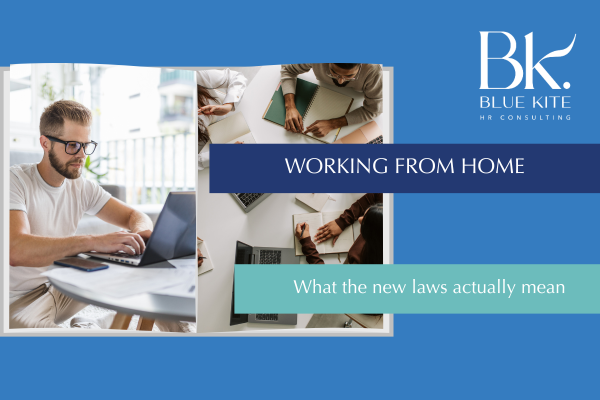
I recently appeared on Ticker News to talk about one of the most significant shifts in Australian employment law in years — the new working from home legislation. But the conversation I wanted to have wasn’t just about the law. It was about everything the law assumes your business already has in place.
Because here’s the truth: most businesses don’t.
What’s Actually Changing
Let’s start with the facts, because there’s a lot of noise out there.
From 1 September 2026, Victorian employees who can reasonably perform their role from home will have a statutory right to work from home for at least two days per week. This right is being enshrined in the Equal Opportunity Act 2010, making Victoria the first jurisdiction in the world to legislate WFH as a protected entitlement.
If your business has fewer than 15 employees, you have a little more time, the law applies to you from 1 July 2027. But don’t let that lull you into inaction.
Disputes won’t go to the Fair Work Commission. They’ll go to the Victorian Equal Opportunity and Human Rights Commission (VEOHRC) for conciliation first, and then to VCAT if unresolved. That’s a different process, a different regulator, and a different compliance framework than most employers are used to.
And here’s what many Victorian businesses are missing: this sits on top of your existing federal obligations. Section 65 of the Fair Work Act 2009 already gives eligible employees the right to request flexible working arrangements, and since 2023, the Fair Work Commission has had the power to arbitrate when employers refuse. That means you’re operating under two frameworks simultaneously, and non-compliance with either carries real risk.
The Case Nobody Is Talking About
While everyone has been focused on the Victorian legislation, there’s a live proceeding at the Fair Work Commission that could have even broader national implications.
The case initiated by the FWC on its own motion is examining whether a working from home term should be inserted into the Clerks – Private Sector Award 2020. The Australian Services Union is seeking a presumed right to work from home when reasonably requested. Not a right to ask. A presumed right. That’s a fundamental shift in where the burden of justification sits.
Currently, employees need to justify why they should be allowed to work from home. Under the proposed model, employers would need to justify why they can’t accommodate it. The proposed clause also includes a minimum of two WFH days per week and a 26-week notice period for any employer wanting to mandate a return to office.
If this gets up, it affects approximately 1.8 million workers covered by the Clerks Award, and legal experts have been clear that it could set a precedent flowing into other modern awards.
Final hearings ran through February 2026. A determination is expected soon.
The question isn’t whether this will affect your business. The question is: are you ready if it does?
The Real Problem Nobody Is Naming
Here’s what I said on Ticker News, and I’ll say it again here: the legislation answers the question of whether people can work from home. It doesn’t answer the much harder question — whether your managers know how to lead them fairly when they do.
Most leadership capability in Australian business was built for in-person, visibility-based management. You could see who was working hard. You could catch issues in the hallway. Performance conversations happened naturally. That model doesn’t translate to hybrid, and the gap is bigger than most businesses realise.
When managers can’t rely on visibility, they default to instinct. And instinct, in a hybrid environment, is often legally risky.
Proximity Bias: The Hidden Hazard in Your Hybrid Model
There’s a specific risk I want to name, because it’s real, it’s measurable, and almost no one businesses are talking about it: proximity bias.
Research consistently shows that employees who are in the office more are perceived as harder working, more committed, and more promotable, regardless of their actual output.
It’s not deliberate discrimination. It’s a deeply human cognitive bias. But in a hybrid workforce, it creates a two-tiered workplace where remote workers are systematically disadvantaged in performance reviews, promotion decisions, and workload allocation.
Under Australia’s psychosocial hazard frameworks, exclusion and inequitable treatment are recognised risks that employers have a duty to manage. Proximity bias doesn’t just damage your culture — it creates legal exposure.
If your hybrid model is quietly favouring in-office workers without your leaders even realising it, you have a problem. And now, with legislation in place to support hybrid work, that problem has teeth.
A Policy Is Not a Strategy
I want to be direct about something. Most businesses will respond to this legislation by updating a policy document. And while that’s a necessary starting point, it is not enough.
A policy that says ’employees may work from home two days per week’ does nothing to address:
- How performance will be fairly measured across different locations
- How managers will communicate inclusively — not defaulting to ad hoc hallway conversations that exclude remote workers
- How team culture is maintained when people are dispersed across home and office
- How you’ll handle a psychosocial complaint from a remote worker who feels excluded or overlooked
The businesses that will struggle with this legislation are the ones who treat compliance as a document exercise. The ones who will get it right are the ones who treat hybrid work as a people strategy question.
What Employers Need to Do — Right Now
Whether you’re in Victoria or operating nationally, here’s the practical reality of what needs to happen before this law takes effect.
1. Know your obligations — all of them.
Victorian employers need to understand both the state framework and the federal Fair Work Act. If you operate across multiple states, your employees may have different entitlements depending on where they’re based. That complexity needs to be managed proactively, not reactively.
2. Document everything.
The Fair Work Commission has been clear: employers can refuse WFH requests, but only with genuine, written business grounds and within the required 21-day response timeframe. Verbal decisions, informal conversations, and undocumented reasoning are the decisions that end up going against employers.
3. Update both your employment agreements AND your policies.
Most businesses focus on one and neglect the other. Your employment agreements need to reflect your current hybrid arrangements. Misalignment between what your contracts say and how your workplace actually operates is a compliance risk, and one of the most common gaps I find in HR audits.
4. Build real leader capability.
Not a one-hour webinar. Not a policy to sign off on. Actual training in how to manage performance remotely, how to run inclusive hybrid team meetings, and how to identify and counteract proximity bias in their own decision-making.
5. The deadline is not September. The deadline is now.
Getting your policies right, updating your employment agreements, and building leader capability takes time. If you wait until August to start, you won’t be ready.
The Shift That Changes Everything
The law is moving — and it’s moving in one clear direction.
From ‘you need permission to work from home’ to ‘you need a reason to make someone come in.’
That is a fundamental shift in where the burden of justification sits. And most Australian businesses haven’t noticed yet.
We’re in a moment where employment law is ahead of leadership capability in most workplaces. That gap, between what the law now expects and what most managers are equipped to do, is where the risk lives. It’s also where the opportunity lives, for the businesses willing to move first.
────────────────────────────────────────────────────────
Catie Paterson is the founder of Blue Kite HR Consulting, with over 20 years of experience supporting Australian businesses to build better, legally compliant workplaces. We provide practical, no-nonsense HR solutions for businesses of all sizes.
To discuss your hybrid work arrangements and what you need to have in place before September 2026, visit bluekite.au or connect with Catie on LinkedIn.
────────────────────────────────────────────────────────
This article is intended as general information only and does not constitute legal advice. For advice specific to your business and workforce, seek guidance from a qualified HR or employment law professional.
Blue Kite specialises in providing
HR services to support businesses
to create better workplaces.