ARTICLES

Good Managers Don't Develop Themselves by Accident
Here’s What the Research Says They Do Differently — and Why Your Business Depends on It.
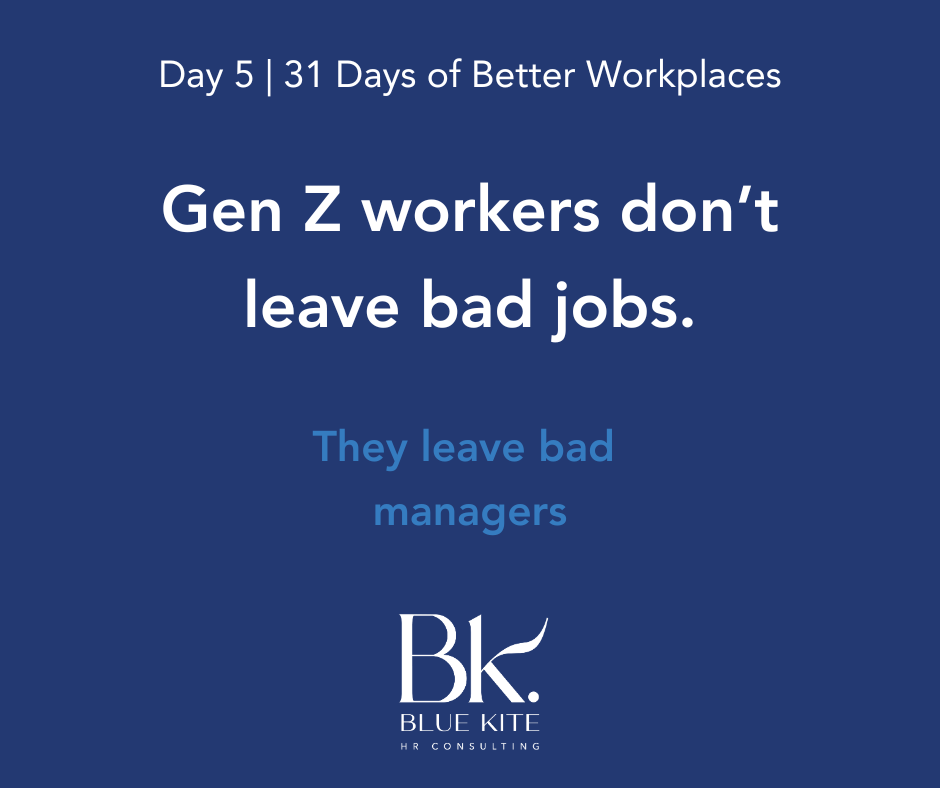
Day 5 of 31 Days of Better Workplaces — today, leadership development. And I want to get specific about what’s changing.
For years, we’ve assumed that people become good managers through experience and instinct. You put someone in a leadership role, they figure it out, and the ones with natural talent rise.
That assumption is producing management teams that are ill-equipped for the workforce they’re now leading.
What’s shifted
The workforce entering management now spans four generations, with Gen Z now making up a significant and growing share of most SME teams. The expectations they bring are not a phase — they’re a permanent recalibration of what employees want from work and from managers.
Gen Z, in particular, want managers who explain the why, who give honest and regular feedback (not just annual reviews), who engage with them as individuals, and who model the work-life boundaries they’re being told to maintain. They have low tolerance for ambiguity, low tolerance for inconsistency, and a strong radar for inauthenticity.
This isn’t criticism — it’s a description of a workforce that grew up with access to information and expects transparency as a default.
What’s good managers are doing differently right now
They are developing coaching capability — learning how to ask questions before providing answers, how to develop capability in others rather than just directing tasks. This is not a soft skill; it drives measurable productivity improvements.
They are building emotional intelligence as a conscious practice — not as a personality trait but as a set of skills: recognising their own patterns under pressure, staying regulated in difficult conversations, understanding what’s driving behaviour in others.
They are creating individual connection — knowing what motivates each person on their team, what their development goals are, what’s happening in their life that affects their work. Not as an intrusion, but as genuine interest.
What smart SMEs are doing now
They’re investing in leadership development before they need it — not after a leadership failure forces the issue. The businesses getting ahead are building management capability systematically, not waiting for it to emerge.
My own leadership program works precisely because it treats leadership as a learnable, practiceable discipline — not a personality trait you either have or you don’t.
The question isn’t whether your managers need development. It’s whether you’re going to address that now, while there’s time, or react to it after your best people leave.
Book a 30-minute free consultation at Blue Kite HR Consulting
Blue Kite specialises in providing
HR services to support businesses
to create better workplaces.