
• Skip to primary navigation
  • Skip to main content

BlueKite HR

  • HOME
  • ABOUT US
  • HR SERVICES
  • COACH WITH ME
  • HEALTH & WELLBEING
  • MEDIA/PR
    • – Articles/Blogs
    • – Keynote Speaking Events
    • – Podcast Interviews
    • – Ticker Interviews
  • BLOG
  • RESOURCES
  • CONTACT

Workforce Planning

16 August, 2026 by Catie Paterson Leave a Comment

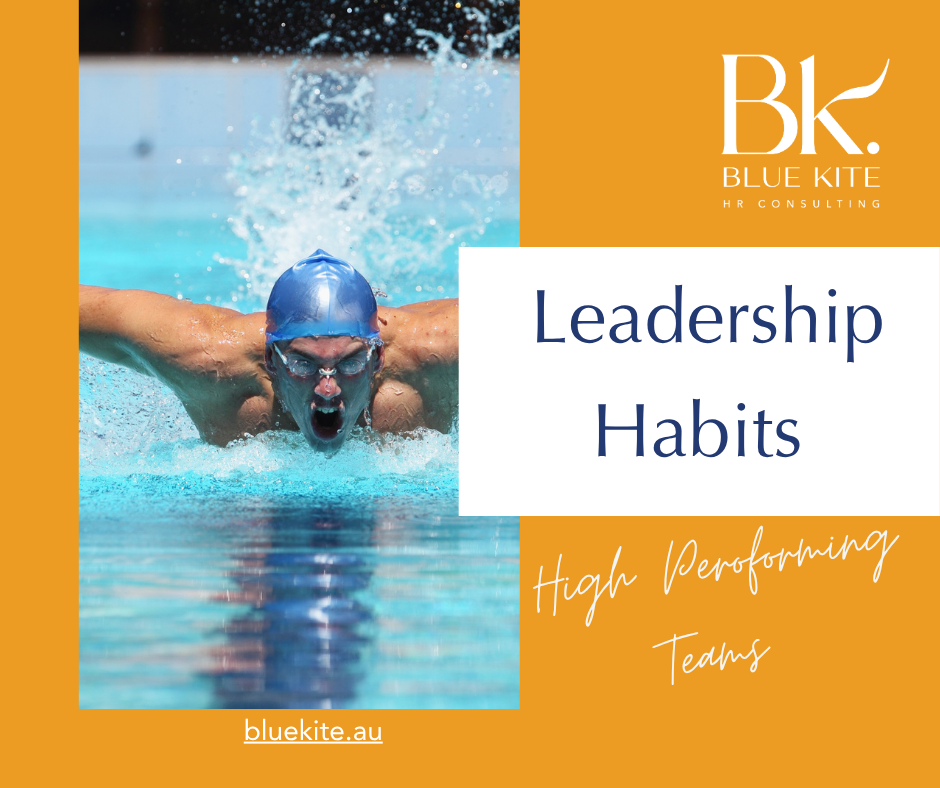
5 Leadership Habits That Build High-Performing Teams

ARTICLES

5 Leadership Habits That Build High-Performing Teams
16 August, 2026
Filed Under: Advisory and compliance, Business Update, Culture, HR essentials, Leadership, Succession Management, Workforce, Workforce Planning

Day 16 of 31 Days of Better Workplaces — high performance doesn’t happen by accident. It’s the result of consistent behaviours that leaders either build deliberately or don’t.

After more than twenty years working with leaders across industries, these are the five habits I see most consistently in the leaders who build genuinely high-performing teams.


Habit 1: They communicate context, not just tasks

High-performing team members want to understand why — why this work matters, how it connects to the bigger picture, what success looks like. The manager who only assigns tasks produces a team that executes instructions. The manager who shares context produces a team that thinks.


Habit 2: They give feedback continuously, not annually

Waiting for a formal review process to tell someone they’re doing well — or not — is a missed opportunity. Brief, specific, real-time feedback — “that was a great way to handle that client” or “I noticed this in your report, here’s what I’d suggest” — compounds over time into a team that knows where they stand and how to improve.


Habit 3: They invest in individual development

High-performing leaders know what each person on their team is working toward — professionally and personally. They look for opportunities to stretch people, give them new experiences, and connect their day-to-day work to their longer-term goals. People perform better when they can see they’re growing.


Habit 4: They protect the team’s capacity

Good leaders push back on unrealistic workloads, prioritise ruthlessly, and don’t allow their team to be pulled in twenty directions at once. They understand that sustained high performance requires sustainable conditions — and they advocate for those conditions.


Habit 5: They model the culture they wantgreement clauses that help manage workplace risk

Whatever you want your team to do, you have to do first. If you want them to be honest, be honest. If you want them to take ownership, take ownership. If you want them to prioritise wellbeing, model it. Culture is not what you mandate — it’s what you demonstrate.
The good news: these are all learnable habits. None of them require a special talent. They require intention and consistency.


Book a free 30-minute consultation at  Blue Kite HR Consulting 
 

BACK TO ALL ARTICLES
Screenshot 2025-11-18 164639

+61 (0) 409 545 634

cpaterson@bluekite.au

FREE CONSULTATION

  • ABOUT
  • HR SERVICES
  • COACH WITH ME
  • HEALTH & WELLBEING
  • MEDIA/PR
  • ARTICLES/BLOG
  • RESOURCES
  • CONTACT
  • PRIVACY

Blue Kite specialises in providing
HR services to support businesses
to create better workplaces.
Filed Under: Advisory and compliance, Business Update, Culture, HR essentials, Leadership, Succession Management, Workforce, Workforce Planning

12 August, 2026 by Bronwyn Coulthart Leave a Comment

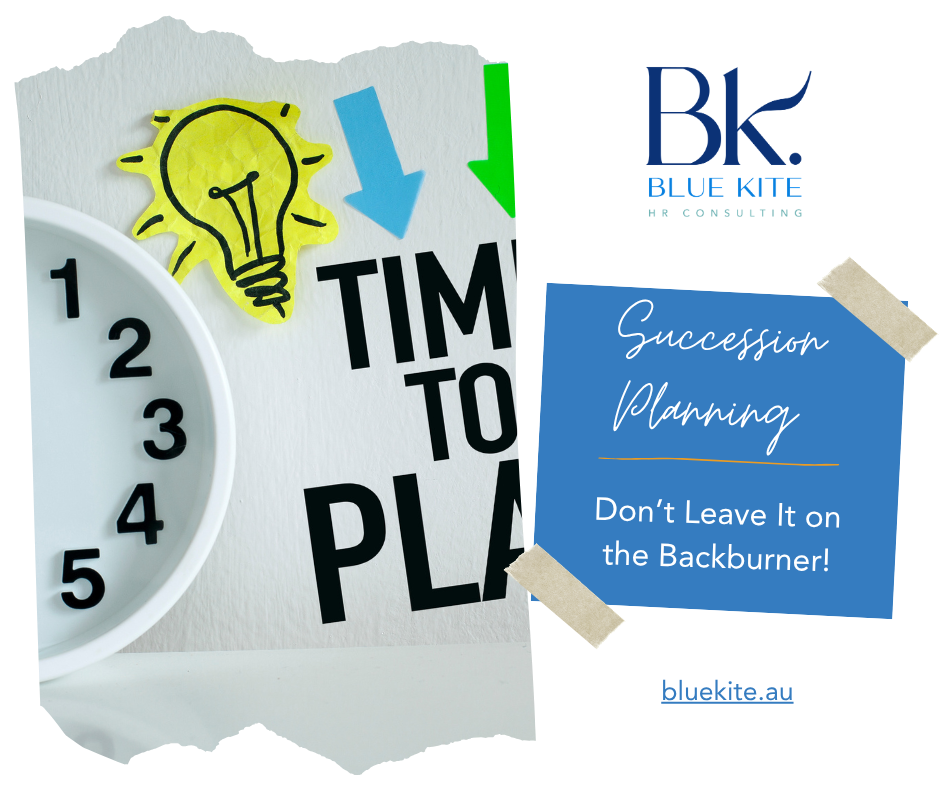
Succession Planning: Why Businesses Leave It Too Late

ARTICLES

Succession Planning: Why Businesses Leave It Too Late

12 August, 2026
Filed Under: Advisory and compliance, Business Update, Career Planning, Change management, Culture, External HR Support, HR essentials, Leadership, Succession Management, Workforce, Workforce Planning

Day 12 of 31 Days of Better Workplaces — succession planning is something most business owners know they should be doing. Most of them aren’t.

The conversation usually goes one of two ways. Either the business owner thinks succession planning is only for large corporations, or they plan to “deal with it when the time comes.” Both positions create significant risk.


What succession planning actually is for a business

It’s not a corporate exercise involving lengthy documentation and committee reviews. For a business, succession planning is about understanding which roles are critical to the business continuing to function, identifying the risks if those roles suddenly became vacant, and having a plan, even a simple one, for what happens if they do.


The most common risk most businesses carry

Key person dependency. One person,  often the owner, or a long-tenured operations manager, or the one person who “knows how everything works”, holds knowledge, relationships, and capability that exists nowhere else in the business. When they leave — and eventually they will — the disruption can be significant.


Three things to do this week 

First

Identify your critical roles. Not just seniority, actual criticality. Which positions, if they became vacant tomorrow with no notice, would cause the most operational damage?

Second

Assess your bench. For each critical role, is there anyone in the business who could step into it, even partially? What would it take to get them ready? That gap analysis is the starting point for your succession plan.

Third

Capture critical knowledge. Start a simple process of documentation, key contacts, processes, passwords, client relationships for your highest-risk roles. This alone reduces the impact of an unexpected departure significantly.


The thing no one says out loud

Succession planning also applies to the owner. If something happened to you tomorrow, what would happen to your business? Your team? Your clients? A succession plan is also a contingency plan, and it’s one of the most responsible things you can build.

Book a free 30-minute consultation at Blue Kite HR Consulting 

BACK TO ALL ARTICLES
Screenshot 2025-11-18 164639

+61 (0) 409 545 634

cpaterson@bluekite.au

FREE CONSULTATION

  • ABOUT
  • HR SERVICES
  • COACH WITH ME
  • HEALTH & WELLBEING
  • MEDIA/PR
  • ARTICLES/BLOG
  • RESOURCES
  • CONTACT
  • PRIVACY

Blue Kite specialises in providing
HR services to support businesses
to create better workplaces.
Filed Under: Advisory and compliance, Business Update, Career Planning, Change management, Culture, External HR Support, HR essentials, Leadership, Succession Management, Workforce, Workforce Planning

11 August, 2026 by Bronwyn Coulthart Leave a Comment

Psychosocial Hazards: Australian Law Has Changed. Most Businesses Don’t Know What That Means for Them Yet — But They Will.

ARTICLES

Psychosocial Hazards: Australian Law Has Changed. Most Businesses Don't Know What That Means for Them Yet — But They Will.

11 August, 2026
Filed Under: Advisory and compliance, Culture, External HR Support, HR essentials, Leadership, Workforce, Workforce Planning

Day 11 of 31 Days of Better Workplaces — this is one of the most important posts in the series, because the legislation is real, the obligations are significant, and the gap between what the law requires and what most businesses are doing right now is substantial.

What has changed 

Psychosocial hazards — factors in the work environment that can cause psychological harm — are now explicitly regulated under Work Health and Safety (WHS) legislation across most Australian states and territories. The model WHS Regulations now require employers to proactively identify, assess, and control psychosocial hazards. This is not optional. It is not aspirational. It is a legal obligation with real consequences.

Safe Work Australia’s Code of Practice on Psychosocial Hazards at Work came into effect, and state regulators are increasingly active in this space. In Victoria, for example, the Workers Compensation scheme has seen a significant increase in psychological injury claims, and those claims are expensive, disruptive, and often preventable.


What counts as a psychosocial hazard

  • Job demands that are excessive or unmanageable.
  • Low job control.
  • Poor support from supervisors.
  • Lack of role clarity.
  • Remote or isolated work.
  • Bullying, harassment, and violence.
  • Traumatic events.
  • Conflict at work.
  • Poor organisational change management.
Notice something? Almost every workplace has at least some of these. The question is not whether psychosocial hazards exist in your business — they almost certainly do. The question is whether you’re managing them.


What the law now requires

You must identify psychosocial hazards in your workplace through consultation with workers, observation, review of data (sick leave, incident reports, turnover), and risk assessment.
You must assess the risk those hazards pose — considering the likelihood and severity of harm, who is at risk, and any existing controls.
You must implement controls that eliminate or minimise the risks, so far as is reasonably practicable.
You must review those controls regularly.


What forward-thinking businesses are doing now

They’re treating psychological health the same way they treat physical health and safety — as a structured, documented, ongoing process. They’re conducting psychosocial risk assessments before they receive a complaint or a WorkCover claim. They’re training leaders to recognise signs of psychological distress and respond appropriately. They’re building clear escalation pathways for when things go wrong.
The businesses that get ahead of this now will have better retention, fewer claims, and a demonstrably safer workplace. The businesses that ignore it are accumulating regulatory and financial risk they don’t yet know they’re carrying.


If you don’t know where to start, start with a workplace review. Map the hazards. Understand your exposure. Build a plan.


Book a free 30-minute consultation at  Blue Kite HR Consulting 

BACK TO ALL ARTICLES
Screenshot 2025-11-18 164639

+61 (0) 409 545 634

cpaterson@bluekite.au

FREE CONSULTATION

  • ABOUT
  • HR SERVICES
  • COACH WITH ME
  • HEALTH & WELLBEING
  • MEDIA/PR
  • ARTICLES/BLOG
  • RESOURCES
  • CONTACT
  • PRIVACY

Blue Kite specialises in providing
HR services to support businesses
to create better workplaces.
Filed Under: Advisory and compliance, Culture, External HR Support, HR essentials, Leadership, Workforce, Workforce Planning

10 August, 2026 by Bronwyn Coulthart Leave a Comment

What to Do When an Employee Claims Unfair Dismissal

ARTICLES

What to Do When an Employee Claims Unfair Dismissal

10 August, 2026
Filed Under: Advisory and compliance, Change management, Culture, HR essentials, Leadership, Workforce, Workforce Planning

Day 10 of 31 Days of Better Workplaces — today, a scenario no employer wants to face but many will: an employee claims unfair dismissal.

First, don’t panic. An unfair dismissal claim doesn’t mean the dismissal was unfair — it means someone has asserted that it was. The Fair Work Commission will assess that based on the facts. Your job is to make sure your facts are solid.

Understand the threshold first 

Unfair dismissal claims can only be made by employees who have completed the minimum employment period — typically six months, or twelve months for small businesses with fewer than fifteen employees. Casual employees with irregular patterns, contractors, and high-income earners above the threshold may be excluded. Know whether the claim is even eligible before you respond to it.

Don’t say anything in the heat of the moment 

The period immediately after a dismissal or a threat of a claim is when people say things they shouldn’t. Don’t engage in informal back-and-forth with the former employee, don’t discuss it with other staff, and don’t put anything in writing without thinking carefully about how it would read to a third party.

Pull your documentation together

Your strongest position is a clear paper trail: documented performance concerns, records of conversations, copies of any formal processes followed, the letter of termination. If the dismissal process was procedurally sound, that documentation is your defence.

Asssess the merit honestly

Was the dismissal for a valid reason? Was the process fair — did the person know what they were accused of, were they given an opportunity to respond, was the decision proportionate? These are the questions the Commission will ask. Answer them honestly to yourself before a commission application makes you answer them on the record.

Consider early resolution

Many unfair dismissal claims resolve through a conciliation conference — an informal, voluntary process where both parties can reach an agreed outcome without a hearing. This is often faster, cheaper, and less stressful than a full hearing, even where you believe your position is strong.
Get HR and legal advice early. The cost of getting it right before the hearing is almost always less than the cost of getting it wrong.

Book a free 30-minute consultation at Blue Kite HR Consulting


BACK TO ALL ARTICLES
Screenshot 2025-11-18 164639

+61 (0) 409 545 634

cpaterson@bluekite.au

FREE CONSULTATION

  • ABOUT
  • HR SERVICES
  • COACH WITH ME
  • HEALTH & WELLBEING
  • MEDIA/PR
  • ARTICLES/BLOG
  • RESOURCES
  • CONTACT
  • PRIVACY

Blue Kite specialises in providing
HR services to support businesses
to create better workplaces.
Filed Under: Advisory and compliance, Change management, Culture, HR essentials, Leadership, Workforce, Workforce Planning

8 August, 2026 by Bronwyn Coulthart Leave a Comment

HR Health Check: 8 Questions Every Business Should Ask Themselves

ARTICLES

HR Health Check: 8 Questions Every SME Should Ask Themselves

8 August, 2026
Filed Under: Advisory and compliance, Business Update, Change management, Culture, External HR Support, HR essentials, Leadership, Workforce, Workforce Planning

Day 8 of 31 Days of Better Workplaces — today is a self-audit. Answer these eight questions honestly and you’ll know exactly where your HR priorities need to be.


 1. Are your employment contracts up to date? 

Have they been reviewed in the last 18 months? Do they reflect current roles and obligations? If you’re using the same template you’ve had for three years, the answer is probably no.

2. Are you paying people correctly under their Award?

Modern Award compliance is one of the most common — and most expensive — gaps for busiensses. Incorrect classifications, missed penalty rates, and outdated pay rates are all serious risks.

3. Do you have compliant policies in place? 

At minimum: a bullying and harassment policy, a WHS policy, a social media policy, and a leave policy. If you don’t have documented policies, you’re managing by word of mouth — and that doesn’t hold up when something goes wrong. 

4. Are your position descriptions current and accurate? 

Outdated position descriptions create confusion about responsibilities, make performance management harder, and create compliance risks if a role’s actual duties don’t match what’s on paper.

5. Do your leaders know how to have a performance conversation?

Most performance problems escalate because managers don’t address them early. Do your team leaders have the skills and the confidence to have these conversations? If not, that’s a significant risk.

6. Do you have a documented onboarding process? 

Not a loose collection of tasks — an actual structured process. If every new person’s onboarding depends on who happens to be available that week, you’re leaving retention to chance.

7. When did you last review your workplace culture? 

Not guessed at — actually assessed. Exit interview data, turnover rates, absenteeism patterns, and team engagement tell you things that gut feel doesn’t.

8. Do you have a clear process for handling complaints?

If an employee came to you today with a complaint about a colleague or manager, would you know exactly how to handle it? If the answer involves a lot of “we’d work it out,” you need a process.
Score yourself honestly. Three or more concerns means it’s time for a proper HR audit — before any of these become a costly problem.

Book your free 30-minute consultation at Blue Kite HR Consulting

BACK TO ALL ARTICLES
Screenshot 2025-11-18 164639

+61 (0) 409 545 634

cpaterson@bluekite.au

FREE CONSULTATION

  • ABOUT
  • HR SERVICES
  • COACH WITH ME
  • HEALTH & WELLBEING
  • MEDIA/PR
  • ARTICLES/BLOG
  • RESOURCES
  • CONTACT
  • PRIVACY

Blue Kite specialises in providing
HR services to support businesses
to create better workplaces.

Filed Under: Advisory and compliance, Business Update, Change management, Culture, External HR Support, HR essentials, Leadership, Workforce, Workforce Planning

5 August, 2026 by Bronwyn Coulthart Leave a Comment

Good Managers Don’t Develop Themselves by Accident

ARTICLES

Good Managers Don't Develop Themselves by Accident

5 August, 2026
Filed Under: Advisory and compliance, Business Update, Change management, Culture, External HR Support, HR essentials, Leadership, Workforce, Workforce Planning

Here’s What the Research Says They Do Differently — and Why Your Business Depends on It.


Day 5 of 31 Days of Better Workplaces — today, leadership development. And I want to get specific about what’s changing.

For years, we’ve assumed that people become good managers through experience and instinct. You put someone in a leadership role, they figure it out, and the ones with natural talent rise.

That assumption is producing management teams that are ill-equipped for the workforce they’re now leading.

What’s shifted  

The workforce entering management now spans four generations, with Gen Z now making up a significant and growing share of most SME teams. The expectations they bring are not a phase — they’re a permanent recalibration of what employees want from work and from managers.
Gen Z, in particular, want managers who explain the why, who give honest and regular feedback (not just annual reviews), who engage with them as individuals, and who model the work-life boundaries they’re being told to maintain. They have low tolerance for ambiguity, low tolerance for inconsistency, and a strong radar for inauthenticity.
This isn’t criticism — it’s a description of a workforce that grew up with access to information and expects transparency as a default.

What’s good managers are doing differently right now

They are developing coaching capability — learning how to ask questions before providing answers, how to develop capability in others rather than just directing tasks. This is not a soft skill; it drives measurable productivity improvements.
They are building emotional intelligence as a conscious practice — not as a personality trait but as a set of skills: recognising their own patterns under pressure, staying regulated in difficult conversations, understanding what’s driving behaviour in others.
They are creating individual connection — knowing what motivates each person on their team, what their development goals are, what’s happening in their life that affects their work. Not as an intrusion, but as genuine interest.

What smart SMEs are doing now

They’re investing in leadership development before they need it — not after a leadership failure forces the issue. The businesses getting ahead are building management capability systematically, not waiting for it to emerge.
My own leadership program works precisely because it treats leadership as a learnable, practiceable discipline — not a personality trait you either have or you don’t.
The question isn’t whether your managers need development. It’s whether you’re going to address that now, while there’s time, or react to it after your best people leave.

Book a 30-minute free consultation at Blue Kite HR Consulting 

BACK TO ALL ARTICLES
Screenshot 2025-11-18 164639

+61 (0) 409 545 634

cpaterson@bluekite.au

FREE CONSULTATION

  • ABOUT
  • HR SERVICES
  • COACH WITH ME
  • HEALTH & WELLBEING
  • MEDIA/PR
  • ARTICLES/BLOG
  • RESOURCES
  • CONTACT
  • PRIVACY

Blue Kite specialises in providing
HR services to support businesses
to create better workplaces.

Filed Under: Advisory and compliance, Business Update, Change management, Culture, External HR Support, HR essentials, Leadership, Workforce, Workforce Planning

  • Page 1
  • Page 2
  • Page 3
  • Go to Next Page »

Copyright © 2026 · Executive Pro on Genesis Framework · WordPress · Log in koopo

  • HOME
  • ABOUT US
  • HR SERVICES
  • COACH WITH ME
  • HEALTH & WELLBEING
  • MEDIA/PR
    • – Articles/Blogs
    • – Keynote Speaking Events
    • – Podcast Interviews
    • – Ticker Interviews
  • BLOG
  • RESOURCES
  • CONTACT