
• Skip to primary navigation
  • Skip to main content

BlueKite HR

  • HOME
  • ABOUT US
  • HR SERVICES
  • COACH WITH ME
  • HEALTH & WELLBEING
  • MEDIA/PR
    • – Articles/Blogs
    • – Keynote Speaking Events
    • – Podcast Interviews
    • – Ticker Interviews
  • BLOG
  • RESOURCES
  • CONTACT

Business Update

14 September, 2026 by Catie Paterson Leave a Comment

The Four-Day Work Week: What the Evidence Says for Business

ARTICLES

The Four-Day Work Week: What the Evidence Says for Business

14 September, 2026
Filed Under: Advisory and compliance, Business Update, Change management, Culture, External HR Support, HR essentials, Leadership

In 2022, the largest four-day work week trial ever conducted ran across sixty-one companies in the UK, involving around 2,900 employees. The results were striking: revenue stayed the same. Most businesses decided not to go back. Employee wellbeing improved substantially. Recruitment became significantly easier.

The four-day work week has moved from thought experiment to operational reality for a growing number of businesses globally — including a small but increasing number in Australia. If you’ve been curious about whether it could work for your business, or dismissing it as a concept only viable for tech companies and progressives, the evidence deserves a closer look.


What the Research Actually Shows

The core argument for a four-day week — most commonly structured as 100% pay, 80% time, 100% output — is that productive work time and hours at work are not the same thing. The research from the UK trial, and subsequent studies in Iceland, Ireland, and Australia, consistently finds that employees produce the same or more output in four days when the reduction in hours is accompanied by genuine work redesign.

The caveats matter. The four-day week doesn’t work without deliberate effort to reduce low-value activity: unnecessary meetings, inefficient processes, unclear priorities. If you simply compress the same work into fewer days, you create stress and burnout rather than wellbeing. The hours reduction is the catalyst, not the solution.

In the Australian context, some small businesses — particularly in professional services, consulting, and knowledge work — have successfully implemented versions of this model. In hospitality, manufacturing, and customer-facing retail, the logistics are considerably more complex, and the model typically requires more creative structuring.


What it Can and Can’t Solve

A four-day week can genuinely improve employee attraction and retention, reduce burnout, and force productive conversations about what work actually matters. It tends to improve focus and reduce presenteeism — the phenomenon of people being physically present but mentally disengaged.

It is not a substitute for addressing structural problems. If your team is overworked because roles are badly designed, workloads are unmanageable, or the business model requires constant overtime, a day off per week doesn’t fix the underlying issues. It compresses them.


How to Explore it for Your Business

If you’re interested in testing the model, start with a structured pilot rather than a permanent switch. Run it for a defined period — three months is common — with a clear framework for measuring whether productivity, client satisfaction, and employee wellbeing have held or improved.

Involve your team in the design. The best versions of the four-day week are built collaboratively, with employees identifying where their time goes and what could be redesigned. It’s as much a culture intervention as a scheduling one.

It won’t work for every business. But dismissing it without genuinely examining the evidence means potentially missing one of the more powerful tools available for attracting and keeping good people in an increasingly competitive market.

Ready to build a better workplace? Book your free-30minute consultation at Blue Kite HR Consulting 
 

BACK TO ALL ARTICLES
Screenshot 2025-11-18 164639

+61 (0) 409 545 634

cpaterson@bluekite.au

FREE CONSULTATION

  • ABOUT
  • HR SERVICES
  • COACH WITH ME
  • HEALTH & WELLBEING
  • MEDIA/PR
  • ARTICLES/BLOG
  • RESOURCES
  • CONTACT
  • PRIVACY

Blue Kite specialises in providing
HR services to support businesses
to create better workplaces.
Filed Under: Advisory and compliance, Business Update, Change management, Culture, External HR Support, HR essentials, Leadership

13 September, 2026 by Catie Paterson Leave a Comment

Values-Based Hiring: Recruiting for Culture Fit Without Bias

ARTICLES

Values-Based Hiring: Recruiting for Culture Fit Without Bias

13 September, 2026
Filed Under: Advisory and compliance, Business Update, Culture, External HR Support, HR essentials, Leadership

A consulting firm had a problem it couldn’t initially articulate. Their team “gelled” brilliantly, everyone got along well, decisions were made smoothly, and client satisfaction was high. They were also almost completely homogeneous — same educational background, same professional networks, similar life experiences. When the market shifted and clients started expecting more diversity of perspective and approach, the firm found it didn’t have what was needed. The “culture fit” they’d hired for so carefully had quietly become a ceiling.

“Culture fit” is one of the most used and most misunderstood concepts in hiring. Used with intention and rigour, it can help you build a team that shares genuine values and works well together. Used carelessly, it becomes a socially acceptable way to hire people who look, think, and communicate like those who are already there — and to exclude people who don’t.


The Difference Between Values Alignment and Cultural Cloning

The concept worth hiring for isn’t “fit” — it’s values alignment. Do this person’s core professional values — how they treat colleagues, how they handle mistakes, how they approach accountability — align with the values your business actually operates by? That’s a meaningful, relevant question.

“Would they get on well with the team” is not the same question. It tends to be answered based on familiarity, shared references, communication style, and how comfortable the interviewers felt in the conversation. Those factors are influenced heavily by shared backgrounds, and they have very little to do with whether someone will do excellent work.


How to Make It Rigourous 

The first step is defining what your values actually mean in practice. “Integrity” is a value most businesses claim. But what does integrity look like in this specific workplace? What behaviours evidence it? What decisions does it inform? Vague values can’t be used to evaluate candidates reliably.

Once you’ve defined values behaviourally, you can write interview questions that actually test for them. Behavioural interview techniques — “tell me about a time when…” structured questions — are significantly more predictive than gut-feel responses to general conversation. They also produce more comparable data across candidates.

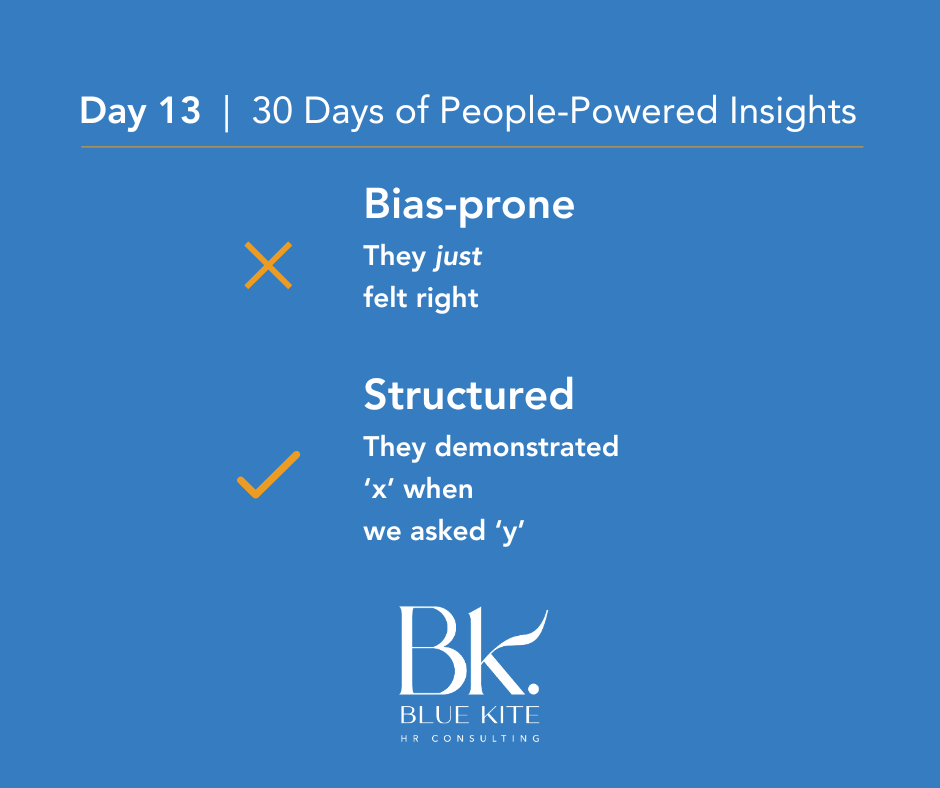
Structure your process consistently. When every candidate is asked different questions based on where the conversation goes, you’re not comparing apples with apples. A structured scorecard — where everyone evaluating a candidate rates the same dimensions against the same criteria — dramatically reduces the influence of bias.

Involve diverse decision-makers. A hiring decision made by a single person or a homogeneous group will always tend towards replication. Multiple perspectives in the assessment process improve both the quality of the decision and its defensibility.


The Business Case For Getting It Right 

Genuinely values-aligned hires tend to stay longer, integrate more effectively, and contribute to the culture in the ways that matter. The goal isn’t a team that agrees on everything — it’s a team that shares a foundation of how to work, treat people, and operate with integrity, while bringing genuinely different experiences, perspectives, and approaches to the actual work.

Ready to build a better workplace? Book your free 30-minute consultation at  Blue Kite HR Consulting 


BACK TO ALL ARTICLES
Screenshot 2025-11-18 164639

+61 (0) 409 545 634

cpaterson@bluekite.au

FREE CONSULTATION

  • ABOUT
  • HR SERVICES
  • COACH WITH ME
  • HEALTH & WELLBEING
  • MEDIA/PR
  • ARTICLES/BLOG
  • RESOURCES
  • CONTACT
  • PRIVACY

Blue Kite specialises in providing
HR services to support businesses
to create better workplaces.
Filed Under: Advisory and compliance, Business Update, Culture, External HR Support, HR essentials, Leadership

11 September, 2026 by Catie Paterson Leave a Comment

Micromanagement: Why Leaders Do It and What It Costs

ARTICLES

Micromanagement: Why Leaders Do It and What It Costs

11 September, 2026
Filed Under: Advisory and compliance, Business Update, Culture, External HR Support, HR essentials, Leadership

A café owner genuinely believed he was being supportive. He checked in on his shift supervisors multiple times an hour. He reviewed every purchase order personally. He gave detailed feedback on how the milk was being poured. Within eighteen months, he’d lost four supervisors — all capable, all citing the same reason: they felt like they had no authority and weren’t trusted to do their jobs.

Micromanagement is one of those leadership behaviours that almost no one would describe themselves as doing. And yet it’s one of the most common reasons employees cite for leaving, disengaging, or underperforming. The disconnect exists because micromanagement rarely feels like control from the inside. It usually feels like thoroughness, care, or responsibility.


Why leaders micromanage

Understanding the behaviour is the first step to addressing it. Most micromanagement comes from one of three places.

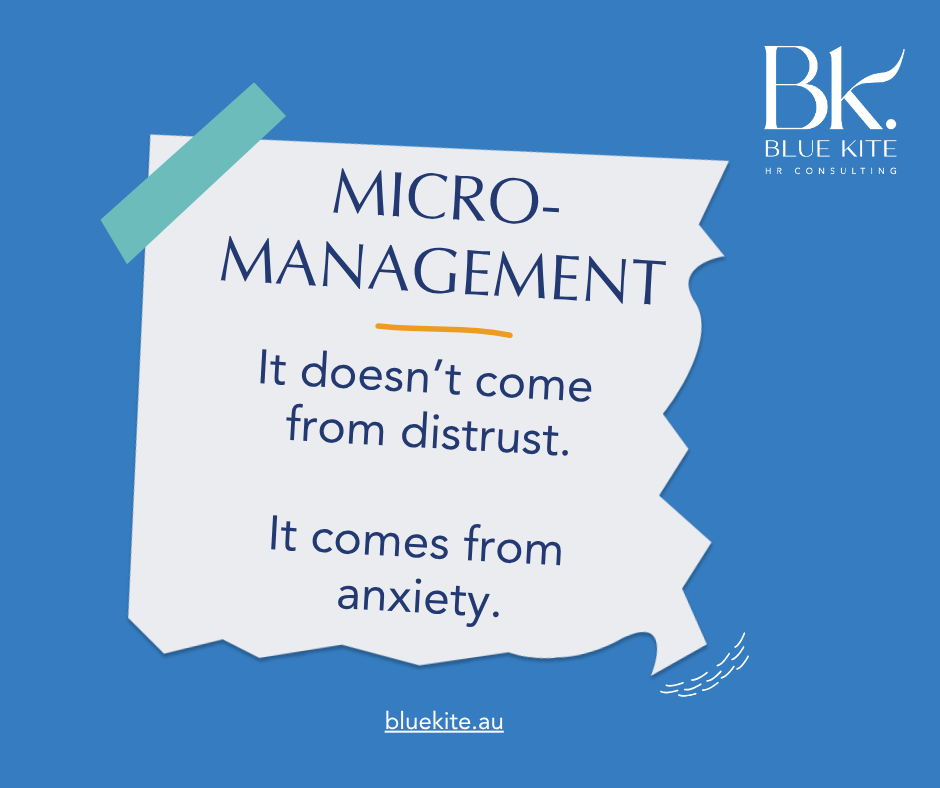
Anxiety about outcomes is the most common driver. When a leader is worried about quality, deadlines, or client satisfaction, close oversight feels like risk management. The problem is that it creates the exact conditions — reduced team capability, lower ownership, higher turnover — that make outcomes worse over time.

A transition from doing to leading that never fully happened is another major source. Many business owners and managers were promoted because they were excellent individual contributors. The skills that made them great in a hands-on role are the same ones that drive them to keep intervening. Moving into leadership requires genuinely letting go of doing, which is harder than it sounds.

A lack of trust — in the individual, the team, or the process — is the third. Sometimes this is warranted by circumstances, and close oversight is temporarily appropriate. More often, it becomes a default mode that persists long after the trust has been established.


What it actually costs a buisness 

The costs are well-documented and significant. Employees who are micromanaged report lower job satisfaction, reduced initiative, and a tendency to wait for direction rather than problem-solve. Over time, they either leave — at which point you’re paying recruitment and training costs — or they stay and become exactly the passive, instruction-dependent workers the micromanager feared they’d be.

The leader also pays a price. Micromanagement is exhausting. A manager who is personally involved in every decision is a bottleneck in their own business. Their time is consumed by work that should be delegated, at the cost of strategic thinking, client relationships, and their own wellbeing.


What the path forward looks like 

Moving out of micromanagement requires honest self-reflection. Which situations trigger the behaviour? Is it specific people, types of work, or levels of stakes? What’s the actual evidence that close oversight is producing better outcomes?

The practical work is in building clear expectations upfront — what does good work look like, what does the person need to succeed — then stepping back and allowing mistakes to be learning opportunities rather than reasons to intervene. Accountability and autonomy aren’t in opposition. They’re partners in building a team that works without you watching.


Ready to build a better workplace? Book your free 30-minute consultation at Blue Kite HR Consulting 


BACK TO ALL ARTICLES
Screenshot 2025-11-18 164639

+61 (0) 409 545 634

cpaterson@bluekite.au

FREE CONSULTATION

  • ABOUT
  • HR SERVICES
  • COACH WITH ME
  • HEALTH & WELLBEING
  • MEDIA/PR
  • ARTICLES/BLOG
  • RESOURCES
  • CONTACT
  • PRIVACY

Blue Kite specialises in providing
HR services to support businesses
to create better workplaces.

Filed Under: Advisory and compliance, Business Update, Culture, External HR Support, HR essentials, Leadership

8 September, 2026 by Catie Paterson Leave a Comment

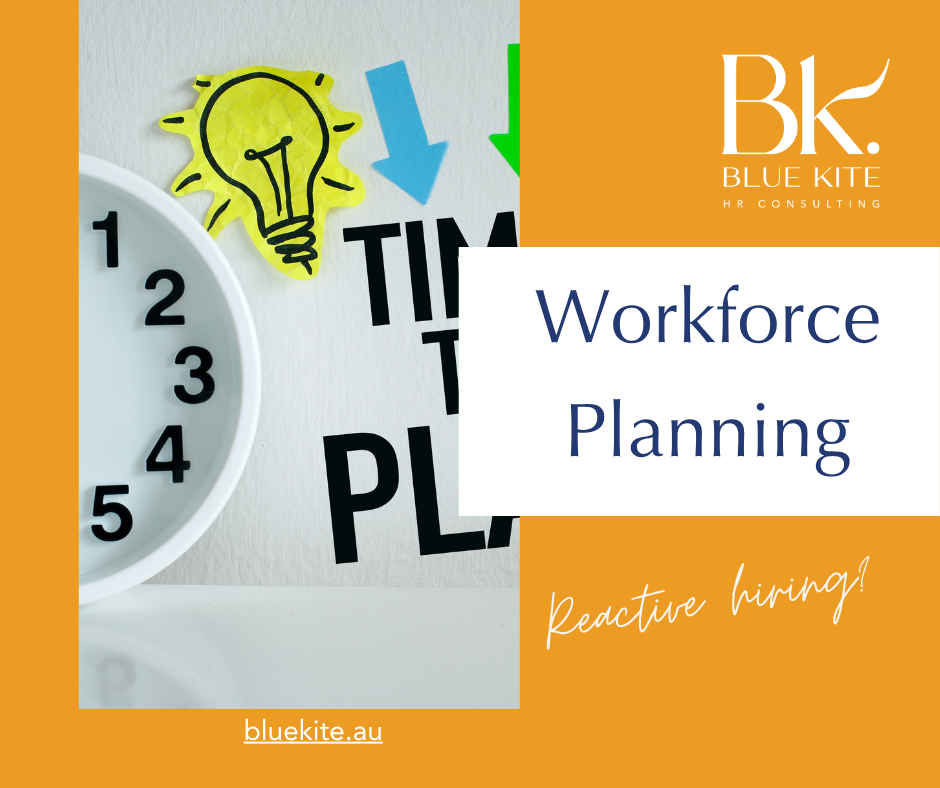
Workforce Planning: Hiring Ahead of Growth, Not Behind It

ARTICLES

Workforce Planning: Hiring Ahead of Growth, Not Behind It

8 September, 2026
Filed Under: Advisory and compliance, Business Update, Change management, Culture, External HR Support, Leadership

A construction firm won a contract that was 40% larger than anything they’d delivered before. The managing director’s first question was about equipment. His second was about sub-contractors. His third — three months into the project — was where all the qualified site supervisors had gone. Hiring began then, under pressure, with a six-week timeline that should have been six months. The project was delivered late. The lessons were expensive.

Reactive hiring is one of the most costly and avoidable problems in growing Australian businesses. When you hire because you’re already overwhelmed, you make worse decisions, offer whatever you need to secure someone quickly, and often end up with a poor fit that costs even more to manage or exit. The alternative — workforce planning — isn’t complicated. It just requires looking up from the immediate horizon.


What Workforce Planning Actually Involves 

Workforce planning is the practice of anticipating your people needs based on where your business is heading, rather than where it is right now. At its simplest, it asks: if our business grows as we expect over the next twelve to twenty-four months, what roles will we need, when will we need them, and how long will it realistically take to fill them?

For a small or medium business, this doesn’t require a dedicated HR team or sophisticated software. It requires honest conversation between the people who understand the business strategy and the people who understand the current team’s capacity.

The key questions are: what roles are likely to become critical, what’s the realistic lead time to hire for them, are there internal candidates who could be developed, and what does the labour market look like for these skills in your area?


The Lead Time Problem

Most business owners significantly underestimate how long good hiring takes. A well-run recruitment process for a skilled role in Australia typically takes six to twelve weeks minimum — more if the market is tight. Add three to six months for a new hire to reach full productivity, and the lead time from “we need someone” to “they’re fully contributing” is often closer to nine months.

If your business grows faster than that lead time allows for, you have a problem that no amount of urgent advertising will fix quickly. You either overpay for speed, compromise on quality, or overburden your existing team — often all three.


The First Steps Toward Getting Ahead

You don’t need a formal workforce plan document to start making better decisions. Begin by mapping your critical roles — the ones where a gap would immediately impact delivery or client relationships — and asking honestly whether those roles could be filled quickly if needed.

Then look at your next twelve months through a capacity lens. What new projects or clients are likely? What growth are you planning? What key employees might leave, retire, or want to reduce their hours? This isn’t about predicting the future perfectly. It’s about reducing the number of times you’re caught completely off guard.

Building this kind of thinking into your quarterly business planning is one of the most practical changes a growing SME can make. It won’t eliminate all people surprises — but it dramatically reduces the ones that cost you the most.

Ready to build a better workplace? Book your free 30-minute consultation at Blue Kite HR Consulting 

BACK TO ALL ARTICLES
Screenshot 2025-11-18 164639

+61 (0) 409 545 634

cpaterson@bluekite.au

FREE CONSULTATION

  • ABOUT
  • HR SERVICES
  • COACH WITH ME
  • HEALTH & WELLBEING
  • MEDIA/PR
  • ARTICLES/BLOG
  • RESOURCES
  • CONTACT
  • PRIVACY

Blue Kite specialises in providing
HR services to support businesses
to create better workplaces.
Filed Under: Advisory and compliance, Business Update, Change management, Culture, External HR Support, Leadership

6 September, 2026 by Catie Paterson Leave a Comment

Pay Transparency: Should You Share Salary Ranges?

ARTICLES

Pay Transparency: Should You Share Salary Ranges?

6 September, 2026
Filed Under: Advisory and compliance, Business Update, Career Planning, Change management, Culture, External HR Support, HR essentials, Leadership

When a mid-sized Melbourne professional services firm first advertised a role with a salary range, their HR manager braced for awkward conversations with existing staff. What she didn’t expect was that the applications were significantly stronger, the time-to-hire dropped, and three current employees who had been quietly job-hunting came off the market because seeing the range confirmed they were being paid fairly.

Pay transparency is having a moment. Several Australian states have introduced or are considering legislation affecting how pay is discussed in workplaces, and the federal government has strengthened protections against pay secrecy clauses under recent Fair Work changes. Employees now have an explicit right to discuss their pay with colleagues if they choose, and employers cannot lawfully include clauses that prohibit this in employment contracts.

That doesn’t mean you’re required to publish salaries. But it does mean the question of how much transparency you want — and whether it’s working for you — is more pressing than it used to be.


The Case For Sharing Ranges

The strongest argument for pay transparency is trust. When employees don’t know whether they’re paid fairly relative to their colleagues and the market, they fill the uncertainty with assumptions — and those assumptions are often negative. Pay secrecy doesn’t prevent comparison; it just makes comparison less accurate and more anxiety-inducing.

Sharing ranges, particularly in job advertisements, also tends to improve application quality. Candidates self-select more accurately. You get fewer people who are fundamentally misaligned on compensation expectations, which saves everyone time.

For businesses with genuine gender or diversity pay gaps, transparency creates accountability. It’s harder to let gaps persist when they’re visible.


The Legitimate Concerns

There are real reasons why some businesses are cautious. If your pay structure has inconsistencies — people in similar roles earning different amounts for reasons that aren’t clearly defensible — transparency will surface that. That can create short-term tension.

In smaller businesses where every compensation decision is essentially an individual negotiation, publishing ranges can make every salary review a comparison exercise. Managing that requires more rigour and process than some SMEs currently have in place.

The practical middle ground for most small and medium businesses isn’t full public disclosure — it’s building a pay structure that you’d be comfortable defending, and then gradually increasing transparency as your confidence in that structure grows. Start by sharing ranges in job ads. Then work towards being able to explain to any employee how their pay was determined. Neither requires publishing everyone’s salary.


What Australian Requires

Under the Fair Work Act as updated through recent legislation, pay secrecy clauses in employment contracts are not enforceable. An employee cannot be disciplined or disadvantaged for disclosing or asking about their own pay. You can still ask employees to exercise discretion, but you cannot require it. Getting your contracts reviewed for legacy pay secrecy clauses is a practical step worth taking.

Pay transparency isn’t just a trend. It’s a direction the market and the legislation are both moving. Getting ahead of it now is considerably less disruptive than being caught on the back foot later.

Ready to build a better workplace? Book your free 30-minute consultation at  Blue Kite HR Consulting 


BACK TO ALL ARTICLES
Screenshot 2025-11-18 164639

+61 (0) 409 545 634

cpaterson@bluekite.au

FREE CONSULTATION

  • ABOUT
  • HR SERVICES
  • COACH WITH ME
  • HEALTH & WELLBEING
  • MEDIA/PR
  • ARTICLES/BLOG
  • RESOURCES
  • CONTACT
  • PRIVACY

Blue Kite specialises in providing
HR services to support businesses
to create better workplaces.

Filed Under: Advisory and compliance, Business Update, Career Planning, Change management, Culture, External HR Support, HR essentials, Leadership

5 September, 2026 by Catie Paterson Leave a Comment

Neurodiversity at Work: Building a Genuinely Inclusive Team

ARTICLES

Neurodiversity at Work: Building a Genuinely Inclusive Team

5 September, 2026
Filed Under: Advisory and compliance, Business Update, Career Planning, Change management, Culture, External HR Support, HR essentials, Leadership

A food manufacturing business in Adelaide had a warehouse worker who was brilliant at picking errors in the production line — faster and more accurate than anyone else on the floor. He was also frequently in trouble for not following the team communication protocols. His supervisor described him as “difficult.” His colleagues thought he was “a bit odd.” What nobody had noticed, or asked about, was that he was autistic.

Once that was understood and accommodated — simple adjustments to how tasks were briefed and feedback was given — he became one of the highest performers in the operation. Nothing changed about his capability. Everything changed about how the environment was set up for him.

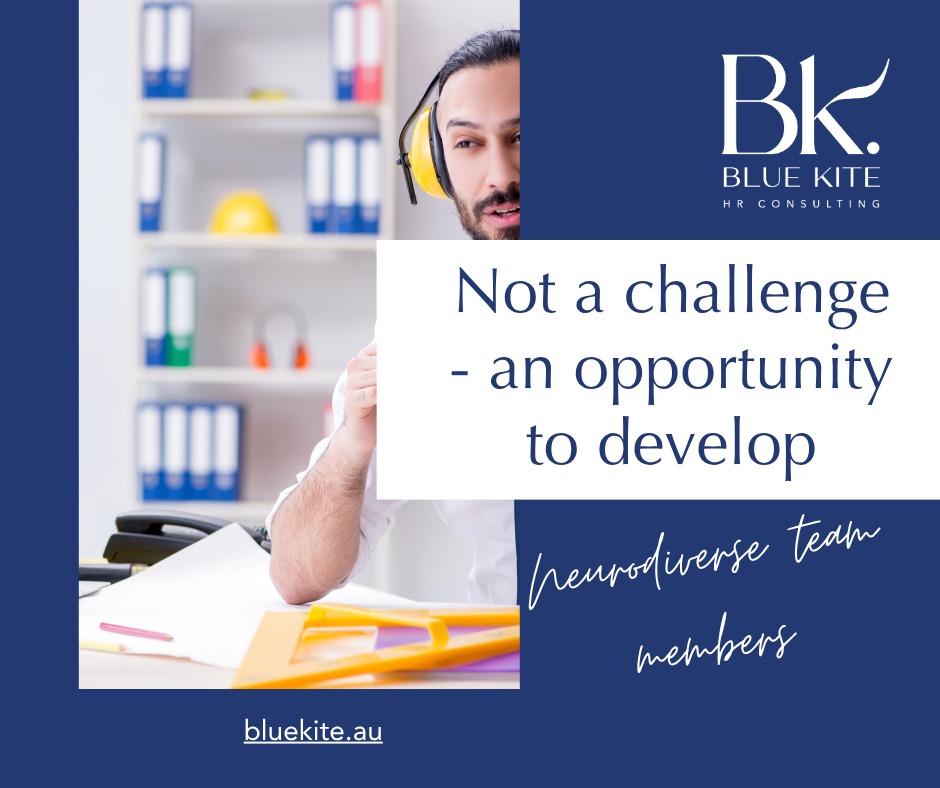
Neurodiversity refers to the natural variation in how human brains process information. It includes autism spectrum conditions, ADHD, dyslexia, dyspraxia, dyscalculia, and a range of other conditions. Around one in seven Australians is considered neurodivergent. In any team of reasonable size, you almost certainly already have neurodivergent employees — whether or not anyone knows it.


Why Standard Workplaces Miss Neurodivergent Talent

Most Australian workplaces are designed around a fairly narrow set of assumptions: that people communicate in particular ways, process information at roughly the same pace, work well in open-plan environments, handle ambiguity comfortably, and manage the unwritten rules of professional interaction without difficulty. For neurodivergent people, many of these assumptions don’t hold.

The result is that genuinely talented people struggle — not because they can’t do the work, but because the environment creates unnecessary friction. They may be labelled as “not a team player,” “poor communicator,” or “inconsistent performer” when the actual issue is a mismatch between how they work and how the workplace is structured.

The Fair Work Act prohibits discrimination on the basis of disability, which in many cases covers neurodivergent conditions. But compliance is a floor, not a ceiling. Building an environment where neurodivergent people can genuinely thrive requires going further.


What Inclusive Workpalces Actually Do Differently

The adjustments that make workplaces more accessible for neurodivergent employees tend to benefit everyone. Clear, written instructions rather than verbal-only briefings. Explicit expectations rather than assumed cultural knowledge. Structured agendas for meetings. Quiet spaces available alongside collaborative areas. Flexibility in how work is delivered rather than rigidity around the method.

These aren’t expensive. They’re mostly about clarity and choice.

The most important step is normalising the conversation. When employees feel they can disclose a condition without it affecting how they’re treated or perceived, you get honest information that lets you support them effectively. When disclosure feels risky, people mask — and masking is exhausting, damaging, and costs you their best work.


What To Start With

If you haven’t thought about neurodiversity in your business before, start here: audit your communication practices for unnecessary ambiguity. Look at your physical or remote work environment for sensory overload. Review how you give feedback and whether it’s explicit enough. And create a way for employees to share needs without it becoming a performance management issue.

You’re not trying to fix people. You’re trying to build a workplace that works for more of them.


Ready to build a better workplace? Book your free 30-minute consultation at Blue Kite HR Consulting 


BACK TO ALL ARTICLES
Screenshot 2025-11-18 164639

+61 (0) 409 545 634

cpaterson@bluekite.au

FREE CONSULTATION

  • ABOUT
  • HR SERVICES
  • COACH WITH ME
  • HEALTH & WELLBEING
  • MEDIA/PR
  • ARTICLES/BLOG
  • RESOURCES
  • CONTACT
  • PRIVACY

Blue Kite specialises in providing
HR services to support businesses
to create better workplaces.

Filed Under: Advisory and compliance, Business Update, Career Planning, Change management, Culture, External HR Support, HR essentials, Leadership

  • « Go to Previous Page
  • Page 1
  • Page 2
  • Page 3
  • Page 4
  • Page 5
  • Page 6
  • Interim pages omitted …
  • Page 19
  • Go to Next Page »

Copyright © 2026 · Executive Pro on Genesis Framework · WordPress · Log in koopo

  • HOME
  • ABOUT US
  • HR SERVICES
  • COACH WITH ME
  • HEALTH & WELLBEING
  • MEDIA/PR
    • – Articles/Blogs
    • – Keynote Speaking Events
    • – Podcast Interviews
    • – Ticker Interviews
  • BLOG
  • RESOURCES
  • CONTACT