
• Skip to primary navigation
  • Skip to main content

BlueKite HR

  • HOME
  • ABOUT US
  • HR SERVICES
  • COACH WITH ME
  • HEALTH & WELLBEING
  • MEDIA/PR
    • – Articles/Blogs
    • – Keynote Speaking Events
    • – Podcast Interviews
    • – Ticker Interviews
  • BLOG
  • RESOURCES
  • CONTACT

Change management

28 August, 2026 by Catie Paterson Leave a Comment

Strengths-Based Leadership: The Performance Approach That Changes Everything

ARTICLES

Strengths-Based Leadership: The Performance Approach That Changes Everything
28 August, 2026
Filed Under: Advisory and compliance, Business Update, Career Planning, Change management, Culture, External HR Support, HR essentials, Leadership

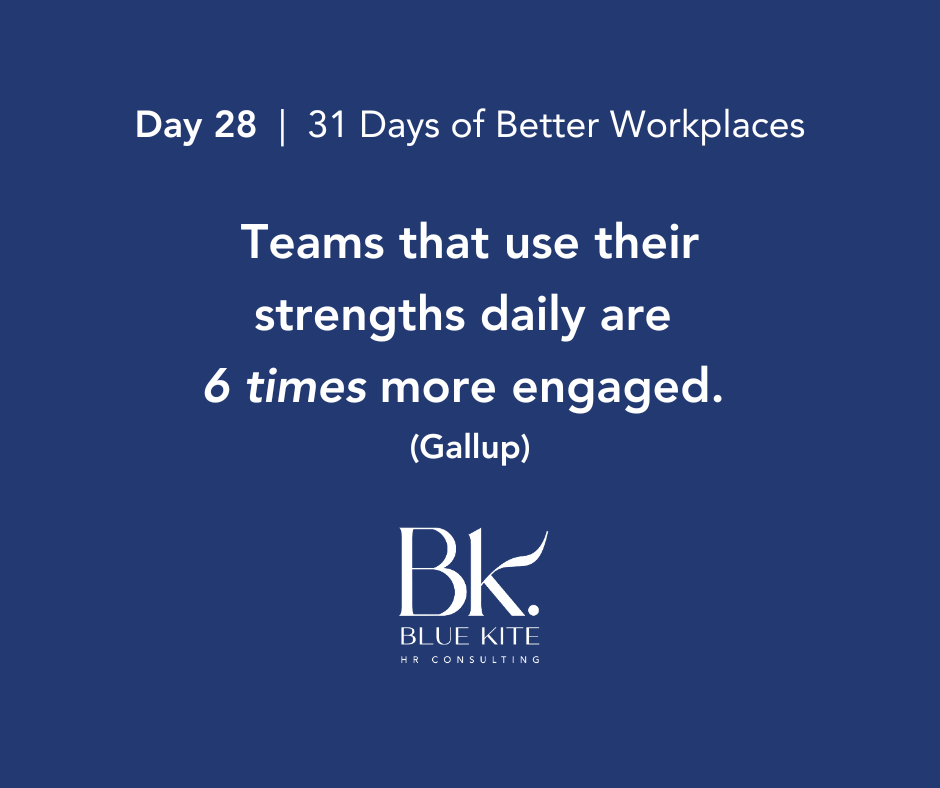
Day 28 of 31 Days of Better Workplaces — today I want to make the case for strengths-based leadership as one of the most evidence-backed and under-utilised approaches in the modern workplace. 

And I want to be honest about why it’s still underused: because most leadership systems are built around fixing weaknesses, not amplifying strengths. Performance reviews spend the majority of time on development areas. Coaching conversations default to what’s not working. Improvement plans are, by definition, focused on deficits.
This is understandable. It’s human to notice what’s wrong. But it’s also producing worse outcomes than the alternative.


What the research shows

Gallup’s research — across millions of workers in dozens of countries — has produced a consistent finding: employees who use their strengths every day are six times more engaged than those who don’t. More engaged employees are more productive, have lower absenteeism, deliver better customer outcomes, and stay significantly longer.
The evidence on strengths-based interventions is also compelling in terms of performance improvement. Focusing development conversations on what someone does naturally well and building more opportunities for them to do it more produces measurably better performance outcomes than focusing exclusively on correcting weaknesses.
This does not mean ignoring genuine performance problems — and I want to be clear about that. If someone’s weaknesses are causing real harm to their work or team, those need to be addressed. Strengths-based leadership is not an excuse to avoid difficult conversations.
But it does mean rebalancing. The current default in most performance management systems is heavily deficit-focused — and the research suggests we’ve got the ratio wrong.


What’s emerging in contemporary businesses 

Strengths-based hiring: using tools like CliftonStrengths or DiSC (I’m an accredited DiSC facilitator) not just for development but to inform role design and team composition — understanding which combinations of strengths create high-performing teams.
Strengths-based job design: deliberately building roles and assignments that allow individuals to spend more of their time in areas of natural strength, rather than requiring everyone to perform identically across all dimensions.
Strengths-aware leadership conversations: leaders who understand the strengths profile of each team member and use that understanding to assign work, provide feedback, and have development conversations.


What this looks like in practice

Instead of asking “what do you need to improve?” in a performance conversation, also asking “where do you feel most energised at work, and how do we create more of that?”
Instead of designing teams for homogeneity, designing them for complementary strengths — understanding that what looks like “a difficult personality” is often a misapplied strength.
Instead of managing everyone the same way, adjusting how you communicate, delegate, and develop based on what each person naturally brings.


My view

The businesses building strengths-based cultures right now are not doing it because it feels good, although it does. They’re doing it because the data says it works. It produces better performance, better retention, and better wellbeing outcomes simultaneously — and in a tight labour market, that combination is a genuine competitive advantage.

Book your free 30-minute consultation at Blue Kite HR Consulting 
 

BACK TO ALL ARTICLES
Screenshot 2025-11-18 164639

+61 (0) 409 545 634

cpaterson@bluekite.au

FREE CONSULTATION

  • ABOUT
  • HR SERVICES
  • COACH WITH ME
  • HEALTH & WELLBEING
  • MEDIA/PR
  • ARTICLES/BLOG
  • RESOURCES
  • CONTACT
  • PRIVACY

Blue Kite specialises in providing
HR services to support businesses
to create better workplaces.
Filed Under: Advisory and compliance, Business Update, Career Planning, Change management, Culture, External HR Support, HR essentials, Leadership

25 August, 2026 by Catie Paterson Leave a Comment

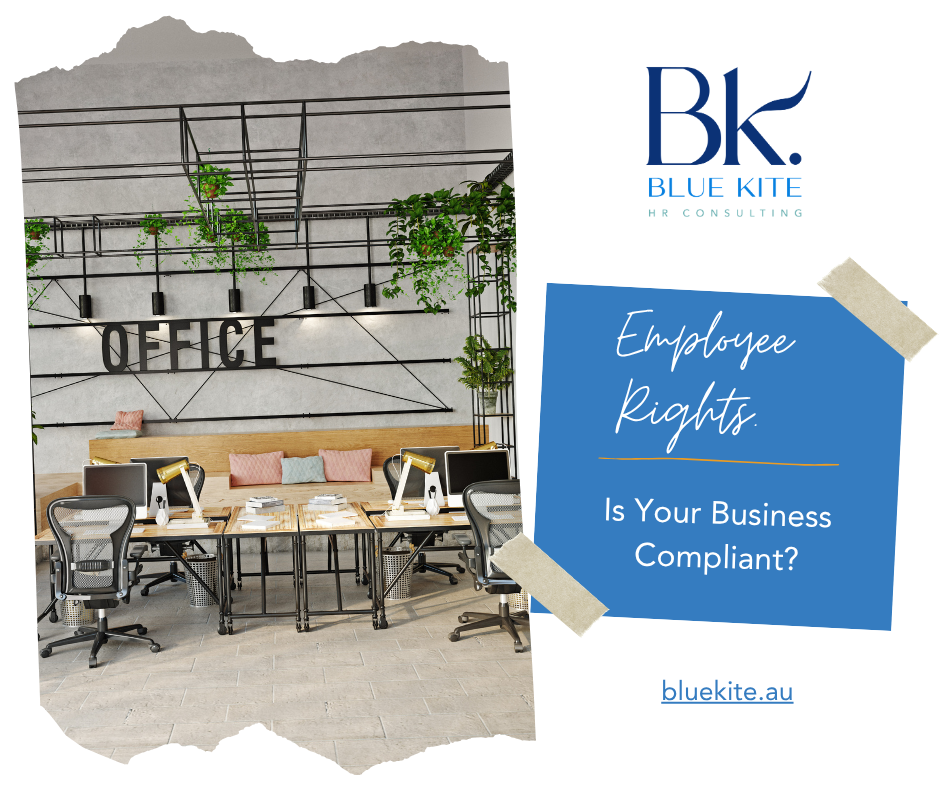
Working Rights Are Changing. Here’s What Australian Businesses Need to Know — and What’s Coming Next.

ARTICLES

Working Rights Are Changing. Here's What Australian Businesses Need to Know — and What's Coming Next.

25 August, 2026
Filed Under: Advisory and compliance, Business Update, Change management, External HR Support, HR essentials

Day 25 of 31 Days of Better Workplaces — flexible work is the issue that’s generated more questions from my clients than almost anything else in the last three years. The legislative landscape is evolving, the employee expectations are settled, and the gap between the two is where most of the conflict lives. 


What’s already changed 

The Fair Work Act amendments have progressively strengthened employee rights around flexible work requests. Employees with caring responsibilities, disability, pregnancy, or employees aged 55 and over now have an enhanced right to request flexible arrangements, and employers must have a genuine reason grounded in reasonable business grounds to refuse.
The bar for what counts as “reasonable business grounds” has risen. “We prefer people in the office” or “it’s how we’ve always done things” is not a sufficient basis for refusal. Specific, demonstrable operational requirements are required.


What employers are getting wrong 

Blanket policies. A policy that mandates a specific number of office days for all employees — regardless of role, caring responsibilities, disability, or individual circumstance — may be lawful in some contexts and discriminatory in others. Blanket mandates are increasingly being challenged, and the outcomes are not always going the employer’s way.
Refusing requests without genuine consideration. The right to request is not a guarantee of a specific arrangement, but it is a guarantee of genuine engagement. Brushing off a request, responding slowly, or giving a form-letter refusal creates legal exposure.
Conflating presence with performance. The evidence on remote work productivity is mixed — it depends heavily on the role, the individual, and the quality of management. But businesses that measure performance by presence are increasingly out of step with both the evidence and the regulatory direction of travel.


What’s coming

The conversation in Australia is moving toward the framework already established in some European jurisdictions — a more explicit right to disconnect outside of standard work hours. The Closing Loopholes legislation has introduced a right to disconnect for many workers, meaning employers need to review their expectations around after-hours communication.


What forward-thinking businesses are doing 

They’re building flexible work policies that are specific, fair, and genuinely applied — not blanket rules or empty commitments. They’re training managers to manage remote and hybrid teams effectively — not assuming that managing in-person and managing remotely require the same skills. They’re treating flexibility as a retention tool, because the evidence is clear that access to flexible work is a significant factor in how employees evaluate whether to stay.
The future of work is hybrid. The businesses building the frameworks to manage that well, now, are the ones that will retain the talent that makes it possible.

Book your free 30-minute consultation at Blue Kite HR Consulting 


BACK TO ALL ARTICLES
Screenshot 2025-11-18 164639

+61 (0) 409 545 634

cpaterson@bluekite.au

FREE CONSULTATION

  • ABOUT
  • HR SERVICES
  • COACH WITH ME
  • HEALTH & WELLBEING
  • MEDIA/PR
  • ARTICLES/BLOG
  • RESOURCES
  • CONTACT
  • PRIVACY

Blue Kite specialises in providing
HR services to support businesses
to create better workplaces.
Filed Under: Advisory and compliance, Business Update, Change management, External HR Support, HR essentials

24 August, 2026 by Catie Paterson Leave a Comment

How to Set KPIs That Actually Drive Performance

ARTICLES

How to Set KPIs That Actually Drive Performance

24 August, 2026
Filed Under: Advisory and compliance, Change management, Culture, External HR Support, HR essentials, Leadership

Day 24 of 31 Days of Better Workplaces — KPIs are one of the most widely used and most widely misunderstood performance tools in business.

Done well, KPIs create clarity, alignment, and accountability. Done badly, they create gaming, resentment, and a disconnect between what the business actually needs and what people are being measured on. 


The most common mistakes

Too many KPIs. When everything is a priority, nothing is. Most roles should have three to five meaningful KPIs — not twelve. If you have more than five, you’re measuring activity rather than outcomes.
KPIs that measure inputs, not outputs. Tracking the number of calls made, the hours logged, or the volume of tasks completed tells you what someone is doing, not what they’re achieving. The best KPIs measure outcomes that actually matter to the business.
KPIs that the individual can’t influence. If someone’s measured on a business result they don’t directly control — total company revenue, a market condition, another team’s performance — you’ve designed a frustration, not a motivator.


How to build KPIs that work  

Start with the role, not the metric. What does success actually look like in this position? What are the two or three things, if done well, that would mean this person is doing their job brilliantly? Those answers become your KPIs.
Make them SMART. Specific, measurable, achievable, relevant, and time-bound. “Improve client satisfaction” is a goal. “Achieve a client satisfaction score of 8.5 or above on the monthly survey by end of Q4” is a KPI.
Build in a review cycle. KPIs should be reviewed — not just at annual review time — but quarterly at minimum. Business priorities shift. A KPI that was relevant six months ago may no longer be.
Connect them to development. The best KPIs are challenging enough to stretch someone while remaining achievable with focus and effort. They create growth, not just measurement.
A well-designed KPI is a conversation starter, not just a number on a spreadsheet.

Book your free 30-minute consultation at Blue Kite HR Consulting 


BACK TO ALL ARTICLES
Screenshot 2025-11-18 164639

+61 (0) 409 545 634

cpaterson@bluekite.au

FREE CONSULTATION

  • ABOUT
  • HR SERVICES
  • COACH WITH ME
  • HEALTH & WELLBEING
  • MEDIA/PR
  • ARTICLES/BLOG
  • RESOURCES
  • CONTACT
  • PRIVACY

Blue Kite specialises in providing
HR services to support businesses
to create better workplaces.
Filed Under: Advisory and compliance, Change management, Culture, External HR Support, HR essentials, Leadership

23 August, 2026 by Catie Paterson Leave a Comment

Termination Done Right: The Legal Steps Most Businesses Skip

ARTICLES

Termination Done Right: The Legal Steps Most Businesses Skip

23 August, 2026
Filed Under: Business Update, Career Planning, Change management, Culture, External HR Support, HR essentials, Leadership

Day 23 of 31 Days of Better Workplaces — termination. It’s the part of the job nobody enjoys, and the part where the most legal mistakes are made. 

Getting termination wrong — even where the grounds for dismissal are completely valid — can convert a justified exit into an unfair dismissal or a general protections claim.


The steps most businesses skip

1. Providing a clear reason 

An employee being terminated has the right to know why. Not a vague statement about “business reasons” or “not being the right fit” — a specific, factual reason. If the termination is for performance or conduct, that reason should not be a surprise: it should have been communicated through a performance management process. 

2. Giving the opportunity to respond

Before a termination decision is finalised, the employee should be given an opportunity to respond to the reason. This doesn’t mean the decision changes — but the process requires that it’s offered. Skipping this step is one of the most common procedural failures in unfair dismissal cases.

3. Allowing a support person

Employees have the right to have a support person present in meetings where dismissal is being discussed. You don’t have to allow legal representation, but a trusted colleague or union representative is their right. Denying this, or failing to offer it, is a procedural risk.

4. Providing appropriate notice 

Termination requires the notice period specified in the contract or Award, or payment in lieu of notice. Not providing this is a breach of contract and an employment law violation.

5. Managing the final pay correctly

Final pay must be processed within a specific timeframe and must include all owed entitlements: outstanding wages, accrued annual leave, long service leave where applicable, and any other contractual entitlements. Errors in final pay are common and create additional legal exposure.


The documentation to have ready

Letter of termination, statement of the reason, final pay calculation, written record of the process followed.
Done properly, termination is clean, compliant, and defensible. Done carelessly, it creates exactly the kind of legal exposure you were trying to avoid.


Book a free 30-minute consulation at Blue Kite HR Consulting 


BACK TO ALL ARTICLES
Screenshot 2025-11-18 164639

+61 (0) 409 545 634

cpaterson@bluekite.au

FREE CONSULTATION

  • ABOUT
  • HR SERVICES
  • COACH WITH ME
  • HEALTH & WELLBEING
  • MEDIA/PR
  • ARTICLES/BLOG
  • RESOURCES
  • CONTACT
  • PRIVACY

Blue Kite specialises in providing
HR services to support businesses
to create better workplaces.
Filed Under: Business Update, Career Planning, Change management, Culture, External HR Support, HR essentials, Leadership

22 August, 2026 by Catie Paterson Leave a Comment

What Leadership Coaching Looks Like in Practice

ARTICLES

What Leadership Coaching Looks Like in Practice

22 August, 2026
Filed Under: Advisory and compliance, Career Planning, Change management, Culture, External HR Support, HR essentials, Leadership

Day 22 of 31 Days of Better Workplaces — today I’m sharing what leadership coaching actually looks like in practice, using the Intentional Coach program as a lens.

Most people associate coaching with executive programmes, large corporates, and price tags that put it out of reach for the average SME. The Intentional Coach program exists specifically to change that — delivering structured, evidence-based coaching for SME leaders and managers who want to lead better but don’t have the time or budget for generic corporate training.


What the program covers 

The Intentional Coach program is built around the real challenges SME leaders face: managing people without the safety net of an HR department, having difficult conversations, building team capability, creating accountability without micromanaging, and maintaining their own wellbeing in a high-pressure environment.
Each participant begins with a tailored questionnaire and a discovery conversation. The reason for this is straightforward: cookie-cutter leadership training rarely produces lasting change, because it doesn’t account for the specific context, team, and challenges the individual is navigating.


What makes it different

It’s delivered remotely, which means it’s accessible regardless of location. It’s tracked over time using a structured system, so both the participant and I can see what’s shifting — not just in the conversations, but in the actual results in their team and business. And it’s built on positive psychology principles, which means it starts from strengths rather than deficits.
The most consistent feedback I receive is not about the tools or frameworks — it’s about having a structured space to think through the real challenges of managing people, with someone who understands both the HR context and the pressures of running or leading a business.


Who is it for?

Business owners who have recently taken on a management role. Managers who were promoted for their technical skills but haven’t had formal people-leadership development. Leadership teams preparing for growth or change. Anyone who wants to lead with more confidence and less reactivity.
If you want to understand whether coaching is the right fit for you or a member of your team, the starting point is a conversation.

Book your free 30-minute consultation at Blue Kite HR Consulting 


BACK TO ALL ARTICLES
Screenshot 2025-11-18 164639

+61 (0) 409 545 634

cpaterson@bluekite.au

FREE CONSULTATION

  • ABOUT
  • HR SERVICES
  • COACH WITH ME
  • HEALTH & WELLBEING
  • MEDIA/PR
  • ARTICLES/BLOG
  • RESOURCES
  • CONTACT
  • PRIVACY

Blue Kite specialises in providing
HR services to support businesses
to create better workplaces.

Filed Under: Advisory and compliance, Career Planning, Change management, Culture, External HR Support, HR essentials, Leadership

21 August, 2026 by Catie Paterson Leave a Comment

The Most Expensive Person in Your Business Isn’t Always the Most Obvious Problem

ARTICLES

The Most Expensive Person in Your Business Isn't Always the Most Obvious Problem

21 August, 2026
Filed Under: Advisory and compliance, Change management, Culture, External HR Support, HR essentials, Leadership

Day 21 of 31 Days of Better Workplaces —

There’s a particular kind of person in some small and medium businesses that the owner is aware of, uncomfortable about, and quietly protecting. They deliver. Their numbers are good. Clients like them — or at least clients never complain about them.

And everyone else on the team walks on eggshells around them. Including, if we’re being honest, the owner.

This is the toxic high performer. And the reason they’re so costly isn’t the behaviour itself — it’s what the behaviour does to everyone else.
What most SME leaders don’t realise is how much authority this person has accumulated outside the formal structure. Other team members have learned to read the room through them. Newer employees figure out the unwritten rules by watching how this person operates and what they can get away with. Their reaction to a business decision — an eye roll in a meeting, a dismissive comment in the kitchen — can quietly undermine more leadership communication than any formal initiative can build.
In short: they are often the real ideological centre of your workplace. The culture revolves around managing them, accommodating them, and working around the discomfort they create.
The performance case for keeping them has been made in your head many times. I understand it. But have you ever calculated the other side of the ledger? The people who left because of them. The ones who quietly reduce their output because ambition feels risky. The cost of a workplace where everyone performs compliance rather than genuine engagement.
Toxic high performers are a culture risk that shows up in the financials long before it shows up anywhere obvious.
Most businesses don’t act until there’s an incident they can’t ignore. By then, the culture has already been shaped around the problem.


Book your free 30-minute consulation at Blue Kite HR Consulting 


BACK TO ALL ARTICLES
Screenshot 2025-11-18 164639

+61 (0) 409 545 634

cpaterson@bluekite.au

FREE CONSULTATION

  • ABOUT
  • HR SERVICES
  • COACH WITH ME
  • HEALTH & WELLBEING
  • MEDIA/PR
  • ARTICLES/BLOG
  • RESOURCES
  • CONTACT
  • PRIVACY

Blue Kite specialises in providing
HR services to support businesses
to create better workplaces.

Filed Under: Advisory and compliance, Change management, Culture, External HR Support, HR essentials, Leadership

  • « Go to Previous Page
  • Page 1
  • Interim pages omitted …
  • Page 3
  • Page 4
  • Page 5
  • Page 6
  • Page 7
  • Interim pages omitted …
  • Page 19
  • Go to Next Page »

Copyright © 2026 · Executive Pro on Genesis Framework · WordPress · Log in koopo

  • HOME
  • ABOUT US
  • HR SERVICES
  • COACH WITH ME
  • HEALTH & WELLBEING
  • MEDIA/PR
    • – Articles/Blogs
    • – Keynote Speaking Events
    • – Podcast Interviews
    • – Ticker Interviews
  • BLOG
  • RESOURCES
  • CONTACT