
• Skip to primary navigation
  • Skip to main content

BlueKite HR

  • HOME
  • ABOUT US
  • HR SERVICES
  • COACH WITH ME
  • HEALTH & WELLBEING
  • MEDIA/PR
    • – Articles/Blogs
    • – Keynote Speaking Events
    • – Podcast Interviews
    • – Ticker Interviews
  • BLOG
  • RESOURCES
  • CONTACT

Change management

16 September, 2026 by Catie Paterson Leave a Comment

How to Keep High-Potential Employees Challenged and Retained

ARTICLES

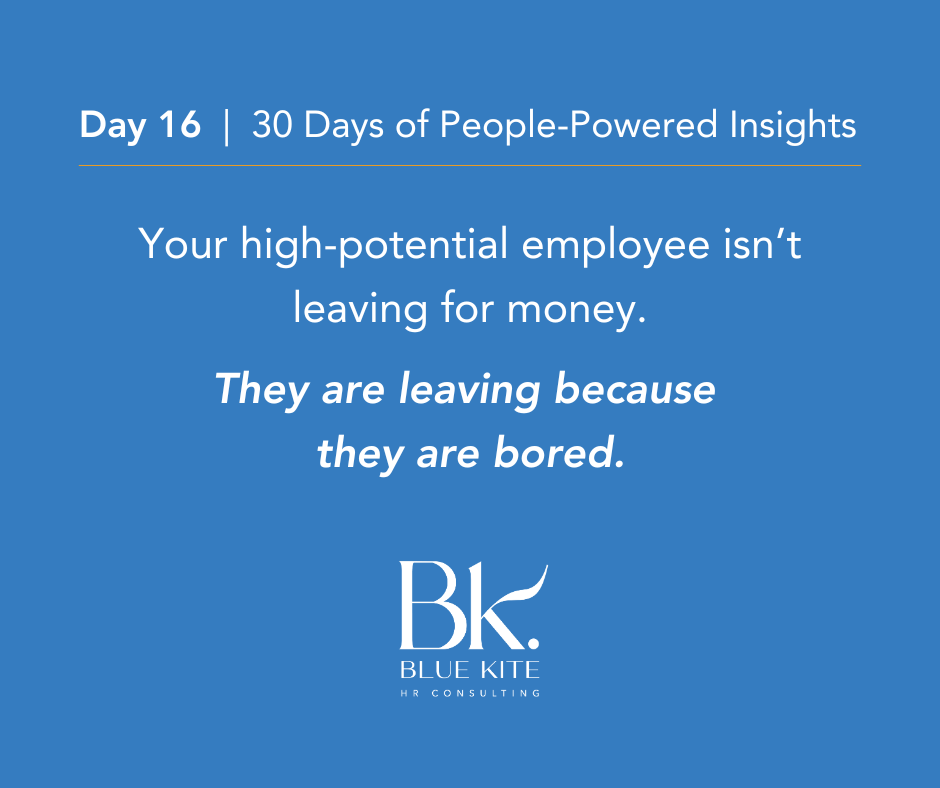
How to Keep High-Potential Employees Challenged and Retained
16 September, 2026
Filed Under: Advisory and compliance, Business Update, Career Planning, Change management, Culture, External HR Support, HR essentials, Leadership

In a professional services firm, a financial analyst everyone described as “exceptional” handed in her notice after two years. She was 28, sharp, ambitious, and thoroughly bored. She’d been given more of the same work since her first six months, praised consistently, and paid fairly. What she hadn’t been given was anything genuinely difficult. “I stopped learning,” she said simply.

High-potential employees — people with the capability and ambition to take on significantly greater responsibility over time — are your greatest competitive advantage and your highest flight risk. They’re typically harder to replace, take on more than their formal role, and disproportionately influence team performance and culture. They’re also far more likely to leave if they’re not challenged, developed, and given a reason to stay.


What High-Potential Employees Actually Need 

Money matters. But for high-potential people, compensation beyond a fair market rate is rarely the primary retention factor — it’s necessary but not sufficient. What drives these employees is the nature of the work itself: difficulty, autonomy, growth, and a sense that their contribution is visible and valued.

They need stretch assignments — work that genuinely requires them to develop new capabilities, not just apply existing ones at higher speed. They need access to interesting problems and, ideally, access to senior decision-makers. They need honest feedback that treats them as capable of handling reality. And they need a credible answer to the question they’re always quietly asking: “Is there a future for me here?”


What Businesses Get Wrong

The most damaging mistake is the “we can’t afford to lose them” trap. Managers who are worried about losing a high performer often keep them in their current role because they’re performing well there, and because moving them would create a gap. This reasoning makes sense in the very short term and is catastrophic over two to three years.

Giving more of the same work to someone who’s mastered it is not development. It’s stagnation with a positive performance review attached to it.

The second error is over-promising and under-delivering. “There will be opportunities down the track” is a common placeholder answer to the growth question. High-potential people have good instincts for what’s genuine and what’s a deflection. If the opportunities aren’t real, they’ll figure it out faster than you think.


Practical Strategies for Smaller Businesses 

You don’t need a formal talent program or a corporate development budget to retain high-potential employees effectively.

Start with a genuine career conversation — not a performance review, but a real discussion about what they’re interested in, where they want to go, and what kind of challenges they’re looking for. Build a development plan that’s specific: particular projects, skills to develop, people to connect with.

Cross-functional exposure is powerful in small businesses. Moving a high performer into a project, client relationship, or area outside their usual domain keeps the work interesting and builds the breadth of capability that makes them even more valuable. Giving them responsibility for leading something — even a small initiative — before they’re technically “ready” is often the fastest path to genuine development.

And have the long-term conversation honestly. If there isn’t a senior role on the horizon, say so — but be clear about what is available and why it’s worth staying.


Ready to build a better workplace? Book your free 30-minute consultation at Blue Kite HR Consulting 
 

BACK TO ALL ARTICLES
Screenshot 2025-11-18 164639

+61 (0) 409 545 634

cpaterson@bluekite.au

FREE CONSULTATION

  • ABOUT
  • HR SERVICES
  • COACH WITH ME
  • HEALTH & WELLBEING
  • MEDIA/PR
  • ARTICLES/BLOG
  • RESOURCES
  • CONTACT
  • PRIVACY

Blue Kite specialises in providing
HR services to support businesses
to create better workplaces.

Filed Under: Advisory and compliance, Business Update, Career Planning, Change management, Culture, External HR Support, HR essentials, Leadership

15 September, 2026 by Catie Paterson Leave a Comment

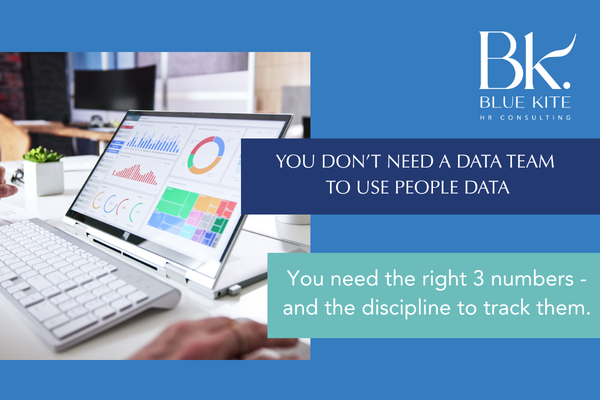
Using People Data to Make Better HR Decisions (Without an HR Team)

ARTICLES

Using People Data to Make Better HR Decisions (Without an HR Team)

15 September, 2026
Filed Under: Advisory and compliance, Business Update, Change management, Culture, External HR Support, HR essentials, Leadership

When a business owner was asked why they’d let a particularly strong employee leave without a counteroffer, the answer was: “I didn’t see it coming.” The warning signs were all there — a string of absences, a drop in the quality of work, disengaged responses in team meetings. But they hadn’t been tracked or noticed as a pattern. They were just noise.

One of the most significant shifts in people management over the past decade has been the availability of data to small and medium businesses. The kind of workforce analytics once reserved for large organisations with dedicated HR information systems is now accessible through the tools many businesses already use — payroll software, rostering platforms, performance tracking, even simple spreadsheets.

The challenge isn’t access to data. It’s knowing which data matters, and building the habit of actually using it.


The People Metrics That Predict Problems

Not all HR data is equally useful. Some of the most commercially relevant metrics for SMEs are also the simplest to track.

Turnover rate — the percentage of your workforce that leaves over a given period — is a starting point. But voluntary turnover (people who choose to leave) tells you something different from involuntary turnover (people you asked to leave). Tracking them separately gives you more useful information. Industry benchmarks are available through Fair Work and sector associations, and they’re worth knowing.

Absence rates are an early indicator of disengagement, workload problems, or cultural issues. An individual absence here and there tells you very little. A pattern — particularly in a specific team or following a particular event — tells you something meaningful.

Time-to-fill for vacancies tells you about your attractiveness as an employer and the efficiency of your recruitment process. Time-to-productivity for new hires tells you about the quality of your onboarding. Both have direct commercial implications.


Common Mistakes When Using People Data

The most common mistake is using data retrospectively — looking at it only after a problem has become serious. The value of people data is in its early warning potential, which requires building the habit of reviewing it regularly rather than only in response to a crisis.

The second mistake is using metrics in isolation. High turnover in one team might reflect a management problem, a market factor, or a role design issue. The data tells you there’s a pattern worth investigating; it doesn’t tell you why. Combining data with qualitative information — exit interviews, one-on-ones, team conversations — gives you a much fuller picture.

The third is tracking data without acting on it. Measuring without responding is a waste of time and, when employees notice that feedback or patterns are collected but ignored, it erodes trust.


Getting Started Simply

You don’t need HR software to start using people data effectively. A simple spreadsheet tracking headcount, voluntary departures, average tenure, and absence rates — reviewed quarterly — will surface patterns that are genuinely useful for business decisions. Start small, build the habit, and add complexity only when you have a specific question the current data can’t answer.


Ready to build a better workplace? Book your free 30-minute consultation at Blue Kite HR Consulting 


BACK TO ALL ARTICLES
Screenshot 2025-11-18 164639

+61 (0) 409 545 634

cpaterson@bluekite.au

FREE CONSULTATION

  • ABOUT
  • HR SERVICES
  • COACH WITH ME
  • HEALTH & WELLBEING
  • MEDIA/PR
  • ARTICLES/BLOG
  • RESOURCES
  • CONTACT
  • PRIVACY

Blue Kite specialises in providing
HR services to support businesses
to create better workplaces.
Filed Under: Advisory and compliance, Business Update, Change management, Culture, External HR Support, HR essentials, Leadership

14 September, 2026 by Catie Paterson Leave a Comment

The Four-Day Work Week: What the Evidence Says for Business

ARTICLES

The Four-Day Work Week: What the Evidence Says for Business

14 September, 2026
Filed Under: Advisory and compliance, Business Update, Change management, Culture, External HR Support, HR essentials, Leadership

In 2022, the largest four-day work week trial ever conducted ran across sixty-one companies in the UK, involving around 2,900 employees. The results were striking: revenue stayed the same. Most businesses decided not to go back. Employee wellbeing improved substantially. Recruitment became significantly easier.

The four-day work week has moved from thought experiment to operational reality for a growing number of businesses globally — including a small but increasing number in Australia. If you’ve been curious about whether it could work for your business, or dismissing it as a concept only viable for tech companies and progressives, the evidence deserves a closer look.


What the Research Actually Shows

The core argument for a four-day week — most commonly structured as 100% pay, 80% time, 100% output — is that productive work time and hours at work are not the same thing. The research from the UK trial, and subsequent studies in Iceland, Ireland, and Australia, consistently finds that employees produce the same or more output in four days when the reduction in hours is accompanied by genuine work redesign.

The caveats matter. The four-day week doesn’t work without deliberate effort to reduce low-value activity: unnecessary meetings, inefficient processes, unclear priorities. If you simply compress the same work into fewer days, you create stress and burnout rather than wellbeing. The hours reduction is the catalyst, not the solution.

In the Australian context, some small businesses — particularly in professional services, consulting, and knowledge work — have successfully implemented versions of this model. In hospitality, manufacturing, and customer-facing retail, the logistics are considerably more complex, and the model typically requires more creative structuring.


What it Can and Can’t Solve

A four-day week can genuinely improve employee attraction and retention, reduce burnout, and force productive conversations about what work actually matters. It tends to improve focus and reduce presenteeism — the phenomenon of people being physically present but mentally disengaged.

It is not a substitute for addressing structural problems. If your team is overworked because roles are badly designed, workloads are unmanageable, or the business model requires constant overtime, a day off per week doesn’t fix the underlying issues. It compresses them.


How to Explore it for Your Business

If you’re interested in testing the model, start with a structured pilot rather than a permanent switch. Run it for a defined period — three months is common — with a clear framework for measuring whether productivity, client satisfaction, and employee wellbeing have held or improved.

Involve your team in the design. The best versions of the four-day week are built collaboratively, with employees identifying where their time goes and what could be redesigned. It’s as much a culture intervention as a scheduling one.

It won’t work for every business. But dismissing it without genuinely examining the evidence means potentially missing one of the more powerful tools available for attracting and keeping good people in an increasingly competitive market.

Ready to build a better workplace? Book your free-30minute consultation at Blue Kite HR Consulting 


BACK TO ALL ARTICLES
Screenshot 2025-11-18 164639

+61 (0) 409 545 634

cpaterson@bluekite.au

FREE CONSULTATION

  • ABOUT
  • HR SERVICES
  • COACH WITH ME
  • HEALTH & WELLBEING
  • MEDIA/PR
  • ARTICLES/BLOG
  • RESOURCES
  • CONTACT
  • PRIVACY

Blue Kite specialises in providing
HR services to support businesses
to create better workplaces.
Filed Under: Advisory and compliance, Business Update, Change management, Culture, External HR Support, HR essentials, Leadership

12 September, 2026 by Catie Paterson Leave a Comment

How to Run an Employee Engagement Survey That Produces Real Change

ARTICLES

How to Run an Employee Engagement Survey That Produces Real Change

12 September, 2026
Filed Under: Advisory and compliance, Career Planning, Change management, Culture, HR essentials, Leadership

An IT services company ran an employee survey. 73% of people responded. The results were collated, shared with leadership, and filed. Eight months later, the company ran another survey. Response rate: 31%. When they dug into the drop, the answer from employees was consistent: “Nothing changed last time. Why would we bother?”

Employee engagement surveys are one of the most widely used tools in people management — and one of the most frequently misused. Run well, they give you genuine insight into what’s driving satisfaction, performance, and retention in your business. Run poorly — or followed up inadequately — they create the impression that leadership asks for feedback and then ignores it, which is often worse than not asking at all.


Why most surveys fail

The mechanics of the survey itself are rarely the problem. The failure usually happens in what comes before and after it.

Before: surveys that ask too many questions, use jargon-heavy language, or don’t connect clearly to anything actionable tend to produce low-quality responses. Employees don’t understand why they’re being asked or what will be done with their answers. Anonymity concerns — even when anonymity is technically guaranteed — suppress honest responses, particularly on sensitive topics.

After: results get shared with leadership, leadership has a conversation about them, and then the findings sit in a document while the business carries on as it was. Employees see no visible change. They conclude that the survey was performative, and trust in the process collapses.


What a survey that actually works look like

Start with a clear purpose. What decisions are you trying to make with this data? What would you change if the results confirmed a concern? If you can’t answer those questions before you run the survey, you’re not ready to run it.

Keep it focused. A survey covering five to ten well-chosen questions that connect to real decisions will produce better data than a comprehensive forty-question exercise that tries to cover everything. Consider a quarterly pulse survey model — shorter, more frequent, more actionable — rather than an annual comprehensive exercise.

Communicate before, during, and after. Employees should understand why you’re asking, how their responses will be handled, and what you plan to do with the results. After the survey, share a genuine summary — including the things that aren’t positive — and commit publicly to specific actions in response to specific findings.

Then do the things. Even one or two visible changes based on survey feedback is enough to maintain trust in the process. The message employees need to receive is: “We asked, we listened, and here’s what’s different as a result.”


A note on size

For businesses under fifty employees, anonymous surveys can feel awkward because even aggregated data can make individuals identifiable. In these settings, a mix of direct one-on-one conversations and very short team-level pulse checks often produces better outcomes than formal survey tools. The principle is the same: ask genuinely, listen carefully, and act visibly.

Ready to build a better workplace? Book a free 30-minute consultation at Blue Kite HR Consulting 


BACK TO ALL ARTICLES
Screenshot 2025-11-18 164639

+61 (0) 409 545 634

cpaterson@bluekite.au

FREE CONSULTATION

  • ABOUT
  • HR SERVICES
  • COACH WITH ME
  • HEALTH & WELLBEING
  • MEDIA/PR
  • ARTICLES/BLOG
  • RESOURCES
  • CONTACT
  • PRIVACY

Blue Kite specialises in providing
HR services to support businesses
to create better workplaces.
Filed Under: Advisory and compliance, Career Planning, Change management, Culture, HR essentials, Leadership

10 September, 2026 by Catie Paterson Leave a Comment

The Psychological Contract: The Unwritten Deal Driving Disengagement

ARTICLES

The Psychological Contract: The Unwritten Deal Driving Disengagement

10 September, 2026
Filed Under: Advisory and compliance, Change management, Culture, External HR Support, HR essentials, Leadership

Nobody signed a piece of paper agreeing to this arrangement. But it exists in every workplace: the set of unspoken expectations between an employer and an employee about what each party will give and receive. This is the psychological contract — and when it breaks, employees don’t usually raise a formal grievance. They disengage quietly, and then they leave. 

The term comes from organisational psychology research, but the concept is entirely familiar. When someone takes a job, they bring a set of expectations that go well beyond the written employment agreement. They expect to be treated fairly. To be recognised for their contribution. To have some security and predictability in their role. To have what they were told during hiring actually match the experience of working there.

When those expectations are met consistently, people tend to be engaged, loyal, and productive. When they’re violated — even once — the damage can be disproportionate and lasting.


What breaks the psychological contract

Broken promises are the most obvious trigger. A candidate is told there are strong growth opportunities, then twelve months in finds there’s no pathway visible. An employee is told the business values work-life balance, then gets an implicit message through consistent out-of-hours expectations that balance is only valued in the brochure. A team is promised consultation on major changes, then hears about a restructure through the grapevine.

These breaches aren’t always intentional. Often they’re the result of managers who said things in good faith during recruitment that the business couldn’t ultimately deliver. But from the employee’s perspective, the impact is the same: the deal they thought they’d signed up for isn’t the deal they’re actually in.

Organisational change is another major trigger. When businesses restructure, change leadership, or shift priorities, employees recalibrate their expectations. If they’re not included in those conversations — if change happens to them rather than with them — the psychological contract is disrupted, even if nothing material in their role has changed.


How to diagnose it in your business 

You can’t directly observe the psychological contract, but you can read its indicators. Disengagement often shows up before formal signals like increased absences or declining performance. Employees who used to contribute actively in meetings go quiet. People who were proactive become transactional — doing exactly what’s asked and nothing more. “Quiet quitting,” which we’ll cover separately in this series, is almost always a psychological contract response.

Ask your managers what’s changed in their teams recently, and whether they’ve checked in on how people are processing those changes. Look at your exit interviews — not just for the stated reasons, but for the patterns underneath them. A breach of the psychological contract is rarely named explicitly, but it’s often there.


Maintaining the contract intentionally

The most important thing is consistency between what you say and what you do. Not just in the hiring process, but in every communication and management decision. When things change — and they always do — communicate early, explain the reasoning, and be honest about what you don’t know yet.

Employees can handle uncertainty. What they can’t sustain is the feeling that they’re not being told the truth.


Ready to build a better workplace? Book your free 30-minute consultation at Blue Kite HR Consulting 


BACK TO ALL ARTICLES
Screenshot 2025-11-18 164639

+61 (0) 409 545 634

cpaterson@bluekite.au

FREE CONSULTATION

  • ABOUT
  • HR SERVICES
  • COACH WITH ME
  • HEALTH & WELLBEING
  • MEDIA/PR
  • ARTICLES/BLOG
  • RESOURCES
  • CONTACT
  • PRIVACY

Blue Kite specialises in providing
HR services to support businesses
to create better workplaces.

Filed Under: Advisory and compliance, Change management, Culture, External HR Support, HR essentials, Leadership

8 September, 2026 by Catie Paterson Leave a Comment

Workforce Planning: Hiring Ahead of Growth, Not Behind It

ARTICLES

Workforce Planning: Hiring Ahead of Growth, Not Behind It

8 September, 2026
Filed Under: Advisory and compliance, Business Update, Change management, Culture, External HR Support, Leadership

A construction firm won a contract that was 40% larger than anything they’d delivered before. The managing director’s first question was about equipment. His second was about sub-contractors. His third — three months into the project — was where all the qualified site supervisors had gone. Hiring began then, under pressure, with a six-week timeline that should have been six months. The project was delivered late. The lessons were expensive.

Reactive hiring is one of the most costly and avoidable problems in growing Australian businesses. When you hire because you’re already overwhelmed, you make worse decisions, offer whatever you need to secure someone quickly, and often end up with a poor fit that costs even more to manage or exit. The alternative — workforce planning — isn’t complicated. It just requires looking up from the immediate horizon.


What Workforce Planning Actually Involves 

Workforce planning is the practice of anticipating your people needs based on where your business is heading, rather than where it is right now. At its simplest, it asks: if our business grows as we expect over the next twelve to twenty-four months, what roles will we need, when will we need them, and how long will it realistically take to fill them?

For a small or medium business, this doesn’t require a dedicated HR team or sophisticated software. It requires honest conversation between the people who understand the business strategy and the people who understand the current team’s capacity.

The key questions are: what roles are likely to become critical, what’s the realistic lead time to hire for them, are there internal candidates who could be developed, and what does the labour market look like for these skills in your area?


The Lead Time Problem

Most business owners significantly underestimate how long good hiring takes. A well-run recruitment process for a skilled role in Australia typically takes six to twelve weeks minimum — more if the market is tight. Add three to six months for a new hire to reach full productivity, and the lead time from “we need someone” to “they’re fully contributing” is often closer to nine months.

If your business grows faster than that lead time allows for, you have a problem that no amount of urgent advertising will fix quickly. You either overpay for speed, compromise on quality, or overburden your existing team — often all three.


The First Steps Toward Getting Ahead

You don’t need a formal workforce plan document to start making better decisions. Begin by mapping your critical roles — the ones where a gap would immediately impact delivery or client relationships — and asking honestly whether those roles could be filled quickly if needed.

Then look at your next twelve months through a capacity lens. What new projects or clients are likely? What growth are you planning? What key employees might leave, retire, or want to reduce their hours? This isn’t about predicting the future perfectly. It’s about reducing the number of times you’re caught completely off guard.

Building this kind of thinking into your quarterly business planning is one of the most practical changes a growing SME can make. It won’t eliminate all people surprises — but it dramatically reduces the ones that cost you the most.

Ready to build a better workplace? Book your free 30-minute consultation at Blue Kite HR Consulting 

BACK TO ALL ARTICLES
Screenshot 2025-11-18 164639

+61 (0) 409 545 634

cpaterson@bluekite.au

FREE CONSULTATION

  • ABOUT
  • HR SERVICES
  • COACH WITH ME
  • HEALTH & WELLBEING
  • MEDIA/PR
  • ARTICLES/BLOG
  • RESOURCES
  • CONTACT
  • PRIVACY

Blue Kite specialises in providing
HR services to support businesses
to create better workplaces.

Filed Under: Advisory and compliance, Business Update, Change management, Culture, External HR Support, Leadership

  • « Go to Previous Page
  • Page 1
  • Page 2
  • Page 3
  • Page 4
  • Page 5
  • Interim pages omitted …
  • Page 19
  • Go to Next Page »

Copyright © 2026 · Executive Pro on Genesis Framework · WordPress · Log in koopo

  • HOME
  • ABOUT US
  • HR SERVICES
  • COACH WITH ME
  • HEALTH & WELLBEING
  • MEDIA/PR
    • – Articles/Blogs
    • – Keynote Speaking Events
    • – Podcast Interviews
    • – Ticker Interviews
  • BLOG
  • RESOURCES
  • CONTACT