
• Skip to primary navigation
  • Skip to main content

BlueKite HR

  • HOME
  • ABOUT US
  • HR SERVICES
  • COACH WITH ME
  • HEALTH & WELLBEING
  • MEDIA/PR
    • – Articles/Blogs
    • – Keynote Speaking Events
    • – Podcast Interviews
    • – Ticker Interviews
  • BLOG
  • RESOURCES
  • CONTACT

External HR Support

14 September, 2026 by Catie Paterson Leave a Comment

The Four-Day Work Week: What the Evidence Says for Business

ARTICLES

The Four-Day Work Week: What the Evidence Says for Business

14 September, 2026
Filed Under: Advisory and compliance, Business Update, Change management, Culture, External HR Support, HR essentials, Leadership

In 2022, the largest four-day work week trial ever conducted ran across sixty-one companies in the UK, involving around 2,900 employees. The results were striking: revenue stayed the same. Most businesses decided not to go back. Employee wellbeing improved substantially. Recruitment became significantly easier.

The four-day work week has moved from thought experiment to operational reality for a growing number of businesses globally — including a small but increasing number in Australia. If you’ve been curious about whether it could work for your business, or dismissing it as a concept only viable for tech companies and progressives, the evidence deserves a closer look.


What the Research Actually Shows

The core argument for a four-day week — most commonly structured as 100% pay, 80% time, 100% output — is that productive work time and hours at work are not the same thing. The research from the UK trial, and subsequent studies in Iceland, Ireland, and Australia, consistently finds that employees produce the same or more output in four days when the reduction in hours is accompanied by genuine work redesign.

The caveats matter. The four-day week doesn’t work without deliberate effort to reduce low-value activity: unnecessary meetings, inefficient processes, unclear priorities. If you simply compress the same work into fewer days, you create stress and burnout rather than wellbeing. The hours reduction is the catalyst, not the solution.

In the Australian context, some small businesses — particularly in professional services, consulting, and knowledge work — have successfully implemented versions of this model. In hospitality, manufacturing, and customer-facing retail, the logistics are considerably more complex, and the model typically requires more creative structuring.


What it Can and Can’t Solve

A four-day week can genuinely improve employee attraction and retention, reduce burnout, and force productive conversations about what work actually matters. It tends to improve focus and reduce presenteeism — the phenomenon of people being physically present but mentally disengaged.

It is not a substitute for addressing structural problems. If your team is overworked because roles are badly designed, workloads are unmanageable, or the business model requires constant overtime, a day off per week doesn’t fix the underlying issues. It compresses them.


How to Explore it for Your Business

If you’re interested in testing the model, start with a structured pilot rather than a permanent switch. Run it for a defined period — three months is common — with a clear framework for measuring whether productivity, client satisfaction, and employee wellbeing have held or improved.

Involve your team in the design. The best versions of the four-day week are built collaboratively, with employees identifying where their time goes and what could be redesigned. It’s as much a culture intervention as a scheduling one.

It won’t work for every business. But dismissing it without genuinely examining the evidence means potentially missing one of the more powerful tools available for attracting and keeping good people in an increasingly competitive market.

Ready to build a better workplace? Book your free-30minute consultation at Blue Kite HR Consulting 
 

BACK TO ALL ARTICLES
Screenshot 2025-11-18 164639

+61 (0) 409 545 634

cpaterson@bluekite.au

FREE CONSULTATION

  • ABOUT
  • HR SERVICES
  • COACH WITH ME
  • HEALTH & WELLBEING
  • MEDIA/PR
  • ARTICLES/BLOG
  • RESOURCES
  • CONTACT
  • PRIVACY

Blue Kite specialises in providing
HR services to support businesses
to create better workplaces.
Filed Under: Advisory and compliance, Business Update, Change management, Culture, External HR Support, HR essentials, Leadership

13 September, 2026 by Catie Paterson Leave a Comment

Values-Based Hiring: Recruiting for Culture Fit Without Bias

ARTICLES

Values-Based Hiring: Recruiting for Culture Fit Without Bias

13 September, 2026
Filed Under: Advisory and compliance, Business Update, Culture, External HR Support, HR essentials, Leadership

A consulting firm had a problem it couldn’t initially articulate. Their team “gelled” brilliantly, everyone got along well, decisions were made smoothly, and client satisfaction was high. They were also almost completely homogeneous — same educational background, same professional networks, similar life experiences. When the market shifted and clients started expecting more diversity of perspective and approach, the firm found it didn’t have what was needed. The “culture fit” they’d hired for so carefully had quietly become a ceiling.

“Culture fit” is one of the most used and most misunderstood concepts in hiring. Used with intention and rigour, it can help you build a team that shares genuine values and works well together. Used carelessly, it becomes a socially acceptable way to hire people who look, think, and communicate like those who are already there — and to exclude people who don’t.


The Difference Between Values Alignment and Cultural Cloning

The concept worth hiring for isn’t “fit” — it’s values alignment. Do this person’s core professional values — how they treat colleagues, how they handle mistakes, how they approach accountability — align with the values your business actually operates by? That’s a meaningful, relevant question.

“Would they get on well with the team” is not the same question. It tends to be answered based on familiarity, shared references, communication style, and how comfortable the interviewers felt in the conversation. Those factors are influenced heavily by shared backgrounds, and they have very little to do with whether someone will do excellent work.


How to Make It Rigourous 

The first step is defining what your values actually mean in practice. “Integrity” is a value most businesses claim. But what does integrity look like in this specific workplace? What behaviours evidence it? What decisions does it inform? Vague values can’t be used to evaluate candidates reliably.

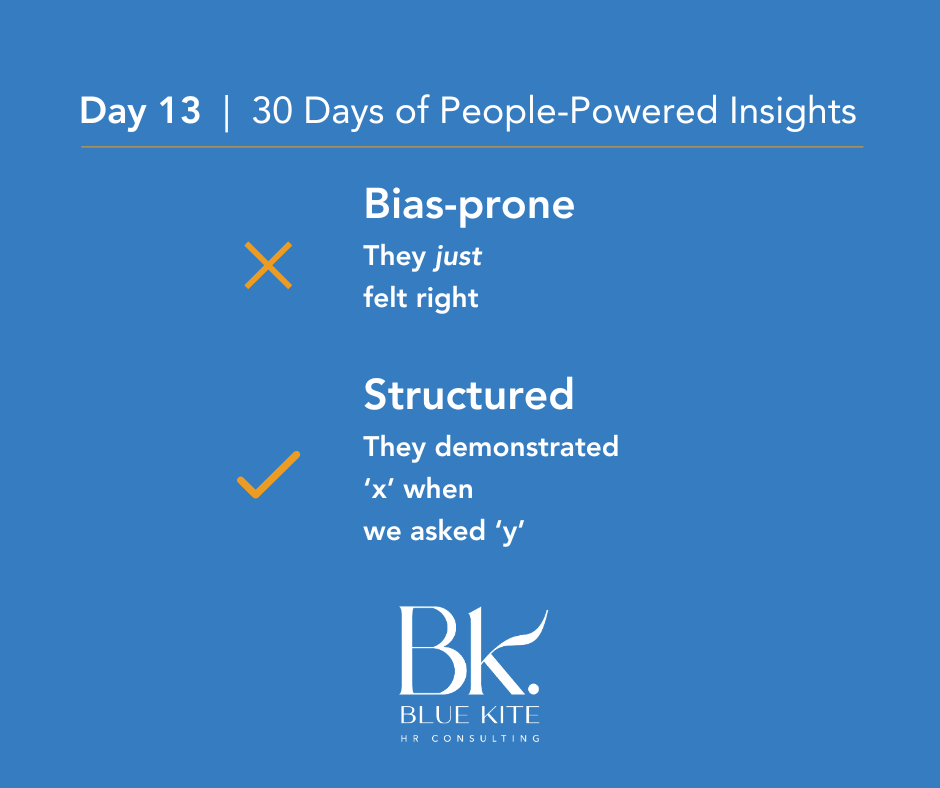
Once you’ve defined values behaviourally, you can write interview questions that actually test for them. Behavioural interview techniques — “tell me about a time when…” structured questions — are significantly more predictive than gut-feel responses to general conversation. They also produce more comparable data across candidates.

Structure your process consistently. When every candidate is asked different questions based on where the conversation goes, you’re not comparing apples with apples. A structured scorecard — where everyone evaluating a candidate rates the same dimensions against the same criteria — dramatically reduces the influence of bias.

Involve diverse decision-makers. A hiring decision made by a single person or a homogeneous group will always tend towards replication. Multiple perspectives in the assessment process improve both the quality of the decision and its defensibility.


The Business Case For Getting It Right 

Genuinely values-aligned hires tend to stay longer, integrate more effectively, and contribute to the culture in the ways that matter. The goal isn’t a team that agrees on everything — it’s a team that shares a foundation of how to work, treat people, and operate with integrity, while bringing genuinely different experiences, perspectives, and approaches to the actual work.

Ready to build a better workplace? Book your free 30-minute consultation at  Blue Kite HR Consulting 


BACK TO ALL ARTICLES
Screenshot 2025-11-18 164639

+61 (0) 409 545 634

cpaterson@bluekite.au

FREE CONSULTATION

  • ABOUT
  • HR SERVICES
  • COACH WITH ME
  • HEALTH & WELLBEING
  • MEDIA/PR
  • ARTICLES/BLOG
  • RESOURCES
  • CONTACT
  • PRIVACY

Blue Kite specialises in providing
HR services to support businesses
to create better workplaces.
Filed Under: Advisory and compliance, Business Update, Culture, External HR Support, HR essentials, Leadership

11 September, 2026 by Catie Paterson Leave a Comment

Micromanagement: Why Leaders Do It and What It Costs

ARTICLES

Micromanagement: Why Leaders Do It and What It Costs

11 September, 2026
Filed Under: Advisory and compliance, Business Update, Culture, External HR Support, HR essentials, Leadership

A café owner genuinely believed he was being supportive. He checked in on his shift supervisors multiple times an hour. He reviewed every purchase order personally. He gave detailed feedback on how the milk was being poured. Within eighteen months, he’d lost four supervisors — all capable, all citing the same reason: they felt like they had no authority and weren’t trusted to do their jobs.

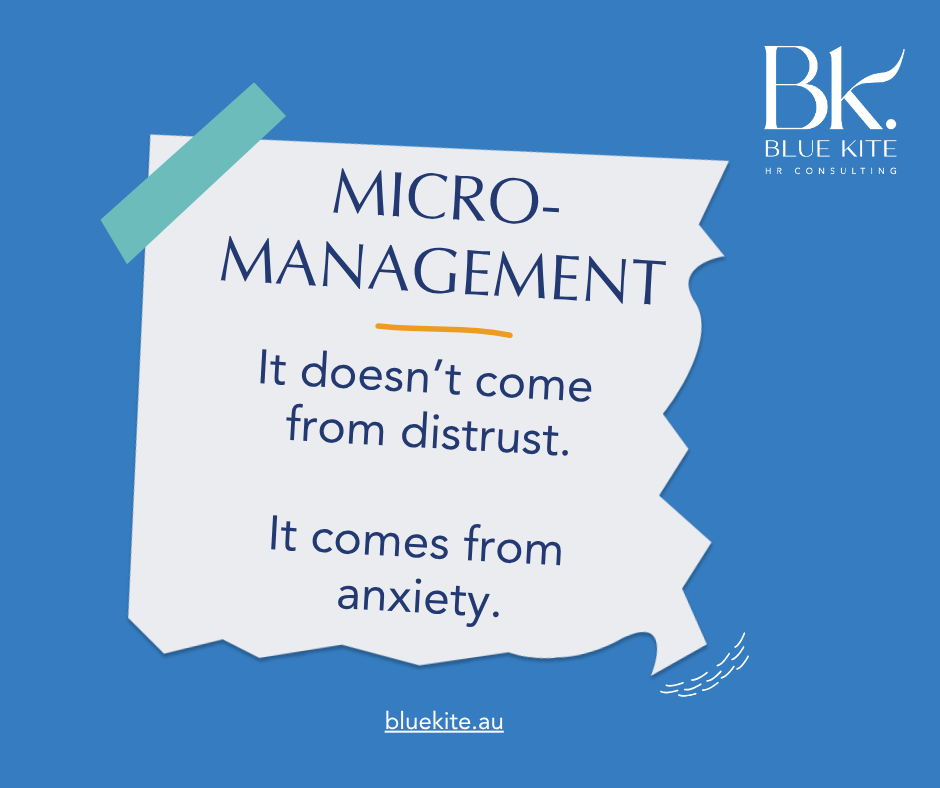
Micromanagement is one of those leadership behaviours that almost no one would describe themselves as doing. And yet it’s one of the most common reasons employees cite for leaving, disengaging, or underperforming. The disconnect exists because micromanagement rarely feels like control from the inside. It usually feels like thoroughness, care, or responsibility.


Why leaders micromanage

Understanding the behaviour is the first step to addressing it. Most micromanagement comes from one of three places.

Anxiety about outcomes is the most common driver. When a leader is worried about quality, deadlines, or client satisfaction, close oversight feels like risk management. The problem is that it creates the exact conditions — reduced team capability, lower ownership, higher turnover — that make outcomes worse over time.

A transition from doing to leading that never fully happened is another major source. Many business owners and managers were promoted because they were excellent individual contributors. The skills that made them great in a hands-on role are the same ones that drive them to keep intervening. Moving into leadership requires genuinely letting go of doing, which is harder than it sounds.

A lack of trust — in the individual, the team, or the process — is the third. Sometimes this is warranted by circumstances, and close oversight is temporarily appropriate. More often, it becomes a default mode that persists long after the trust has been established.


What it actually costs a buisness 

The costs are well-documented and significant. Employees who are micromanaged report lower job satisfaction, reduced initiative, and a tendency to wait for direction rather than problem-solve. Over time, they either leave — at which point you’re paying recruitment and training costs — or they stay and become exactly the passive, instruction-dependent workers the micromanager feared they’d be.

The leader also pays a price. Micromanagement is exhausting. A manager who is personally involved in every decision is a bottleneck in their own business. Their time is consumed by work that should be delegated, at the cost of strategic thinking, client relationships, and their own wellbeing.


What the path forward looks like 

Moving out of micromanagement requires honest self-reflection. Which situations trigger the behaviour? Is it specific people, types of work, or levels of stakes? What’s the actual evidence that close oversight is producing better outcomes?

The practical work is in building clear expectations upfront — what does good work look like, what does the person need to succeed — then stepping back and allowing mistakes to be learning opportunities rather than reasons to intervene. Accountability and autonomy aren’t in opposition. They’re partners in building a team that works without you watching.


Ready to build a better workplace? Book your free 30-minute consultation at Blue Kite HR Consulting 


BACK TO ALL ARTICLES
Screenshot 2025-11-18 164639

+61 (0) 409 545 634

cpaterson@bluekite.au

FREE CONSULTATION

  • ABOUT
  • HR SERVICES
  • COACH WITH ME
  • HEALTH & WELLBEING
  • MEDIA/PR
  • ARTICLES/BLOG
  • RESOURCES
  • CONTACT
  • PRIVACY

Blue Kite specialises in providing
HR services to support businesses
to create better workplaces.

Filed Under: Advisory and compliance, Business Update, Culture, External HR Support, HR essentials, Leadership

10 September, 2026 by Catie Paterson Leave a Comment

The Psychological Contract: The Unwritten Deal Driving Disengagement

ARTICLES

The Psychological Contract: The Unwritten Deal Driving Disengagement

10 September, 2026
Filed Under: Advisory and compliance, Change management, Culture, External HR Support, HR essentials, Leadership

Nobody signed a piece of paper agreeing to this arrangement. But it exists in every workplace: the set of unspoken expectations between an employer and an employee about what each party will give and receive. This is the psychological contract — and when it breaks, employees don’t usually raise a formal grievance. They disengage quietly, and then they leave. 

The term comes from organisational psychology research, but the concept is entirely familiar. When someone takes a job, they bring a set of expectations that go well beyond the written employment agreement. They expect to be treated fairly. To be recognised for their contribution. To have some security and predictability in their role. To have what they were told during hiring actually match the experience of working there.

When those expectations are met consistently, people tend to be engaged, loyal, and productive. When they’re violated — even once — the damage can be disproportionate and lasting.


What breaks the psychological contract

Broken promises are the most obvious trigger. A candidate is told there are strong growth opportunities, then twelve months in finds there’s no pathway visible. An employee is told the business values work-life balance, then gets an implicit message through consistent out-of-hours expectations that balance is only valued in the brochure. A team is promised consultation on major changes, then hears about a restructure through the grapevine.

These breaches aren’t always intentional. Often they’re the result of managers who said things in good faith during recruitment that the business couldn’t ultimately deliver. But from the employee’s perspective, the impact is the same: the deal they thought they’d signed up for isn’t the deal they’re actually in.

Organisational change is another major trigger. When businesses restructure, change leadership, or shift priorities, employees recalibrate their expectations. If they’re not included in those conversations — if change happens to them rather than with them — the psychological contract is disrupted, even if nothing material in their role has changed.


How to diagnose it in your business 

You can’t directly observe the psychological contract, but you can read its indicators. Disengagement often shows up before formal signals like increased absences or declining performance. Employees who used to contribute actively in meetings go quiet. People who were proactive become transactional — doing exactly what’s asked and nothing more. “Quiet quitting,” which we’ll cover separately in this series, is almost always a psychological contract response.

Ask your managers what’s changed in their teams recently, and whether they’ve checked in on how people are processing those changes. Look at your exit interviews — not just for the stated reasons, but for the patterns underneath them. A breach of the psychological contract is rarely named explicitly, but it’s often there.


Maintaining the contract intentionally

The most important thing is consistency between what you say and what you do. Not just in the hiring process, but in every communication and management decision. When things change — and they always do — communicate early, explain the reasoning, and be honest about what you don’t know yet.

Employees can handle uncertainty. What they can’t sustain is the feeling that they’re not being told the truth.


Ready to build a better workplace? Book your free 30-minute consultation at Blue Kite HR Consulting 


BACK TO ALL ARTICLES
Screenshot 2025-11-18 164639

+61 (0) 409 545 634

cpaterson@bluekite.au

FREE CONSULTATION

  • ABOUT
  • HR SERVICES
  • COACH WITH ME
  • HEALTH & WELLBEING
  • MEDIA/PR
  • ARTICLES/BLOG
  • RESOURCES
  • CONTACT
  • PRIVACY

Blue Kite specialises in providing
HR services to support businesses
to create better workplaces.
Filed Under: Advisory and compliance, Change management, Culture, External HR Support, HR essentials, Leadership

9 September, 2026 by Catie Paterson Leave a Comment

Internal Mobility: Your Next Best Hire Is Already on Your Team

ARTICLES

Internal Mobility: Your Next Best Hire Is Already on Your Team

9 September, 2026
Filed Under: Advisory and compliance, Career Planning, Culture, External HR Support, HR essentials, Leadership

An accounting firm spent $18,000 and twelve weeks recruiting a client relationship manager. Three weeks after the new hire started, a senior accountant who’d been with the firm for four years handed in her notice. In her exit interview, she mentioned she’d been hoping to move into a client-facing role for over a year. Nobody had known.

Internal mobility — the practice of moving people across roles, teams, and functions within your own business — is one of the most underused levers available to small and medium businesses. The reflexive instinct when a vacancy appears is to advertise externally. The smarter first move is often to look inward.


Why internal mobility is so valuable

When you promote or move someone internally, you retain a person who already understands your business, your clients, and your culture. The learning curve is dramatically shorter. The risk is lower. And critically, you signal to your entire team that growth is available without needing to leave.

Research from LinkedIn and other workforce analysts consistently shows that employees who have moved into new roles internally stay with their organisations significantly longer than those who haven’t. Internal mobility is one of the strongest drivers of retention — not because businesses are promoting everyone, but because employees can see a path forward.

For small businesses with limited formal career ladders, this is especially powerful. You don’t need to offer a five-level hierarchy to retain ambitious people. You need to offer genuine development and movement over time.


Where most businesses fall down

The most common failure is that nobody is having the career conversation. Managers assume employees will ask if they want something different. Employees assume they’d be told if an opportunity was available. Both sides wait. Nobody moves. The employee eventually leaves.

The second failure is the “we’d never fill their current role” problem. A great employee wants to try something new, but their manager says no because they’re too valuable where they are. This is a false economy. Blocking internal movement is one of the most reliable ways to guarantee the person leaves entirely within twelve months.

The third is bias in the process. When internal opportunities arise, they’re often filled through informal networks — a manager taps someone they know and rate, rather than making the opportunity visible to everyone. This tends to advantage people who are already well-connected and disadvantage those who are newer, quieter, or in less visible roles.


Building internal mobility into your business 

At its simplest, this means having career conversations regularly — not just at performance review time — and creating a way for employees to express interest in different types of work. Even a simple question in a one-on-one: “is there anything in this business you’d love to have a go at?” opens the door.

When vacancies arise, get in the habit of asking whether anyone internal might be a strong candidate — and making that opportunity visible rather than filling it quietly. The cost of a few months of development is almost always less than the cost of a full external hire.

Your existing team is not a fixed resource. It’s a dynamic one, if you create the conditions for it to be.


Ready to build better workplaces? Book your free 30-minute consultation at Blue Kite HR Consulting 


BACK TO ALL ARTICLES
Screenshot 2025-11-18 164639

+61 (0) 409 545 634

cpaterson@bluekite.au

FREE CONSULTATION

  • ABOUT
  • HR SERVICES
  • COACH WITH ME
  • HEALTH & WELLBEING
  • MEDIA/PR
  • ARTICLES/BLOG
  • RESOURCES
  • CONTACT
  • PRIVACY

Blue Kite specialises in providing
HR services to support businesses
to create better workplaces.

Filed Under: Advisory and compliance, Career Planning, Culture, External HR Support, HR essentials, Leadership

8 September, 2026 by Catie Paterson Leave a Comment

Workforce Planning: Hiring Ahead of Growth, Not Behind It

ARTICLES

Workforce Planning: Hiring Ahead of Growth, Not Behind It

8 September, 2026
Filed Under: Advisory and compliance, Business Update, Change management, Culture, External HR Support, Leadership

A construction firm won a contract that was 40% larger than anything they’d delivered before. The managing director’s first question was about equipment. His second was about sub-contractors. His third — three months into the project — was where all the qualified site supervisors had gone. Hiring began then, under pressure, with a six-week timeline that should have been six months. The project was delivered late. The lessons were expensive.

Reactive hiring is one of the most costly and avoidable problems in growing Australian businesses. When you hire because you’re already overwhelmed, you make worse decisions, offer whatever you need to secure someone quickly, and often end up with a poor fit that costs even more to manage or exit. The alternative — workforce planning — isn’t complicated. It just requires looking up from the immediate horizon.


What Workforce Planning Actually Involves 

Workforce planning is the practice of anticipating your people needs based on where your business is heading, rather than where it is right now. At its simplest, it asks: if our business grows as we expect over the next twelve to twenty-four months, what roles will we need, when will we need them, and how long will it realistically take to fill them?

For a small or medium business, this doesn’t require a dedicated HR team or sophisticated software. It requires honest conversation between the people who understand the business strategy and the people who understand the current team’s capacity.

The key questions are: what roles are likely to become critical, what’s the realistic lead time to hire for them, are there internal candidates who could be developed, and what does the labour market look like for these skills in your area?


The Lead Time Problem

Most business owners significantly underestimate how long good hiring takes. A well-run recruitment process for a skilled role in Australia typically takes six to twelve weeks minimum — more if the market is tight. Add three to six months for a new hire to reach full productivity, and the lead time from “we need someone” to “they’re fully contributing” is often closer to nine months.

If your business grows faster than that lead time allows for, you have a problem that no amount of urgent advertising will fix quickly. You either overpay for speed, compromise on quality, or overburden your existing team — often all three.


The First Steps Toward Getting Ahead

You don’t need a formal workforce plan document to start making better decisions. Begin by mapping your critical roles — the ones where a gap would immediately impact delivery or client relationships — and asking honestly whether those roles could be filled quickly if needed.

Then look at your next twelve months through a capacity lens. What new projects or clients are likely? What growth are you planning? What key employees might leave, retire, or want to reduce their hours? This isn’t about predicting the future perfectly. It’s about reducing the number of times you’re caught completely off guard.

Building this kind of thinking into your quarterly business planning is one of the most practical changes a growing SME can make. It won’t eliminate all people surprises — but it dramatically reduces the ones that cost you the most.

Ready to build a better workplace? Book your free 30-minute consultation at Blue Kite HR Consulting 

BACK TO ALL ARTICLES
Screenshot 2025-11-18 164639

+61 (0) 409 545 634

cpaterson@bluekite.au

FREE CONSULTATION

  • ABOUT
  • HR SERVICES
  • COACH WITH ME
  • HEALTH & WELLBEING
  • MEDIA/PR
  • ARTICLES/BLOG
  • RESOURCES
  • CONTACT
  • PRIVACY

Blue Kite specialises in providing
HR services to support businesses
to create better workplaces.

Filed Under: Advisory and compliance, Business Update, Change management, Culture, External HR Support, Leadership

  • « Go to Previous Page
  • Page 1
  • Page 2
  • Page 3
  • Page 4
  • Page 5
  • Page 6
  • Interim pages omitted …
  • Page 14
  • Go to Next Page »

Copyright © 2026 · Executive Pro on Genesis Framework · WordPress · Log in koopo

  • HOME
  • ABOUT US
  • HR SERVICES
  • COACH WITH ME
  • HEALTH & WELLBEING
  • MEDIA/PR
    • – Articles/Blogs
    • – Keynote Speaking Events
    • – Podcast Interviews
    • – Ticker Interviews
  • BLOG
  • RESOURCES
  • CONTACT