
• Skip to primary navigation
  • Skip to main content

BlueKite HR

  • HOME
  • ABOUT US
  • HR SERVICES
  • COACH WITH ME
  • HEALTH & WELLBEING
  • MEDIA/PR
    • – Articles/Blogs
    • – Keynote Speaking Events
    • – Podcast Interviews
    • – Ticker Interviews
  • BLOG
  • RESOURCES
  • CONTACT

External HR Support

22 October, 2026 by Catie Paterson Leave a Comment

Workplace Democracy: The Business Case for Giving Employees Real Voice

ARTICLES

Workplace Democracy: The Business Case for Giving Employees Real Voice

22 October, 2026
Filed Under: Advisory and compliance, Business Update, Change management, Culture, External HR Support, HR essentials, Leadership

Most businesses have some form of employee voice mechanism. An engagement survey. An anonymous suggestion box. A quarterly town hall where senior leaders share updates and invite questions. 

These things exist — and in most cases, they perform approximately the function of making leadership feel that people have been heard while changing almost nothing.

Genuine workplace democracy is different. It is the structural embedding of employee voice into the decisions that shape their working lives — not as consultation that can be ignored, but as meaningful input that visibly influences outcomes.


Why voices drive performance

The business case is not ideological. It is empirical. Organisations with high levels of employee voice consistently outperform those without on a range of metrics: retention, innovation output, safety culture, and customer satisfaction.

The mechanism is straightforward. People who have genuine voice in their working environment have a stake in the decisions made there. They invest more. They are more likely to surface problems early, to propose solutions, to treat the success of the business as connected to their own. They are also far less likely to leave.

A 2024 analysis by the Behavioural Insights Team Australia found that employees who reported high levels of genuine voice at work were 28% more likely to be highly engaged and 37% less likely to be actively job-seeking. The ROI on genuine participation is not hypothetical.


What real voices looks like

Three practices that create genuine voice (as opposed to the performance of it):

1. Create decision forums with real stakes.

Not “feedback on the new leave policy” but “here is the problem we are trying to solve — what should we do?” The distinction matters. One is consultation; the other is co-creation.

2. Close the loop, every time.

The fastest way to kill employee voice is to ask for input and never report back on what happened to it. If feedback changed the decision, say so. If it did not, explain why. The follow-through is where trust lives.

3. Differentiate between types of decisions.

Employees do not need input on every decision — and pretending otherwise creates noise. But decisions about work design, team culture, and operational processes that directly affect them? Those deserve genuine engagement.

You do not need a flat hierarchy or a radical governance model to give people real voice. You need the discipline to actually listen — and the courage to let it change something.


Ready to get ahead of this? Book your free 30-minute consultation at Blue Kite HR Consulting 
 

BACK TO ALL ARTICLES
Screenshot 2025-11-18 164639

+61 (0) 409 545 634

cpaterson@bluekite.au

FREE CONSULTATION

  • ABOUT
  • HR SERVICES
  • COACH WITH ME
  • HEALTH & WELLBEING
  • MEDIA/PR
  • ARTICLES/BLOG
  • RESOURCES
  • CONTACT
  • PRIVACY

Blue Kite specialises in providing
HR services to support businesses
to create better workplaces.


Filed Under: Advisory and compliance, Business Update, Change management, Culture, External HR Support, HR essentials, Leadership

21 October, 2026 by Catie Paterson Leave a Comment

The Work-Life Integration Myth: Why Blending Everything Is Failing Your Best People

ARTICLES

The Work-Life Integration Myth: Why Blending Everything Is Failing Your Best People

21 October, 2026
Filed Under: Advisory and compliance, Business Update, Change management, Culture, External HR Support, HR essentials, Leadership

For years, “work-life balance” was the aspiration — and most workplaces were honest about the fact that they were not achieving it. Then the concept of “work-life integration” arrived and everything seemed to get better.

The problem is that integration, for many people, has not delivered more freedom. It has dissolved the last remaining boundaries between work and personal life — and what lives in that dissolved space is not harmony. It is exhaustion.


Who integreation harms most

The research is consistent and concerning. A 2024 Deloitte survey of Australian knowledge workers found that employees operating in highly integrated work-life arrangements — those without clear boundaries between professional and personal time — reported higher levels of burnout than those with clear, consistent working hours.

The effect was strongest for three groups: parents (particularly mothers, who reported that “integration” often meant doing both jobs simultaneously rather than either job fully), high performers (who found that having access to work at all times meant the expectation was always present), and employees in leadership roles (who reported that the flexibility of integration created an implicit expectation of always-on availability that had no ceiling).

The people most harmed by work-life integration are often the people most businesses can least afford to lose.


What boundaries actually require

Integration advocates are right that rigid 9-to-5 structures do not work for everyone. The answer is not balance or integration — it is intentional boundaries, negotiated individually and respected organisationally:

1. Distinguish between schedule flexibility and availability expectations.

These are different things. A person can have a flexible schedule and clear availability norms. Conflating them is where the harm happens.

2. Make it safe to have boundaries.

If protecting personal time is perceived as lack of commitment, the policy is irrelevant. Leaders who visibly model boundaries give everyone else permission.

3. Have the conversation directly with each person.

What does sustainable look like for them? What are the non-negotiables? This is not permissiveness — it is intelligent workforce management.

The most engaged, loyal, high-performing employees are not those who have blended everything. They are those who have clear enough boundaries to bring their best selves to both sides of the line.


Ready to get ahead of this? Book your free 30-minute consultation at Blue Kite HR Consulting 


BACK TO ALL ARTICLES
Screenshot 2025-11-18 164639

+61 (0) 409 545 634

cpaterson@bluekite.au

FREE CONSULTATION

  • ABOUT
  • HR SERVICES
  • COACH WITH ME
  • HEALTH & WELLBEING
  • MEDIA/PR
  • ARTICLES/BLOG
  • RESOURCES
  • CONTACT
  • PRIVACY

Blue Kite specialises in providing
HR services to support businesses
to create better workplaces.
Filed Under: Advisory and compliance, Business Update, Change management, Culture, External HR Support, HR essentials, Leadership

20 October, 2026 by Catie Paterson Leave a Comment

Anticipatory HR: Using People Data to Predict Problems Before They Happen

ARTICLES

Anticipatory HR: Using People Data to Predict Problems Before They Happen

20 October, 2026
Filed Under: Advisory and compliance, Business Update, Change management, Culture, External HR Support, HR essentials, Leadership

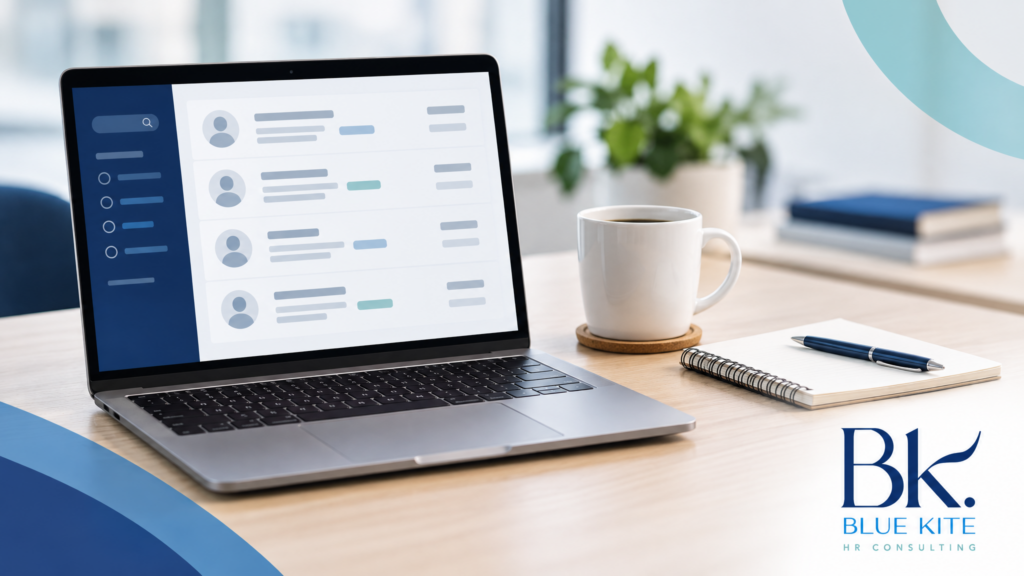
Most HR practice is reactive. Someone resigns and we ask why. A team’s performance drops and we investigate. A manager loses their best people and we schedule an exit interview series. We gather good information — usually too late to act on it.

Anticipatory HR flips this model. Instead of responding to problems after they emerge, it uses available data to identify risk signals before they become crises. The concept sounds sophisticated, and in enterprise settings it can be. But the core principle is accessible to businesses of any size: if you pay attention to the right signals, you will see most problems before they land.

The question is whether you are looking.


What data you probably already have

You do not need an expensive analytics platform to start thinking predictively. Most businesses already hold data that, if interpreted intentionally, would flag emerging people risks:

Attendance and leave patterns — abrupt changes in leave frequency, especially short unplanned absences, often precede a performance or wellbeing issue by weeks or months. Team-level absenteeism spikes are rarely random.

Engagement and pulse survey data — when analysed at the team level rather than the whole-organisation level, the patterns are often striking. A specific team that consistently scores lower on “my manager supports me” is a risk signal, not a benchmark data point.

Exit interview themes — when someone leaves, they often tell you exactly what went wrong. If your exit interview data is sitting in a spreadsheet uncollated, you are losing the most candid feedback your business receives.


Building an early warning practice 

Three steps to begin:

1. Identify your three highest-risk leading indicators.

Based on your history, what data signals have preceded the people problems that cost your business the most? Start there.

2. Create a regular rhythm of reviewing people data with a predictive lens.

Monthly or quarterly, ask: “What does our current data suggest is coming?” rather than “What has already happened?”

3. Act on signals, not certainties.

Anticipatory HR requires the willingness to have a conversation before there is a confirmed problem. A manager who is flagged as a retention risk can be supported, coached, or redeployed. One who resigns with four of their team members in their final month is a very different challenge.

The data you need to get ahead of most people problems is already in your organisation. The question is whether anyone is looking at it with that intent.


Ready to get ahead of this? Book your free 30-minute consultation at Blue Kite HR Consulting 


BACK TO ALL ARTICLES
Screenshot 2025-11-18 164639

+61 (0) 409 545 634

cpaterson@bluekite.au

FREE CONSULTATION

  • ABOUT
  • HR SERVICES
  • COACH WITH ME
  • HEALTH & WELLBEING
  • MEDIA/PR
  • ARTICLES/BLOG
  • RESOURCES
  • CONTACT
  • PRIVACY

Blue Kite specialises in providing
HR services to support businesses
to create better workplaces.

Filed Under: Advisory and compliance, Business Update, Change management, Culture, External HR Support, HR essentials, Leadership

19 October, 2026 by Catie Paterson Leave a Comment

Ethical AI Hiring: The Bias Problem You Didn’t Know You Were Buying

ARTICLES

Ethical AI Hiring: The Bias Problem You Didn't Know You Were Buying

19 October, 2026
Filed Under: Advisory and compliance, Business Update, Career Planning, Change management, Culture, External HR Support, HR essentials, Leadership, Life Experiences

AI-powered recruitment tools promise speed, objectivity, and scale. Automated CV screening, AI interview analysis, predictive “culture fit” scoring — the technology is increasingly accessible, and the pitch is compelling: remove human bias from the hiring process.

There is a serious problem with this narrative. AI hiring tools do not remove bias. They systematise it.

Every AI model is trained on historical data. In recruitment, that means historical hiring decisions — which reflects the preferences, biases, and constraints of whoever made those decisions in the past. An AI that learns from a dataset where senior hires were overwhelmingly male, or where candidates from certain postcodes were consistently screened out, will replicate those patterns at scale and with an appearance of objectivity that makes them harder to challenge.


The legal risk is real

In Australia, using an AI tool that produces discriminatory hiring outcomes exposes the employer to liability under the Age Discrimination Act, the Sex Discrimination Act, the Racial Discrimination Act, and relevant state anti-discrimination legislation — regardless of whether the discrimination was intentional. “The algorithm did it” is not a defence.

The Australian Human Rights Commission has been clear that automated decision-making in hiring does not relieve employers of their discrimination obligations. If your tool produces disparate impact on a protected group, you own that outcome.

A 2023 study by the University of Melbourne found that a significant number of AI resume screening tools available to Australian businesses showed measurable gender and age-related bias in their outputs. Most vendors did not disclose how their models were trained.


Using AI hiring tools responsibly

Three requirements before deploying any AI in your hiring process:

1. Ask vendors directly how their model was trained –

what datasets were used, and what bias testing has been conducted. If they cannot answer clearly, walk away.

2. Audit the outcomes of your current tools.

If your AI screening consistently produces a candidate pool that is less diverse than your applicant pool, that is a signal requiring immediate investigation.

3. Keep humans in every significant decision point.

AI can rank and filter. Humans must evaluate and decide. Document that human judgment has been applied to every hire — not just the final stage.


AI can make good hiring faster. It can also make bad hiring faster. The difference is whether you are paying attention.


If Ready to get ahead of this? Book your free 30-minute consultation at Blue Kite HR Consulting 


BACK TO ALL ARTICLES
Screenshot 2025-11-18 164639

+61 (0) 409 545 634

cpaterson@bluekite.au

FREE CONSULTATION

  • ABOUT
  • HR SERVICES
  • COACH WITH ME
  • HEALTH & WELLBEING
  • MEDIA/PR
  • ARTICLES/BLOG
  • RESOURCES
  • CONTACT
  • PRIVACY

Blue Kite specialises in providing
HR services to support businesses
to create better workplaces.

Filed Under: Advisory and compliance, Business Update, Career Planning, Change management, Culture, External HR Support, HR essentials, Leadership, Life Experiences

16 October, 2026 by Catie Paterson Leave a Comment

Digital Wellbeing: When Always-On Culture Becomes a Liability

ARTICLES

Digital Wellbeing: When Always-On Culture Becomes a Liability

16 October, 2026
Filed Under: Advisory and compliance, Business Update, Change management, Culture, External HR Support, HR essentials, Leadership

It is 9:30pm. Your employee gets a message from their manager asking for an update on a project. They respond — because the culture in your business makes it clear that being responsive is valued. 

They feel mild stress at the interruption. Their sleep is slightly disrupted. Tomorrow, they are marginally less focused than they would have been.

Multiply this by five nights a week, fifty weeks a year, and you begin to understand the compound cost of always-on culture.


The legal dimension is no longer theoretical 

In September 2024, Australia became one of the first countries in the world to legislate a genuine “right to disconnect.” Under changes to the Fair Work Act, most employees in non-small-business settings now have the right to refuse unreasonable contact outside their working hours, and refusing to engage cannot constitute grounds for adverse action.

The legislation applies to small businesses from August 2025. If you have not yet reviewed your communication practices and updated your policies, you are behind the curve — and potentially exposed.

But the business case for addressing this extends well beyond compliance. A 2024 study by Safe Work Australia found that employees who regularly worked outside contracted hours were 42% more likely to report high levels of psychological distress. Psychological distress is a psychosocial hazard. Psychosocial hazards are now squarely within your duty of care.


Creating a digital wellbeing policy that actually works

A policy only changes behaviour if it is supported by leadership modelling, clear expectations, and genuine accountability. Three steps:

1. Establish explicit norms around communication hours.

What are the hours during which a response is expected? What constitutes genuine urgency that warrants after-hours contact? Write this down, share it, and have your leaders live it.

2. Audit your own communication patterns as a leader.

If you send emails at midnight, your team will check their inbox at midnight — regardless of what the policy says. Culture flows from the top.

3. Review your on-call and after-hours arrangements.

If you have roles that genuinely require after-hours availability, ensure this is compensated appropriately, documented clearly, and as limited in scope as operationally possible.


Always-on culture was a competitive signal in a different era. In the current environment, it is a turnover driver, a compliance risk, and a wellbeing liability. The businesses getting ahead of this now will not be managing a crisis later.


Ready to get ahead of this? Book your free 30-minute consultation at Blue Kite HR Consulting 


BACK TO ALL ARTICLES
Screenshot 2025-11-18 164639

+61 (0) 409 545 634

cpaterson@bluekite.au

FREE CONSULTATION

  • ABOUT
  • HR SERVICES
  • COACH WITH ME
  • HEALTH & WELLBEING
  • MEDIA/PR
  • ARTICLES/BLOG
  • RESOURCES
  • CONTACT
  • PRIVACY

Blue Kite specialises in providing
HR services to support businesses
to create better workplaces.

Filed Under: Advisory and compliance, Business Update, Change management, Culture, External HR Support, HR essentials, Leadership

15 October, 2026 by Catie Paterson Leave a Comment

The Attention Economy at Work: Focus Is Now Your Scarcest Resource

ARTICLES

The Attention Economy at Work: Focus Is Now Your Scarcest Resource

15 October, 2026
Filed Under: Advisory and compliance, Business Update, Career Planning, Change management, Culture, External HR Support, HR essentials, Leadership

Every notification your employees receive is a bid for their attention. Every meeting that could have been an email. Every Teams message sent while someone is in deep work.

Every email flagged “urgent” that is not. Together, these add up to one of the most significant and underacknowledged productivity drains in the modern workplace.

We have spent decades optimising processes, systems, and technology. We have almost entirely ignored the cognitive cost of the environment we have built around our people.


What Attention Fragmentation costs

Research from the University of California Irvine has shown that after an interruption, the average worker takes more than twenty minutes to return to a state of full focus on their original task. If your team is being interrupted on average every eleven minutes — which is a finding from multiple workplace studies — the mathematics of lost productivity are brutal.

The Deloitte 2025 Global Human Capital Trends report identified “attention management” as an emerging priority for organisations, noting that the organisations consistently outperforming in creative and complex problem-solving work were those that had deliberately engineered protected time for focused work into their operating rhythms.

This is not a personal productivity problem. It is an organisational design problem


Reclaiming focus as a business strategy 

Three practical interventions that do not require a culture overhaul:

1. Establish “focus blocks” as a team norm.

Even two hours each day — agreed by the whole team, not just individuals — where meetings are not scheduled and notifications are muted creates a different category of work output.

2. Audit your meeting culture.

How many meetings on your calendar last week could have been an email, a voice note, or a brief written update? The answer is almost always “more than we’d like to admit.” Introduce a meeting-free morning or afternoon and measure the response.

3. Review your communication channels for urgency creep.

When everything is flagged urgent, nothing is. Creating clearer norms around which channel means what — and what response time is expected — reduces the anxiety tax of always being on.

Your people cannot think well in a constant state of interruption. Protecting attention is not a luxury — it is how the best work gets done.


Ready to get ahead of this? Book your free 30-minute consultation at Blue Kite HR Consulting 


BACK TO ALL ARTICLES
Screenshot 2025-11-18 164639

+61 (0) 409 545 634

cpaterson@bluekite.au

FREE CONSULTATION

  • ABOUT
  • HR SERVICES
  • COACH WITH ME
  • HEALTH & WELLBEING
  • MEDIA/PR
  • ARTICLES/BLOG
  • RESOURCES
  • CONTACT
  • PRIVACY

Blue Kite specialises in providing
HR services to support businesses
to create better workplaces.

Filed Under: Advisory and compliance, Business Update, Career Planning, Change management, Culture, External HR Support, HR essentials, Leadership

  • « Go to Previous Page
  • Page 1
  • Page 2
  • Page 3
  • Page 4
  • Interim pages omitted …
  • Page 18
  • Go to Next Page »

Copyright © 2026 · Executive Pro on Genesis Framework · WordPress · Log in koopo

  • HOME
  • ABOUT US
  • HR SERVICES
  • COACH WITH ME
  • HEALTH & WELLBEING
  • MEDIA/PR
    • – Articles/Blogs
    • – Keynote Speaking Events
    • – Podcast Interviews
    • – Ticker Interviews
  • BLOG
  • RESOURCES
  • CONTACT