
• Skip to primary navigation
  • Skip to main content

BlueKite HR

  • HOME
  • ABOUT US
  • HR SERVICES
  • COACH WITH ME
  • HEALTH & WELLBEING
  • MEDIA/PR
    • – Articles/Blogs
    • – Keynote Speaking Events
    • – Podcast Interviews
    • – Ticker Interviews
  • BLOG
  • RESOURCES
  • CONTACT

Life Experiences

19 October, 2026 by Catie Paterson Leave a Comment

Ethical AI Hiring: The Bias Problem You Didn’t Know You Were Buying

ARTICLES

Ethical AI Hiring: The Bias Problem You Didn't Know You Were Buying
19 October, 2026
Filed Under: Advisory and compliance, Business Update, Career Planning, Change management, Culture, External HR Support, HR essentials, Leadership, Life Experiences

AI-powered recruitment tools promise speed, objectivity, and scale. Automated CV screening, AI interview analysis, predictive “culture fit” scoring — the technology is increasingly accessible, and the pitch is compelling: remove human bias from the hiring process.

There is a serious problem with this narrative. AI hiring tools do not remove bias. They systematise it.

Every AI model is trained on historical data. In recruitment, that means historical hiring decisions — which reflects the preferences, biases, and constraints of whoever made those decisions in the past. An AI that learns from a dataset where senior hires were overwhelmingly male, or where candidates from certain postcodes were consistently screened out, will replicate those patterns at scale and with an appearance of objectivity that makes them harder to challenge.


The legal risk is real

In Australia, using an AI tool that produces discriminatory hiring outcomes exposes the employer to liability under the Age Discrimination Act, the Sex Discrimination Act, the Racial Discrimination Act, and relevant state anti-discrimination legislation — regardless of whether the discrimination was intentional. “The algorithm did it” is not a defence.

The Australian Human Rights Commission has been clear that automated decision-making in hiring does not relieve employers of their discrimination obligations. If your tool produces disparate impact on a protected group, you own that outcome.

A 2023 study by the University of Melbourne found that a significant number of AI resume screening tools available to Australian businesses showed measurable gender and age-related bias in their outputs. Most vendors did not disclose how their models were trained.


Using AI hiring tools responsibly

Three requirements before deploying any AI in your hiring process:

1. Ask vendors directly how their model was trained –

what datasets were used, and what bias testing has been conducted. If they cannot answer clearly, walk away.

2. Audit the outcomes of your current tools.

If your AI screening consistently produces a candidate pool that is less diverse than your applicant pool, that is a signal requiring immediate investigation.

3. Keep humans in every significant decision point.

AI can rank and filter. Humans must evaluate and decide. Document that human judgment has been applied to every hire — not just the final stage.


AI can make good hiring faster. It can also make bad hiring faster. The difference is whether you are paying attention.


If Ready to get ahead of this? Book your free 30-minute consultation at Blue Kite HR Consulting 
 

BACK TO ALL ARTICLES
Screenshot 2025-11-18 164639

+61 (0) 409 545 634

cpaterson@bluekite.au

FREE CONSULTATION

  • ABOUT
  • HR SERVICES
  • COACH WITH ME
  • HEALTH & WELLBEING
  • MEDIA/PR
  • ARTICLES/BLOG
  • RESOURCES
  • CONTACT
  • PRIVACY

Blue Kite specialises in providing
HR services to support businesses
to create better workplaces.

Filed Under: Advisory and compliance, Business Update, Career Planning, Change management, Culture, External HR Support, HR essentials, Leadership, Life Experiences

13 October, 2026 by Catie Paterson Leave a Comment

Financial Wellbeing as an HR Strategy: The Stress in the Room Nobody Names

ARTICLES

Financial Wellbeing as an HR Strategy: The Stress in the Room Nobody Names

13 October, 2026
Filed Under: Advisory and compliance, Career Planning, Change management, Culture, External HR Support, HR essentials, Leadership, Life Experiences

Ask most HR professionals what their wellbeing strategy covers and you will hear: mental health support, EAP services, flexible working, perhaps physical wellness initiatives. What you will rarely hear is financial wellbeing.

This is a significant gap. Financial stress is among the most common causes of reduced productivity, absenteeism, and diminished concentration in the Australian workforce — yet it remains almost entirely unaddressed by most employers, as though it exists in a different category from “real” workplace wellbeing.


The numbers are stark 

The Australian Banking Association’s 2025 Financial Resilience Report found that nearly 40% of Australian workers carry significant financial stress into work at least once a week. The most common stressors: mortgage pressure, cost-of-living increases, and inadequate savings for unexpected expenses.

The productivity cost is measurable. Research from the Financial Health Network found that workers experiencing high financial stress spent an average of three hours per week managing financial concerns during working hours. At a median salary, that is real money in lost output for every affected employee in your team.

Financial stress also correlates strongly with mental health challenges, which means your EAP investment is partly compensating for a problem that a financial wellbeing strategy could address upstream.


What Employers can do 

You do not need to be a financial advisor — and you should not try to be. But there are meaningful things in your control:

1. Review your pay structure for genuine transparency.

Pay inequity — even where it is legal — creates financial anxiety when people suspect they are underpaid relative to peers. Transparent salary bands reduce this.

2. Provide access to independent financial wellness resources.

This can be as simple as including an accredited financial counselling referral in your EAP, or partnering with a super fund’s education program. The bar is low; the impact is real.

3. Normalise the conversation.

Financial stress thrives in silence. A manager who can say “if you are experiencing financial difficulty and it is affecting your work, let’s talk about what support options exist” removes a significant barrier to help-seeking.

Wellbeing is not just about mental health. It is about the whole person who shows up to work every day — and for many of your people right now, money is the thing keeping them up at night.


Ready to get ahead of this? Book your free 30-minute consultation at Blue Kite HR Consulting 


BACK TO ALL ARTICLES
Screenshot 2025-11-18 164639

+61 (0) 409 545 634

cpaterson@bluekite.au

FREE CONSULTATION

  • ABOUT
  • HR SERVICES
  • COACH WITH ME
  • HEALTH & WELLBEING
  • MEDIA/PR
  • ARTICLES/BLOG
  • RESOURCES
  • CONTACT
  • PRIVACY

Blue Kite specialises in providing
HR services to support businesses
to create better workplaces.
Filed Under: Advisory and compliance, Career Planning, Change management, Culture, External HR Support, HR essentials, Leadership, Life Experiences

23 June, 2026 by Bronwyn Coulthart Leave a Comment

Leadership as a Driver of Employee Experience

ARTICLES

Leadership as a Driver of Employee Experience

23 June, 2026
Filed Under: Advisory and compliance, Business Update, Career Planning, Change management, Culture, HR essentials, Leadership, Life Experiences, Workforce

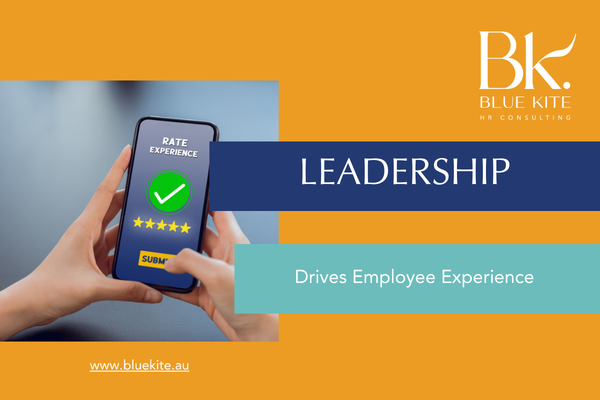
Employee experience is often discussed in terms of benefits, flexibility and workplace initiatives. While these elements contribute, one of the most significant drivers of employee experience is leadership.

The way leaders communicate, set expectations and support their teams shapes how employees experience their work on a daily basis. Clear direction, consistent feedback and respectful interactions contribute to a more positive and productive environment.

Conversely, unclear expectations, inconsistent communication or reactive leadership can create frustration and disengagement. These issues are often reflected in employee feedback, retention patterns and overall performance.

Leaders influence how work feels—not just what work is done. This includes how decisions are explained, how challenges are addressed and how individuals are supported in their roles.

Improving the employee experience, therefore, requires a focus on leadership capability. This may involve developing communication skills, strengthening feedback practices and supporting leaders to manage teams effectively.

Businesses that recognise the connection between leadership and employee experience are better positioned to create environments where people can perform at their best.

Employee experience is not solely the result of policies or programs. It is shaped daily through leadership behaviour.

Get on the waitlist for my Blue Kite HR Advisory Portal, here.

BACK TO ALL ARTICLES
Screenshot 2025-11-18 164639

+61 (0) 409 545 634

cpaterson@bluekite.au

FREE CONSULTATION

  • ABOUT
  • HR SERVICES
  • COACH WITH ME
  • HEALTH & WELLBEING
  • MEDIA/PR
  • ARTICLES/BLOG
  • RESOURCES
  • CONTACT
  • PRIVACY

Blue Kite specialises in providing
HR services to support businesses
to create better workplaces.
Filed Under: Advisory and compliance, Business Update, Career Planning, Change management, Culture, HR essentials, Leadership, Life Experiences, Workforce

22 June, 2026 by Bronwyn Coulthart Leave a Comment

Future Skills for Leaders

ARTICLES

Future Skills for Leaders

22 June, 2026
Filed Under: Advisory and compliance, Business Update, Career Planning, Change management, Culture, HR essentials, Leadership, Life Experiences, Succession Management, Workforce, Workforce Planning

Leadership capability is evolving in response to changing workplace dynamics. While technical expertise remains important, it is no longer sufficient on its own. Leaders are increasingly required to navigate complexity, manage diverse teams and respond to ongoing change.

Skills such as emotional intelligence, adaptability and communication are becoming central to effective leadership. These capabilities support stronger relationships, clearer decision-making and more effective team management.

Emotional intelligence enables leaders to understand and respond to the needs of their team, manage their own reactions and approach challenges with greater awareness. Adaptability supports leaders in adjusting to changing circumstances and maintaining focus in uncertain environments.

Communication is equally important. Clear, consistent communication helps align teams, set expectations and reduce ambiguity.

Developing these skills requires deliberate effort. Organisations may support this through leadership development programs, coaching and ongoing feedback.

The leaders who are most effective in modern workplaces are those who can combine technical capability with strong interpersonal skills. This balance supports both performance and culture.

As workplaces continue to evolve, leadership development must evolve alongside them. Focusing on the right skills is essential for long-term success.

Get on the waitlist for my Blue Kite HR Advisory Portal, here.

BACK TO ALL ARTICLES
Screenshot 2025-11-18 164639

+61 (0) 409 545 634

cpaterson@bluekite.au

FREE CONSULTATION

  • ABOUT
  • HR SERVICES
  • COACH WITH ME
  • HEALTH & WELLBEING
  • MEDIA/PR
  • ARTICLES/BLOG
  • RESOURCES
  • CONTACT
  • PRIVACY

Blue Kite specialises in providing
HR services to support businesses
to create better workplaces.
Filed Under: Advisory and compliance, Business Update, Career Planning, Change management, Culture, HR essentials, Leadership, Life Experiences, Succession Management, Workforce, Workforce Planning

21 June, 2026 by Bronwyn Coulthart Leave a Comment

Leadership Burnout: The Overlooked Risk

ARTICLES

Leadership Burnout: The Overlooked Risk

21 June, 2026
Filed Under: Advisory and compliance, Business Update, Career Planning, Change management, Culture, HR essentials, Leadership, Life Experiences, Onboarding, Workforce, Workforce Planning

Leadership burnout is an increasingly common issue, yet it is often overlooked in business discussions about wellbeing. While attention is typically focused on employee experience, the demands placed on leaders can be significant and, if not managed effectively, can impact both individuals and teams.

Leaders are often responsible for managing performance, addressing challenges, supporting their teams and delivering results. In environments with high expectations and ongoing change, these responsibilities can accumulate quickly.

When leaders experience burnout, the effects can extend beyond the individual. Decision-making may become reactive, communication can become less effective and the overall team environment may be impacted.

Supporting leaders requires recognising these pressures and providing appropriate structures. This may include clear role expectations, manageable workloads, access to support and development opportunities.

Businesses also benefit from building leadership capability in areas such as delegation, prioritisation and communication. These skills can help leaders manage demands more effectively and maintain a sustainable approach to their role.

Leadership wellbeing is not separate from business performance. It is closely linked. Supporting leaders supports teams, and ultimately, business outcomes.

Get on the waitlist for my Blue Kite HR Advisory Portal, here.

BACK TO ALL ARTICLES
Screenshot 2025-11-18 164639

+61 (0) 409 545 634

cpaterson@bluekite.au

FREE CONSULTATION

  • ABOUT
  • HR SERVICES
  • COACH WITH ME
  • HEALTH & WELLBEING
  • MEDIA/PR
  • ARTICLES/BLOG
  • RESOURCES
  • CONTACT
  • PRIVACY

Blue Kite specialises in providing
HR services to support businesses
to create better workplaces.

Filed Under: Advisory and compliance, Business Update, Career Planning, Change management, Culture, HR essentials, Leadership, Life Experiences, Onboarding, Workforce, Workforce Planning

11 June, 2026 by Bronwyn Coulthart Leave a Comment

HR as a Strategic Function: Moving Beyond Administration

ARTICLES

HR as a Strategic Function: Moving Beyond Administration

11 June, 2026
Filed Under: Advisory and compliance, Business Update, Career Planning, Change management, Culture, Leadership, Life Experiences, Workforce

In many businesses, HR is still viewed primarily as an administrative function—responsible for contracts, policies, compliance and employee relations.

While these areas remain important, they represent only part of HR’s potential value. Increasingly, HR is being recognised as a strategic function that directly influences business performance.

A strategic HR approach focuses on aligning people practices with business objectives. It considers how leadership capability, workforce structure, culture and employee experience contribute to organisational outcomes. This requires HR to move beyond transactional tasks and engage more actively in decision-making at a senior level.

For example, decisions about growth, restructuring or transformation all have significant people implications. Without strong HR input, organisations risk overlooking critical factors such as capability gaps, leadership readiness and cultural impact.

To operate strategically, HR teams need both commercial understanding and practical insight into how work gets done. They must be able to translate business goals into clear people strategies—whether that involves developing leaders, improving performance management or strengthening engagement.

Importantly, this shift is not solely the responsibility of HR. Leaders across the organisation must also recognise the value of effective people practices and engage with HR as a partner, not just a support function.

When HR operates strategically, it contributes to better decision-making, stronger leadership and more consistent performance. In a competitive environment, this can be a significant differentiator.

Get on the waitlist for my Blue Kite HR Advisory Portal, here.

BACK TO ALL ARTICLES
Screenshot 2025-11-18 164639

+61 (0) 409 545 634

cpaterson@bluekite.au

FREE CONSULTATION

  • ABOUT
  • HR SERVICES
  • COACH WITH ME
  • HEALTH & WELLBEING
  • MEDIA/PR
  • ARTICLES/BLOG
  • RESOURCES
  • CONTACT
  • PRIVACY

Blue Kite specialises in providing
HR services to support businesses
to create better workplaces.

Filed Under: Advisory and compliance, Business Update, Career Planning, Change management, Culture, Leadership, Life Experiences, Workforce

  • Page 1
  • Page 2
  • Go to Next Page »

Copyright © 2026 · Executive Pro on Genesis Framework · WordPress · Log in koopo

  • HOME
  • ABOUT US
  • HR SERVICES
  • COACH WITH ME
  • HEALTH & WELLBEING
  • MEDIA/PR
    • – Articles/Blogs
    • – Keynote Speaking Events
    • – Podcast Interviews
    • – Ticker Interviews
  • BLOG
  • RESOURCES
  • CONTACT