
• Skip to primary navigation
  • Skip to main content

BlueKite HR

  • HOME
  • ABOUT US
  • HR SERVICES
  • COACH WITH ME
  • HEALTH & WELLBEING
  • MEDIA/PR
    • – Articles/Blogs
    • – Keynote Speaking Events
    • – Podcast Interviews
    • – Ticker Interviews
  • BLOG
  • RESOURCES
  • CONTACT

Onboarding

30 June, 2026 by Bronwyn Coulthart Leave a Comment

HR as a Growth Engine: Moving Beyond Risk Management

ARTICLES

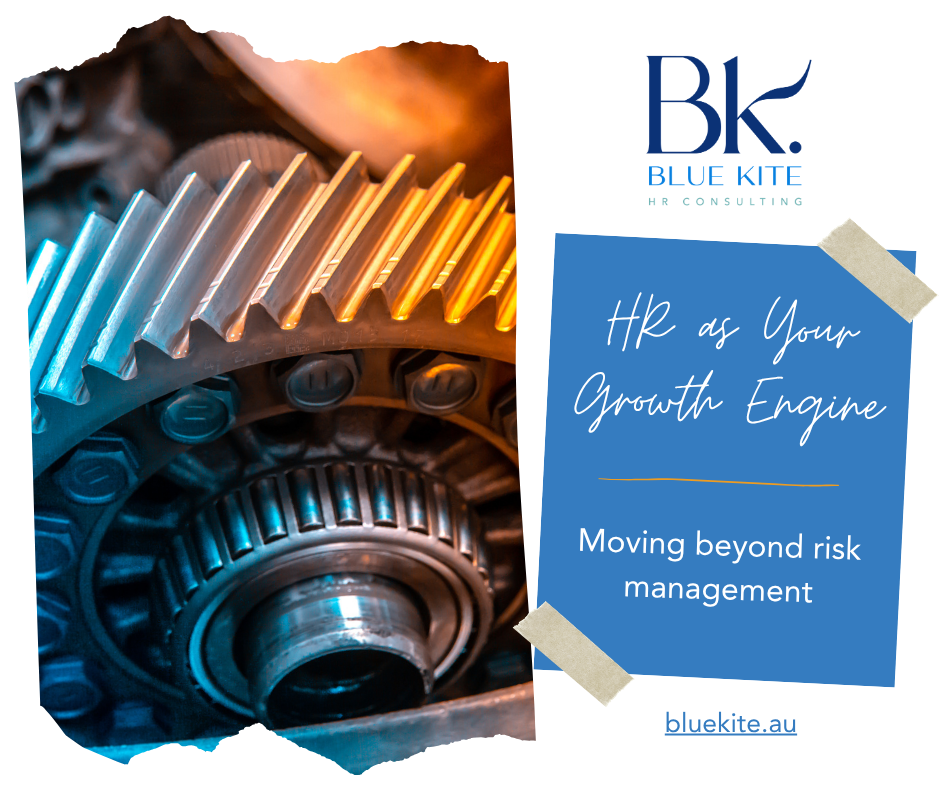
HR as a Growth Engine: Moving Beyond Risk Management
30 June, 2026
Filed Under: Advisory and compliance, Business Update, Career Planning, Change management, Culture, HR essentials, Onboarding, Workforce, Workforce Planning

HR has traditionally been associated with risk management—ensuring compliance, managing employee relations and maintaining policies. While these responsibilities remain important, they represent only part of HR’s potential contribution to a business.

Increasingly, organisations are recognising HR as a driver of growth. When aligned with business objectives, HR can influence leadership capability, workforce effectiveness and overall performance.

A growth-focused HR function looks beyond processes and considers how people practices support business outcomes. This may involve developing leadership capability, improving performance management, strengthening culture or enhancing the employee experience.

For example, effective leadership development can improve decision-making and team performance. Clear performance management processes can support accountability and productivity. A strong culture can enhance engagement and retention.

To operate in this way, HR needs to be involved in strategic decision-making. This requires a clear understanding of the business, its objectives and the role people play in achieving them.

Importantly, this shift is not solely about HR. It requires leaders across the business to engage with people practices as a core part of business performance.

HR is not only there to manage risk. When used effectively, it can support growth, strengthen capability and contribute to long-term success.

Get on the waitlist for my Blue Kite HR Advisory Portal, here.
BACK TO ALL ARTICLES
Screenshot 2025-11-18 164639

+61 (0) 409 545 634

cpaterson@bluekite.au

FREE CONSULTATION

  • ABOUT
  • HR SERVICES
  • COACH WITH ME
  • HEALTH & WELLBEING
  • MEDIA/PR
  • ARTICLES/BLOG
  • RESOURCES
  • CONTACT
  • PRIVACY

Blue Kite specialises in providing
HR services to support businesses
to create better workplaces.
Filed Under: Advisory and compliance, Business Update, Career Planning, Change management, Culture, HR essentials, Onboarding, Workforce, Workforce Planning

21 June, 2026 by Bronwyn Coulthart Leave a Comment

Leadership Burnout: The Overlooked Risk

ARTICLES

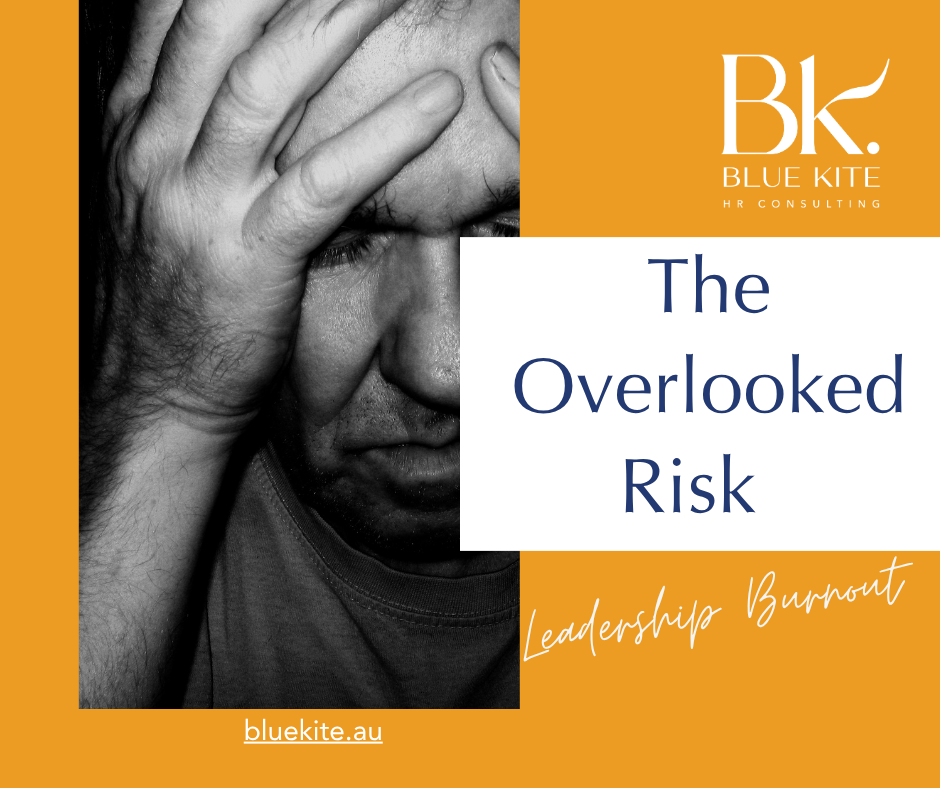
Leadership Burnout: The Overlooked Risk

21 June, 2026
Filed Under: Advisory and compliance, Business Update, Career Planning, Change management, Culture, HR essentials, Leadership, Life Experiences, Onboarding, Workforce, Workforce Planning

Leadership burnout is an increasingly common issue, yet it is often overlooked in business discussions about wellbeing. While attention is typically focused on employee experience, the demands placed on leaders can be significant and, if not managed effectively, can impact both individuals and teams.

Leaders are often responsible for managing performance, addressing challenges, supporting their teams and delivering results. In environments with high expectations and ongoing change, these responsibilities can accumulate quickly.

When leaders experience burnout, the effects can extend beyond the individual. Decision-making may become reactive, communication can become less effective and the overall team environment may be impacted.

Supporting leaders requires recognising these pressures and providing appropriate structures. This may include clear role expectations, manageable workloads, access to support and development opportunities.

Businesses also benefit from building leadership capability in areas such as delegation, prioritisation and communication. These skills can help leaders manage demands more effectively and maintain a sustainable approach to their role.

Leadership wellbeing is not separate from business performance. It is closely linked. Supporting leaders supports teams, and ultimately, business outcomes.

Get on the waitlist for my Blue Kite HR Advisory Portal, here.

BACK TO ALL ARTICLES
Screenshot 2025-11-18 164639

+61 (0) 409 545 634

cpaterson@bluekite.au

FREE CONSULTATION

  • ABOUT
  • HR SERVICES
  • COACH WITH ME
  • HEALTH & WELLBEING
  • MEDIA/PR
  • ARTICLES/BLOG
  • RESOURCES
  • CONTACT
  • PRIVACY

Blue Kite specialises in providing
HR services to support businesses
to create better workplaces.
Filed Under: Advisory and compliance, Business Update, Career Planning, Change management, Culture, HR essentials, Leadership, Life Experiences, Onboarding, Workforce, Workforce Planning

13 June, 2026 by Bronwyn Coulthart Leave a Comment

Psychological Safety as a Performance Driver

ARTICLES

Psychological Safety as a Performance Driver

13 June, 2026
Filed Under: Advisory and compliance, Business Update, Career Planning, Change management, Culture, Onboarding, Workforce

Psychological safety is often discussed in the context of wellbeing or workplace culture, but its impact extends directly to performance. Teams that feel safe to speak up, ask questions and challenge ideas are more likely to identify issues early, generate better solutions and collaborate effectively.

In contrast, environments where people feel hesitant to contribute can limit performance. When individuals are concerned about how their input will be received, they are less likely to share ideas, raise concerns or admit mistakes. This can lead to missed opportunities, slower problem-solving and increased risk.

Creating psychological safety does not mean lowering standards or avoiding difficult conversations. In fact, it supports higher standards by enabling more open, constructive dialogue. It allows teams to address challenges directly rather than avoiding them.

Leaders play a central role in establishing this environment. How they respond to questions, feedback and mistakes sets the tone. Consistent, respectful and measured responses encourage participation. Reactive or dismissive behaviour can quickly discourage it.

Practical steps might include encouraging input during meetings, acknowledging contributions, responding constructively to errors and creating space for discussion without immediate judgment.

Psychological safety is not a “soft” concept. It is a practical enabler of performance. Organisations that prioritise it are better positioned to adapt, innovate and respond effectively in complex environments.

Get on the waitlist for my Blue Kite HR Advisory Portal, here.

BACK TO ALL ARTICLES
Screenshot 2025-11-18 164639

+61 (0) 409 545 634

cpaterson@bluekite.au

FREE CONSULTATION

  • ABOUT
  • HR SERVICES
  • COACH WITH ME
  • HEALTH & WELLBEING
  • MEDIA/PR
  • ARTICLES/BLOG
  • RESOURCES
  • CONTACT
  • PRIVACY

Blue Kite specialises in providing
HR services to support businesses
to create better workplaces.

Filed Under: Advisory and compliance, Business Update, Career Planning, Change management, Culture, Onboarding, Workforce

4 June, 2026 by Bronwyn Coulthart Leave a Comment

The Role of Positive Psychology in Transforming Organisational Culture

ARTICLES

The Path to CPC: A World of Hotel Management, Hospitality and HR

4 June, 2026
Filed Under: Advisory and compliance, Culture, HR essentials, Leadership, Life Experiences, Onboarding, Workforce

When people hear the term positive psychology, they sometimes assume it is about forced optimism or ignoring difficult issues.

In reality, positive psychology is far more practical—and far more powerful—than that. In workplace settings, it offers a valuable framework for helping organisations build healthier cultures, stronger teams and more sustainable performance.

At its core, positive psychology focuses on what helps people function well. That includes strengths, motivation, resilience, meaning, connection and the conditions that allow individuals and teams to thrive. It does not deny problems. Instead, it asks a different question: what is already working, and how can we build more of it?

This is particularly relevant to organisational culture. Many businesses focus heavily on what is broken—poor behaviours, performance gaps, conflict or disengagement. While these issues do need attention, culture transformation cannot be built on correction alone. It also requires a deliberate focus on what supports trust, energy, contribution and growth.

A positive psychology approach might involve helping leaders identify and use strengths more effectively, building recognition into team routines, creating more psychologically safe environments or designing work in ways that increase autonomy and meaning.

These are not “soft” ideas. They have practical impact. When people feel valued, connected and capable, they are more likely to engage, collaborate and perform consistently.

Transforming culture is not about putting a positive spin on serious issues. It is about creating the right conditions for people and organisations to function at their best. Positive psychology gives businesses a useful lens through which to do exactly that.

Get on the waitlist for my Blue Kite HR Advisory Portal, here.


BACK TO ALL ARTICLES
Screenshot 2025-11-18 164639

+61 (0) 409 545 634

cpaterson@bluekite.au

FREE CONSULTATION

  • ABOUT
  • HR SERVICES
  • COACH WITH ME
  • HEALTH & WELLBEING
  • MEDIA/PR
  • ARTICLES/BLOG
  • RESOURCES
  • CONTACT
  • PRIVACY

Blue Kite specialises in providing
HR services to support businesses
to create better workplaces.
Filed Under: Advisory and compliance, Culture, HR essentials, Leadership, Life Experiences, Onboarding, Workforce

11 March, 2022 by Bronwyn Coulthart Leave a Comment

Structured Onboarding and Induction: A Catalyst for Employee Satisfaction, Engagement, and Retention

ARTICLES

Structured Onboarding and Induction: A Catalyst for Employee Satisfaction, Engagement, and Retention

11 March, 2022
Filed Under: Onboarding

Recruitment can be an arduous, time-consuming, and costly process. And, when you finally find the ‘right’ person for your organisation, you want them to enjoy their workplace so they choose to stay with you for the long-term, not look elsewhere for job satisfaction and fulfilment. An organised, professional, and positive onboarding experience is a fabulous introduction to your business! Critical in managing and retaining great team members, structured onboarding acts as a catalyst for employee satisfaction, engagement, and retention. 

 “Through onboarding, companies enjoy 54% greater productivity from their new hires.” (source: Human Resources Director)

What is a Successful Onboarding Program? 

From an HR perspective, the recruitment and selection process often takes centre stage. But the key to successful integration of your new employee is preparation – before they even begin their first day.  

A comprehensive onboarding program will benefit your entire organisation. It helps your new starter to feel comfortable and invested, and to quickly reach their full potential. A planned, well-managed and smooth transition supports your new staff member, your team, and you! 

Onboarding starts long before your new starter’s first day and continues to their first-year anniversary.

With the new starter experience at the forefront, a good onboarding strategy is overlaid with the foundational role that company culture plays in anchoring the process.  

Develop a Clear and Concise Onboarding Program 

To create a successful workplace environment, ensure your employees are at the centre of everything you do. This starts with onboarding.  

To prepare a structured program: 

-Be aware of the key steps/milestones, and key actions included in these 

-Develop checklists, tools and resources for each step of the onboarding process. This will ensure tasks are not forgotten and reduces stress for both you and your new starter.

-Include other team members required to make the onboarding process successful during each step/milestone 

-Include the four important areas of Culture, Outcomes, Administration and Team in every step of the onboarding process 

-Ensure professional and personal development goals are set and reviewed throughout the timeline

-Plan regular engagement with your new starter to provide support and answer any queries  

-Gather feedback from your new starter’s peers and ‘buddy’ to determine how they are settling into their role and the business 

-Include social experiences so your new starter builds connection with their peers and managers.  

Induction: HR and Beyond 

Traditionally, induction has been driven by compliance; paperwork, forms and ‘ticking the boxes’ are the centre of the program. While this is a key component of onboarding, the experience of your new starter should be at the forefront of this, and any, program you develop for your business.  

Here are some valuable tips to develop a successful onboarding program: 

 –Take the time to explain and answer questions about your company culture and show patience to help your new starter build confidence in their role 

-Create a collective responsibility for the success of your new starter by sharing onboarding duties with their peers 

-Ask current team members about their onboarding experiences to gain insight into the process 

-Don’t overload your new starter with too much paperwork on their first day 

-Prepare simple logistics – set up their workstations/desk and technology needs, and organise their business cards – so everything is ready for their first day 

-Don’t expect your new employee to ‘hit the ground running’. Understand that the time you invest in getting them up to speed is a reflection of the importance of their role. 

Structured Onboarding Supports your Staff from the Start 

People worry about many situations and outcomes when they begin a new role. Whether they join your team onsite, or their work includes more flexible remote structures, they deserve to enjoy a well-crafted welcome. It is important to provide training and orientation experiences which boost their confidence, integration, and productivity – right from the start. 

From a practical onboarding perspective, ensure they are set up in payroll, their equipment is ready, and their emails work. But you also need to consider any social and emotional fears that come hand-in-hand with new beginnings. Onboarding is the perfect opportunity to remove many of their worries and make their transition as smooth as possible.  

Five Phases to Successful Onboarding   

 The onboarding process will be different for every business, depending on the size, workplace structure and culture, and HR policies and procedures already in place. We have developed a five-phase process that assists you to deliver a training and orientation experience that will immediately boost the confidence, productivity, and resilience of your new staff members.  

Create and use your customised system time and again to multiply workplace engagement and productivity across your entire team. 

Phase One: Engage and Prepare  

-Preparation is the key! 

-Ensure you put together all the tools and resources your new starter will require. 

Phase Two: First Day  

-First impressions are vital! The truth is, most new employees decide whether they feel at home in a new job during the first three weeks. 

-Create a positive impression that supports your new staff member through an integrated approach. 

 Phase Three: First Month  

-Your new starter’s success in these first few weeks is central to their investment into the responsibilities of their role and the contribution they can make to fulfilling your company mission. 

-Develop the processes and resources to ensure that your new starter is comfortable, confident, and absolutely clear on how valuable they are to the company. 

 Phase Four: Probation Period  

-The cost of poor onboarding doesn’t just affect your employees, it has huge impacts on your bottom line. 

-Set highly focussed goals for your new starter to achieve during this time. This will create momentum that fuels achievement and engagement. 

 Phase Five: First Anniversary 

-Typically, it takes eight months for a newly hired employee to reach full productivity, yet the average onboarding program lasts only three. 

-Arriving at the one-year mark with your new team member is an achievement worth celebrating! Ensure you celebrate your new starter reaching such a huge milestone, and plan ahead to keep the momentum going. 

-The end of the first year is also a good time to discuss how they feel about their job. This feedback will give you the opportunity to make any necessary adjustments to their position requirements or workplace environment. 

‘I truly believe that onboarding is an art. Each new employee brings with them a potential to achieve and succeed. To lose the energy of a new hire through poor onboarding is an opportunity lost.’ 

Sarah Wetzel, Director of Human Resources at engage: BDR

 Create an effective onboarding experience for your new starters with this FREE Induction and Onboarding Checklist . 

Launching soon – Induction and Onboarding online program to take you through the five-phase process to develop your own customised onboarding system. Contact us to  to find out more.

BACK TO ALL ARTICLES
Screenshot 2025-11-18 164639

+61 (0) 409 545 634

cpaterson@bluekite.au

FREE CONSULTATION

  • ABOUT
  • HR SERVICES
  • COACH WITH ME
  • HEALTH & WELLBEING
  • MEDIA/PR
  • ARTICLES/BLOG
  • RESOURCES
  • CONTACT
  • PRIVACY

Blue Kite specialises in providing
HR services to support businesses
to create better workplaces.

Filed Under: Onboarding

27 October, 2020 by Bronwyn Coulthart Leave a Comment

Media: Interview for The Better Business for Good Company on Reboarding

ARTICLES

Media: Interview for The Better Business for Good Company on Reboarding

27 October, 2020
Filed Under: Onboarding

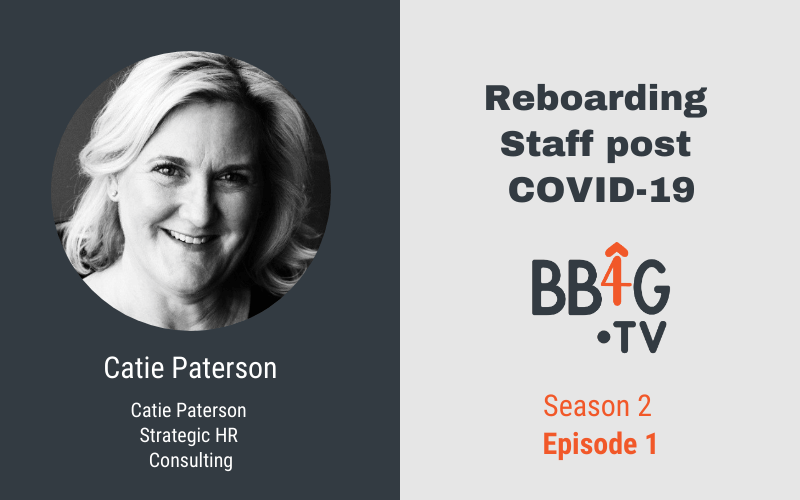
Catie joined host Brenda Thomson on The Better Business for Good Company TV show (BB4G TV) to discuss the importance steps to consider in a return to work transition plan:

Key decision areas of health & safety, type of work, financial and staff preferences.

Managing the team and the changes.

Steps to consider to ease the transition.

Do your staff know what to expect when they return to the workplace or worksite?

Catch up on Catie’s episode now on the Better Business for Good Company website or click the link below to watch this episode on YouTube.

Here is the link to the BB4G TV full episode:

https://bb4g.co/reboarding-staff-post-covid-19/

BACK TO ALL ARTICLES
Screenshot 2025-11-18 164639

+61 (0) 409 545 634

cpaterson@bluekite.au

FREE CONSULTATION

  • ABOUT
  • HR SERVICES
  • COACH WITH ME
  • HEALTH & WELLBEING
  • MEDIA/PR
  • ARTICLES/BLOG
  • RESOURCES
  • CONTACT
  • PRIVACY

Blue Kite specialises in providing
HR services to support businesses
to create better workplaces.

Filed Under: Onboarding

  • Page 1
  • Page 2
  • Go to Next Page »

Copyright © 2026 · Executive Pro on Genesis Framework · WordPress · Log in koopo

  • HOME
  • ABOUT US
  • HR SERVICES
  • COACH WITH ME
  • HEALTH & WELLBEING
  • MEDIA/PR
    • – Articles/Blogs
    • – Keynote Speaking Events
    • – Podcast Interviews
    • – Ticker Interviews
  • BLOG
  • RESOURCES
  • CONTACT