
• Skip to primary navigation
  • Skip to main content

BlueKite HR

  • HOME
  • ABOUT US
  • HR SERVICES
  • COACH WITH ME
  • HEALTH & WELLBEING
  • MEDIA/PR
    • – Articles/Blogs
    • – Keynote Speaking Events
    • – Podcast Interviews
    • – Ticker Interviews
  • BLOG
  • RESOURCES
  • CONTACT

Leadership

22 August, 2026 by Catie Paterson Leave a Comment

What Leadership Coaching Looks Like in Practice

ARTICLES

What Leadership Coaching Looks Like in Practice
22 August, 2026
Filed Under: Advisory and compliance, Career Planning, Change management, Culture, External HR Support, HR essentials, Leadership

Day 22 of 31 Days of Better Workplaces — today I’m sharing what leadership coaching actually looks like in practice, using the Intentional Coach program as a lens.

Most people associate coaching with executive programmes, large corporates, and price tags that put it out of reach for the average SME. The Intentional Coach program exists specifically to change that — delivering structured, evidence-based coaching for SME leaders and managers who want to lead better but don’t have the time or budget for generic corporate training.


What the program covers 

The Intentional Coach program is built around the real challenges SME leaders face: managing people without the safety net of an HR department, having difficult conversations, building team capability, creating accountability without micromanaging, and maintaining their own wellbeing in a high-pressure environment.
Each participant begins with a tailored questionnaire and a discovery conversation. The reason for this is straightforward: cookie-cutter leadership training rarely produces lasting change, because it doesn’t account for the specific context, team, and challenges the individual is navigating.


What makes it different

It’s delivered remotely, which means it’s accessible regardless of location. It’s tracked over time using a structured system, so both the participant and I can see what’s shifting — not just in the conversations, but in the actual results in their team and business. And it’s built on positive psychology principles, which means it starts from strengths rather than deficits.
The most consistent feedback I receive is not about the tools or frameworks — it’s about having a structured space to think through the real challenges of managing people, with someone who understands both the HR context and the pressures of running or leading a business.


Who is it for?

Business owners who have recently taken on a management role. Managers who were promoted for their technical skills but haven’t had formal people-leadership development. Leadership teams preparing for growth or change. Anyone who wants to lead with more confidence and less reactivity.
If you want to understand whether coaching is the right fit for you or a member of your team, the starting point is a conversation.

Book your free 30-minute consultation at Blue Kite HR Consulting 
 

BACK TO ALL ARTICLES
Screenshot 2025-11-18 164639

+61 (0) 409 545 634

cpaterson@bluekite.au

FREE CONSULTATION

  • ABOUT
  • HR SERVICES
  • COACH WITH ME
  • HEALTH & WELLBEING
  • MEDIA/PR
  • ARTICLES/BLOG
  • RESOURCES
  • CONTACT
  • PRIVACY

Blue Kite specialises in providing
HR services to support businesses
to create better workplaces.
Filed Under: Advisory and compliance, Career Planning, Change management, Culture, External HR Support, HR essentials, Leadership

21 August, 2026 by Catie Paterson Leave a Comment

The Most Expensive Person in Your Business Isn’t Always the Most Obvious Problem

ARTICLES

The Most Expensive Person in Your Business Isn't Always the Most Obvious Problem

21 August, 2026
Filed Under: Advisory and compliance, Change management, Culture, External HR Support, HR essentials, Leadership

Day 21 of 31 Days of Better Workplaces —

There’s a particular kind of person in some small and medium businesses that the owner is aware of, uncomfortable about, and quietly protecting. They deliver. Their numbers are good. Clients like them — or at least clients never complain about them.

And everyone else on the team walks on eggshells around them. Including, if we’re being honest, the owner.

This is the toxic high performer. And the reason they’re so costly isn’t the behaviour itself — it’s what the behaviour does to everyone else.
What most SME leaders don’t realise is how much authority this person has accumulated outside the formal structure. Other team members have learned to read the room through them. Newer employees figure out the unwritten rules by watching how this person operates and what they can get away with. Their reaction to a business decision — an eye roll in a meeting, a dismissive comment in the kitchen — can quietly undermine more leadership communication than any formal initiative can build.
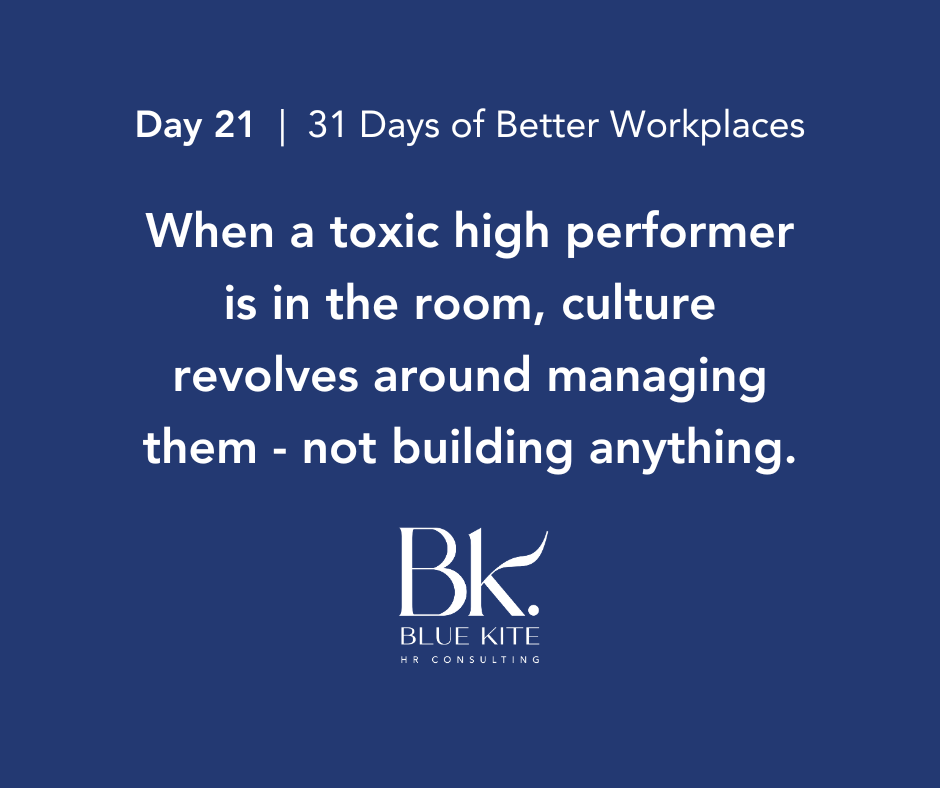
In short: they are often the real ideological centre of your workplace. The culture revolves around managing them, accommodating them, and working around the discomfort they create.
The performance case for keeping them has been made in your head many times. I understand it. But have you ever calculated the other side of the ledger? The people who left because of them. The ones who quietly reduce their output because ambition feels risky. The cost of a workplace where everyone performs compliance rather than genuine engagement.
Toxic high performers are a culture risk that shows up in the financials long before it shows up anywhere obvious.
Most businesses don’t act until there’s an incident they can’t ignore. By then, the culture has already been shaped around the problem.


Book your free 30-minute consulation at Blue Kite HR Consulting 


BACK TO ALL ARTICLES
Screenshot 2025-11-18 164639

+61 (0) 409 545 634

cpaterson@bluekite.au

FREE CONSULTATION

  • ABOUT
  • HR SERVICES
  • COACH WITH ME
  • HEALTH & WELLBEING
  • MEDIA/PR
  • ARTICLES/BLOG
  • RESOURCES
  • CONTACT
  • PRIVACY

Blue Kite specialises in providing
HR services to support businesses
to create better workplaces.
Filed Under: Advisory and compliance, Change management, Culture, External HR Support, HR essentials, Leadership

20 August, 2026 by Catie Paterson Leave a Comment

Performance Management Myths Businesses Believe (and Why They’re Costly)

ARTICLES

Performance Management Myths SMEs Believe (and Why They're Costly)

20 August, 2026
Filed Under: Advisory and compliance, Culture, External HR Support, HR essentials, Leadership

Day 20 of 31 Days of Better Workplaces — let’s address some of the performance management beliefs that are actively making things worse for businesses.


Myth 1: “If I ignore it, it’ll sort itself out.” 

It won’t. Performance issues almost never resolve on their own. They either stabilise at an unsatisfactory level, continue to deteriorate, or spread — other team members notice the lack of accountability and draw their own conclusions about what standards apply.


Myth 2: “A PIP is just a way to build a case to fire someone.” 

A Performance Improvement Plan done properly is a genuine opportunity and a last resort — not a formality before termination. If you’re only ever creating PIPs as a step in an exit process, you’re using the tool wrong and you’re exposing the business to unfair dismissal risk.


Myth 3: “Good people don’t need feedback — they already know how they’re going.”

Your best performers benefit from feedback as much as, or more than, anyone else. They want to know what good looks like at the next level, where they can develop, and that their work is being noticed. Assuming they don’t need to hear it is how you lose them.


Myth 4: “We’re too small for formal processes — we just deal with things informally.”

Informal culture does not replace process. When an informal conversation doesn’t resolve an issue, or when an employee disputes what they were told, the business that has nothing documented has no position to stand on. You can be a small business with a warm culture AND have clear, documented processes. They’re not mutually exclusive.


Myth 5: “Performance management takes too much time.”

The investment in addressing a performance issue early — a few well-structured conversations over a few weeks — is a fraction of the time, cost, and distraction involved in managing a formal process, a resignation, or an unfair dismissal claim six months down the track.
The time argument for avoiding performance management is exactly backwards.


Book a free 30-minute consultation at Blue Kite HR Consulting 


BACK TO ALL ARTICLES
Screenshot 2025-11-18 164639

+61 (0) 409 545 634

cpaterson@bluekite.au

FREE CONSULTATION

  • ABOUT
  • HR SERVICES
  • COACH WITH ME
  • HEALTH & WELLBEING
  • MEDIA/PR
  • ARTICLES/BLOG
  • RESOURCES
  • CONTACT
  • PRIVACY

Blue Kite specialises in providing
HR services to support businesses
to create better workplaces.
Filed Under: Advisory and compliance, Culture, External HR Support, HR essentials, Leadership

19 August, 2026 by Catie Paterson Leave a Comment

The Retention Conversation Has Changed. Here’s What Actually Makes Employees Stay — and Why Most Businesses Are Still Answering the Wrong Question.

ARTICLES

The Retention Conversation Has Changed. Here's What Actually Makes Employees Stay — and Why Most Businesses Are Still Answering the Wrong Question.

19 August, 2026
Filed Under: Advisory and compliance, Business Update, Culture, External HR Support, HR essentials, Leadership

Day 19 of 31 Days of Better Workplaces — retention is the topic most business owners come to me about. And most of them are focused on the wrong thing.

The assumption has been that retention is primarily about compensation. Pay people enough and they stay. Pay them less than a competitor and they leave.
That was never entirely true, and it’s less true now than it’s ever been.


What the research actually shows

McKinsey’s research on why employees leave identified the top drivers as: not feeling valued by the organisation, not feeling valued by their manager, and not having a sense of belonging. Compensation appeared lower on the list — not because it doesn’t matter, but because pay dissatisfaction is rarely the primary driver of resignation.
Gallup’s engagement research consistently finds that the quality of the manager-employee relationship is the most significant predictor of employee engagement and retention. People leave managers, not companies.


What’s shifted in the current labour market

The Covid-era “Great Resignation” and the sustained tightness in Australian labour markets have fundamentally reset employee expectations. Flexible work is no longer a perk — it’s a baseline expectation for most knowledge workers. Meaning and purpose at work matter more than previous generations reported. The expectation of transparency from leadership — about strategy, about challenges, about the future — has increased significantly.


What this means for businesses

The conversation about retention has to shift from “what do we pay” to “what is the experience of working here?”
Are your people growing? Do they know where they stand? Do they feel like their contribution matters? Is there a reason to stay beyond the salary?


What forward-thinking businesses are doing now

They’re running regular pulse surveys — not annual engagement surveys that take six months to action, but short, frequent temperature checks that enable rapid response.
They’re investing in manager capability as a retention lever — understanding that the quality of the direct manager relationship is the single most controllable variable in retention.
They’re being explicit about development pathways. Even in small businesses where there may not be a formal career ladder, people want to know they’re progressing. Creating learning opportunities, stretch assignments, and mentoring relationships is how you provide that in a small business context.
They’re offering flexibility with structure — not an unmanaged free-for-all, but a deliberate framework that gives people autonomy over when and how they work within clear boundaries.
The businesses that figure out retention now — before the next tight labour market, before their best people get a call from a competitor — are building a durable advantage.

Book a free 30-minute consultation at Blue Kite HR Consulting 


BACK TO ALL ARTICLES
Screenshot 2025-11-18 164639

+61 (0) 409 545 634

cpaterson@bluekite.au

FREE CONSULTATION

  • ABOUT
  • HR SERVICES
  • COACH WITH ME
  • HEALTH & WELLBEING
  • MEDIA/PR
  • ARTICLES/BLOG
  • RESOURCES
  • CONTACT
  • PRIVACY

Blue Kite specialises in providing
HR services to support businesses
to create better workplaces.
Filed Under: Advisory and compliance, Business Update, Culture, External HR Support, HR essentials, Leadership

18 August, 2026 by Catie Paterson Leave a Comment

Structured Onboarding: The Checklist That Sets New Hires Up to Succeed

ARTICLES

Structured Onboarding: The Checklist That Sets New Hires Up to Succeed

18 August, 2026
Filed Under: Advisory and compliance, Business Update, Culture, HR essentials, Leadership

Day 18 of 31 Days of Better Workplaces — today I’m giving you something practical: a structured onboarding checklist you can adapt for your own business.

We talked on Day 2 about the 90-day onboarding framework. Today is the operational detail — what actually needs to happen, and when.


Before Day One 

  • Employment contract signed and filed
  • Tax file number declaration, superannuation form completed
  • Payroll set up
  • IT access and equipment ready
  • First day schedule prepared and sent to the new starter
  • Team notified of the new person’s start, role, and first week plan
  • Buddy or mentor assigned


Day One

  • Personal welcome from their manager — not delegated to administration
  • Office / workspace tour and introductions
  • Access to systems confirmed and working
  • Review of the role, initial expectations, and first week priorities
  • Health and safety induction
  • Emergency procedures and workplace policies reviewed
  • Lunch with the team or manager


Week One

  • Daily check-in with direct manager
  • Introduction to key stakeholders and collaborators
  • First work assignment — meaningful, achievable, confidence-building
  • Access to any required training materials or systems

If this issue has made you think about your own business, there are practical steps you can take.


End of Week One

  • Conduct a quick debrief — how are they finding it, what questions do they have, what support do they need?


30-day Review 

  • Conduct a formal check-in conversation: how they’re settling in, early observations about the role, any gaps in support or informationPerformance check — tracking to expectations? Any development needs identified?


60-day Review

  • Performance check — tracking to expectations? Any development needs identified?


90-day Review 

  • End of probation assessment (where applicable)
  • Clear feedback on performance
  • Development plan for the next period
  • Confirmation of ongoing employment (or the conversation if it’s not working)
Save this list. Adapt it. Assign ownership for each item. An onboarding process only works if someone is accountable for it happening.


Book a free 30-minute consultation at Blue Kite HR Consulting


BACK TO ALL ARTICLES
Screenshot 2025-11-18 164639

+61 (0) 409 545 634

cpaterson@bluekite.au

FREE CONSULTATION

  • ABOUT
  • HR SERVICES
  • COACH WITH ME
  • HEALTH & WELLBEING
  • MEDIA/PR
  • ARTICLES/BLOG
  • RESOURCES
  • CONTACT
  • PRIVACY

Blue Kite specialises in providing
HR services to support businesses
to create better workplaces.

Filed Under: Advisory and compliance, Business Update, Culture, HR essentials, Leadership

17 August, 2026 by Catie Paterson Leave a Comment

Bullying and Harassment: Early Warning Signs Leaders Miss

ARTICLES

Bullying and Harassment: Early Warning Signs Leaders Miss

17 August, 2026
Filed Under: Advisory and compliance, Business Update, Culture, External HR Support, HR essentials, Leadership

Day 17 of 31 Days of Better Workplaces — bullying and harassment in the workplace aren’t always obvious. By the time a formal complaint is made, the situation has usually been building for a long time — and there were signs that, in hindsight, a leader could have acted on earlier.

Here are the warning signs that most managers miss:


Changes in team dynamics

Sudden shifts in who talks to whom. An individual who was previously engaged becoming quiet and withdrawn. Teams that previously collaborated becoming siloed or tense. These behavioural changes are often the first visible indicator that something is wrong.


Absenteeism and sick leave patterns

Frequent short-term absences — particularly on Mondays, or before and after specific events — can indicate that someone is avoiding a person or situation. A previously reliable employee who starts calling in sick regularly deserves a genuine check-in, not an assumption about work ethic.


The person who always needs to “check with” someone else

An employee who is capable of independent decision-making but consistently defers to or seeks approval from a specific colleague — sometimes excessively, sometimes anxiously — may be navigating a dynamic they haven’t felt safe to raise.


Complaints that don’t come through formal channels

Informal mentions — “so-and-so is a bit difficult to work with” or “I just try to avoid certain situations” — are often the only signal someone will give before they resign. Take them seriously and ask a second question.


High turnover in a specific team or under a specific manager

If people keep leaving one area of the business, and the business keeps attributing it to external factors, it’s worth looking at what those leavers have in common. Often the answer is a single person.


What to do when you see these signs

Don’t wait for a formal complaint. Have a quiet, private conversation. Create a safe space for someone to tell you what’s actually happening. You’re not launching an investigation — you’re doing your job as a leader, which includes paying attention.
Early intervention protects individuals, teams, and the business.


Book a free 30-minute consultattion at Blue Kite HR Consulting 


BACK TO ALL ARTICLES
Screenshot 2025-11-18 164639

+61 (0) 409 545 634

cpaterson@bluekite.au

FREE CONSULTATION

  • ABOUT
  • HR SERVICES
  • COACH WITH ME
  • HEALTH & WELLBEING
  • MEDIA/PR
  • ARTICLES/BLOG
  • RESOURCES
  • CONTACT
  • PRIVACY

Blue Kite specialises in providing
HR services to support businesses
to create better workplaces.

Filed Under: Advisory and compliance, Business Update, Culture, External HR Support, HR essentials, Leadership

  • « Go to Previous Page
  • Page 1
  • Interim pages omitted …
  • Page 9
  • Page 10
  • Page 11
  • Page 12
  • Page 13
  • Interim pages omitted …
  • Page 29
  • Go to Next Page »

Copyright © 2026 · Executive Pro on Genesis Framework · WordPress · Log in koopo

  • HOME
  • ABOUT US
  • HR SERVICES
  • COACH WITH ME
  • HEALTH & WELLBEING
  • MEDIA/PR
    • – Articles/Blogs
    • – Keynote Speaking Events
    • – Podcast Interviews
    • – Ticker Interviews
  • BLOG
  • RESOURCES
  • CONTACT