
• Skip to primary navigation
  • Skip to main content

BlueKite HR

  • HOME
  • ABOUT US
  • HR SERVICES
  • COACH WITH ME
  • HEALTH & WELLBEING
  • MEDIA/PR
    • – Articles/Blogs
    • – Keynote Speaking Events
    • – Podcast Interviews
    • – Ticker Interviews
  • BLOG
  • RESOURCES
  • CONTACT

Advisory and compliance

6 August, 2026 by Bronwyn Coulthart Leave a Comment

Difficult Conversations

ARTICLES

Difficult Conversations

6 August, 2026
Filed Under: Advisory and compliance, Change management, Culture, External HR Support, HR essentials, Leadership, Workforce

If there’s one skill that separates effective leaders from struggling ones, it’s the ability to have a difficult conversation without either avoiding it or handling it so poorly it makes things worse. 

Most people don’t avoid difficult conversations because they don’t care. They avoid them because they don’t know how to structure them, they’re worried about the reaction, or they’ve had experiences in the past where it went badly.
Here’s a framework that works.

Before the conversation

Get clear on what you’re actually trying to achieve. Is this about a specific behaviour that needs to change? A performance issue? A cultural concern? The clearer you are, the more effective the conversation will be. Gather your facts. Stick to observable behaviour, not character assessments.

Opening the Conversation

Be direct. Don’t soften it so much the message gets lost, but don’t lead with accusation either. Try: “I want to talk to you about something I’ve noticed and get your perspective.” That’s an honest opening that signals both what the conversation is about and that you’re interested in hearing their side.

During the conversation

State what you’ve observed specifically and concisely. Then stop talking and listen. Ask questions. “Can you help me understand what’s happening from your perspective?” often reveals context you didn’t have. Don’t fill every silence — give them space to respond.

The agreement 

Be clear about what needs to change and by when. Don’t leave the conversation vague. Both parties should leave with the same understanding of what was discussed and what happens next.

After the conversation

Follow up. Check in within a week. Acknowledge improvement when you see it. Document what was discussed if the issue is serious enough to warrant it.

The rule I give leaders 

If you’ve been thinking about having a conversation for more than two weeks, you’ve waited too long. The longer an issue sits, the harder the conversation becomes and the more resentment builds on both sides.

Done early, done respectfully, and done well — a difficult conversation is one of the most caring things a manager can do.

Book a free 30-minute consultation at Blue Kite HR Consulting 
BACK TO ALL ARTICLES
Screenshot 2025-11-18 164639

+61 (0) 409 545 634

cpaterson@bluekite.au

FREE CONSULTATION

  • ABOUT
  • HR SERVICES
  • COACH WITH ME
  • HEALTH & WELLBEING
  • MEDIA/PR
  • ARTICLES/BLOG
  • RESOURCES
  • CONTACT
  • PRIVACY

Blue Kite specialises in providing
HR services to support businesses
to create better workplaces.
Filed Under: Advisory and compliance, Change management, Culture, External HR Support, HR essentials, Leadership, Workforce

5 August, 2026 by Bronwyn Coulthart Leave a Comment

Good Managers Don’t Develop Themselves by Accident

ARTICLES

Good Managers Don't Develop Themselves by Accident

5 August, 2026
Filed Under: Advisory and compliance, Business Update, Change management, Culture, External HR Support, HR essentials, Leadership, Workforce, Workforce Planning

Here’s What the Research Says They Do Differently — and Why Your Business Depends on It.


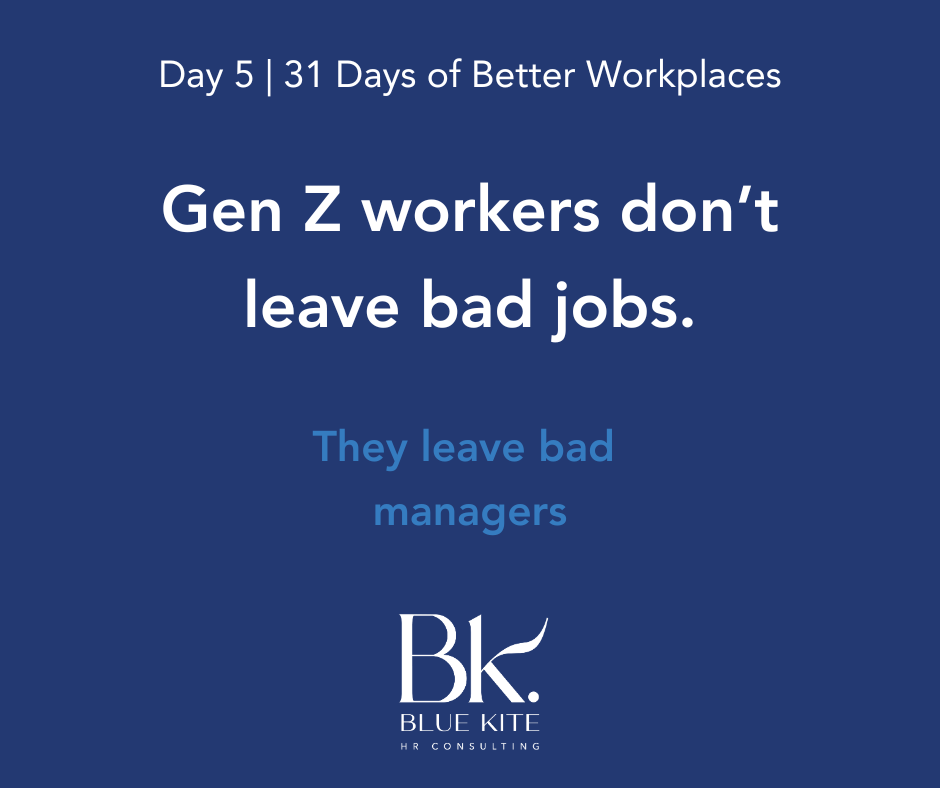
Day 5 of 31 Days of Better Workplaces — today, leadership development. And I want to get specific about what’s changing.

For years, we’ve assumed that people become good managers through experience and instinct. You put someone in a leadership role, they figure it out, and the ones with natural talent rise.

That assumption is producing management teams that are ill-equipped for the workforce they’re now leading.

What’s shifted  

The workforce entering management now spans four generations, with Gen Z now making up a significant and growing share of most SME teams. The expectations they bring are not a phase — they’re a permanent recalibration of what employees want from work and from managers.
Gen Z, in particular, want managers who explain the why, who give honest and regular feedback (not just annual reviews), who engage with them as individuals, and who model the work-life boundaries they’re being told to maintain. They have low tolerance for ambiguity, low tolerance for inconsistency, and a strong radar for inauthenticity.
This isn’t criticism — it’s a description of a workforce that grew up with access to information and expects transparency as a default.

What’s good managers are doing differently right now

They are developing coaching capability — learning how to ask questions before providing answers, how to develop capability in others rather than just directing tasks. This is not a soft skill; it drives measurable productivity improvements.
They are building emotional intelligence as a conscious practice — not as a personality trait but as a set of skills: recognising their own patterns under pressure, staying regulated in difficult conversations, understanding what’s driving behaviour in others.
They are creating individual connection — knowing what motivates each person on their team, what their development goals are, what’s happening in their life that affects their work. Not as an intrusion, but as genuine interest.

What smart SMEs are doing now

They’re investing in leadership development before they need it — not after a leadership failure forces the issue. The businesses getting ahead are building management capability systematically, not waiting for it to emerge.
My own leadership program works precisely because it treats leadership as a learnable, practiceable discipline — not a personality trait you either have or you don’t.
The question isn’t whether your managers need development. It’s whether you’re going to address that now, while there’s time, or react to it after your best people leave.

Book a 30-minute free consultation at Blue Kite HR Consulting 

BACK TO ALL ARTICLES
Screenshot 2025-11-18 164639

+61 (0) 409 545 634

cpaterson@bluekite.au

FREE CONSULTATION

  • ABOUT
  • HR SERVICES
  • COACH WITH ME
  • HEALTH & WELLBEING
  • MEDIA/PR
  • ARTICLES/BLOG
  • RESOURCES
  • CONTACT
  • PRIVACY

Blue Kite specialises in providing
HR services to support businesses
to create better workplaces.
Filed Under: Advisory and compliance, Business Update, Change management, Culture, External HR Support, HR essentials, Leadership, Workforce, Workforce Planning

2 August, 2026 by Catie Paterson Leave a Comment

The Real Cost of Skipping Onboarding

ARTICLES

The Real Cost of Skipping Onboarding

2 August, 2026
Filed Under: Advisory and compliance, Business Update, Culture, External HR Support, HR essentials, Leadership

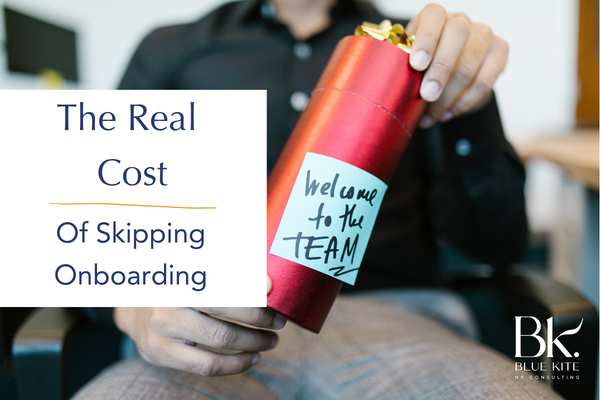
You spent time and money finding the right person. Don’t lose them in the first 90 days because onboarding was an afterthought.

Research consistently shows that employees who go through a structured onboarding process are significantly more likely to still be with you at the 12-month mark. For small businesses, losing a new hire within that first year isn’t just frustrating — it’s costly. Recruitment fees, training time, and lost productivity add up quickly.


What poor onboarding looks like

  • The new employee’s first day involves waiting around for a laptop and a stack of paperwork
  • No one is clear on what “good” looks like in their first 30, 60, or 90 days
  • The manager is too busy to check in regularly
  • Cultural expectations and team norms are never explicitly explained.


What structured onboarding looks like instead

  • A clear pre-start checklist so they arrive to a ready workspace
  • A 30-60-90 day plan with specific expectations for each phase
  • Regular check-ins built into the calendar from day one
  • An introduction to team culture, values, and how decisions get made.

You don’t need an HR department to do this well. A simple, customised onboarding framework — tailored to your business — can turn a chaotic first week into a confident start, and a confident start into a long-term employee.


The investment is small. The return in retention is significant.


Book a free 30-minute consultation at Blue Kite HR Consulting.


BACK TO ALL ARTICLES
Screenshot 2025-11-18 164639

+61 (0) 409 545 634

cpaterson@bluekite.au

FREE CONSULTATION

  • ABOUT
  • HR SERVICES
  • COACH WITH ME
  • HEALTH & WELLBEING
  • MEDIA/PR
  • ARTICLES/BLOG
  • RESOURCES
  • CONTACT
  • PRIVACY

Blue Kite specialises in providing
HR services to support businesses
to create better workplaces.
Filed Under: Advisory and compliance, Business Update, Culture, External HR Support, HR essentials, Leadership

1 August, 2026 by Catie Paterson Leave a Comment

Is Your Employment Contract Actually Protecting You?

ARTICLES

Is Your Employment Contract Actually Protecting You?

1 August, 2026
Filed Under: Advisory and compliance, Business Update, Culture, External HR Support, HR essentials

Most small business owners don’t realise their employment contracts are out of date until something goes wrong — and by then, it’s expensive.

Employment law in Australia moves fast. Changes to the Fair Work Act, updated award conditions, and new rights around flexible work mean that a contract written three years ago may no longer reflect your actual legal obligations. The gap between what your contract says and what the law requires is exactly where disputes start.

Here’s what to check right now 

  • Does your contract reference the correct Modern Award (and the current version)?
  • Have you included the right provisions around casual conversion and flexible work requests?
  • Is your termination clause consistent with the National Employment Standards?
  • Are your policies referenced in the contract actually up to date?

If you’re not sure, that’s a red flag in itself. Contracts that are vague, outdated, or silent on key issues don’t protect your business — they create ambiguity that employees and their representatives can exploit.

The fix is simpler that what you think

An employment contract review doesn’t have to take weeks. A focused HR audit can identify gaps across your agreements, policies, and onboarding documents in a single session, and a template update can be customised to your business within days.

Don’t wait for a termination dispute or an unfair dismissal claim to find out your paperwork wasn’t up to scratch. Get ahead of it now.

Book a free 30-minute cosultation at Blue Kite HR Consulting 


BACK TO ALL ARTICLES
Screenshot 2025-11-18 164639

+61 (0) 409 545 634

cpaterson@bluekite.au

FREE CONSULTATION

  • ABOUT
  • HR SERVICES
  • COACH WITH ME
  • HEALTH & WELLBEING
  • MEDIA/PR
  • ARTICLES/BLOG
  • RESOURCES
  • CONTACT
  • PRIVACY

Blue Kite specialises in providing
HR services to support businesses
to create better workplaces.
Filed Under: Advisory and compliance, Business Update, Culture, External HR Support, HR essentials

31 July, 2026 by Catie Paterson Leave a Comment

When Loyalty Becomes a Liability

ARTICLES

When Loyalty Becomes a Liability

31 July, 2026
Filed Under: Advisory and compliance, Business Update, Career Planning, Change management, Culture, External HR Support, HR essentials, Leadership

Loyalty is a virtue most organisations actively cultivate. Long service is rewarded. Commitment is celebrated. The person who has been there through multiple cycles of growth and difficulty is valued for the institutional knowledge and continuity they represent.

These things are genuinely important. And they exist alongside a risk that is less often named.

Loyalty, when it becomes the primary frame through which a business values its people, can make things difficult:

  • The long-tenured employee who has outgrown the role but whose loyalty is too valued to challenge.
  • The founding team member whose contribution was critical in the early years, but whose capabilities have not scaled with the bsuiness needs.
  • The leader whose ways of working made sense in a different context, and who has become a constraint on the thinking of the people around them.

Businesses sometimes become loyal back to their most loyal people, in ways that protect the relationship at the cost of the business’ capacity to evolve. Difficult conversations do not happen because the history is too important. Performance standards are applied differently because the tenure earns an unofficial exemption. The message sent to everyone else is, again, that different rules apply to different people.

Respecting loyalty and enabling a business to evolve are not mutually exclusive. Navigating the tension requires honesty; about what the business needs now, about what has genuinely been contributed, about what it means to value a person, and still hold them to the same expectations as everyone else.

That conversation is hard. It is also, for many businesses overdue.


If you want practical support reviewing your workplace policies, contracts, leadership capability, or workplace culture, Blue Kite HR Consulting can help you take a proactive approach before issues become bigger problems.


BACK TO ALL ARTICLES
Screenshot 2025-11-18 164639

+61 (0) 409 545 634

cpaterson@bluekite.au

FREE CONSULTATION

  • ABOUT
  • HR SERVICES
  • COACH WITH ME
  • HEALTH & WELLBEING
  • MEDIA/PR
  • ARTICLES/BLOG
  • RESOURCES
  • CONTACT
  • PRIVACY

Blue Kite specialises in providing
HR services to support businesses
to create better workplaces.

Filed Under: Advisory and compliance, Business Update, Career Planning, Change management, Culture, External HR Support, HR essentials, Leadership

29 July, 2026 by Catie Paterson Leave a Comment

What Job Titles Are Actually Signalling

ARTICLES

What Job Titles Are Actually Signalling

29 July, 2026
Filed Under: Advisory and compliance, Business Update, Change management, Culture, External HR Support, HR essentials, Leadership

Titles signal status. In hierarchical businesses, the gap between titles at different levels communicates something about who is valued, whose judgment counts and whose contribution is considered strategic versus operational. When the most junior people in a business carry the most generic titles — “coordinator,” “associate,” “assistant” — regardless of the complexity or impact of their work, the signal is not subtle.

Titles also shape identity and self-perception. Research on role identity suggests that what people are called influences how they think about the scope of their contribution. A person whose title reflects the strategic dimension of their work thinks about their role differently from someone whose title describes only the functional one.

And titles shape external perception in ways that affect an businesses ability to attract and retain people. Candidates compare titles across businesses as a proxy for seniority and progression opportunity. A title that is generic relative to market equivalents can make a role look less advanced than it is, and can affect both who applies and whether a strong candidate accepts.

None of this suggests that title inflation,  escalating everyone’s title regardless of responsibility, is the answer. It suggests that businesses should be deliberate about what their titling conventions are communicating, and whether that communication is serving their business, people and their culture.


If you want practical support reviewing your workplace policies, contracts, leadership capability, or workplace culture, Blue Kite HR Consulting can help you take a proactive approach before issues become bigger problems.


BACK TO ALL ARTICLES
Screenshot 2025-11-18 164639

+61 (0) 409 545 634

cpaterson@bluekite.au

FREE CONSULTATION

  • ABOUT
  • HR SERVICES
  • COACH WITH ME
  • HEALTH & WELLBEING
  • MEDIA/PR
  • ARTICLES/BLOG
  • RESOURCES
  • CONTACT
  • PRIVACY

Blue Kite specialises in providing
HR services to support businesses
to create better workplaces.

Filed Under: Advisory and compliance, Business Update, Change management, Culture, External HR Support, HR essentials, Leadership

  • « Go to Previous Page
  • Page 1
  • Interim pages omitted …
  • Page 8
  • Page 9
  • Page 10
  • Page 11
  • Page 12
  • Interim pages omitted …
  • Page 21
  • Go to Next Page »

Copyright © 2026 · Executive Pro on Genesis Framework · WordPress · Log in koopo

  • HOME
  • ABOUT US
  • HR SERVICES
  • COACH WITH ME
  • HEALTH & WELLBEING
  • MEDIA/PR
    • – Articles/Blogs
    • – Keynote Speaking Events
    • – Podcast Interviews
    • – Ticker Interviews
  • BLOG
  • RESOURCES
  • CONTACT