
• Skip to primary navigation
  • Skip to main content

BlueKite HR

  • HOME
  • ABOUT US
  • HR SERVICES
  • COACH WITH ME
  • HEALTH & WELLBEING
  • MEDIA/PR
    • – Articles/Blogs
    • – Keynote Speaking Events
    • – Podcast Interviews
    • – Ticker Interviews
  • BLOG
  • RESOURCES
  • CONTACT

Advisory and compliance

17 August, 2026 by Catie Paterson Leave a Comment

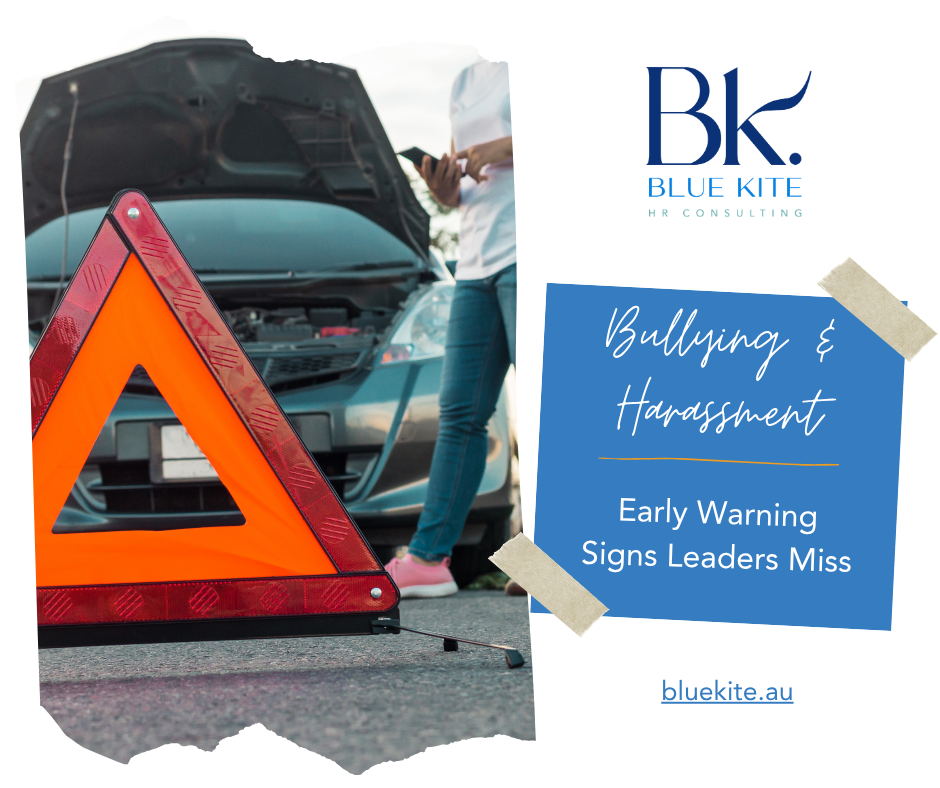
Bullying and Harassment: Early Warning Signs Leaders Miss

ARTICLES

Bullying and Harassment: Early Warning Signs Leaders Miss
17 August, 2026
Filed Under: Advisory and compliance, Business Update, Culture, External HR Support, HR essentials, Leadership

Day 17 of 31 Days of Better Workplaces — bullying and harassment in the workplace aren’t always obvious. By the time a formal complaint is made, the situation has usually been building for a long time — and there were signs that, in hindsight, a leader could have acted on earlier.

Here are the warning signs that most managers miss:


Changes in team dynamics

Sudden shifts in who talks to whom. An individual who was previously engaged becoming quiet and withdrawn. Teams that previously collaborated becoming siloed or tense. These behavioural changes are often the first visible indicator that something is wrong.


Absenteeism and sick leave patterns

Frequent short-term absences — particularly on Mondays, or before and after specific events — can indicate that someone is avoiding a person or situation. A previously reliable employee who starts calling in sick regularly deserves a genuine check-in, not an assumption about work ethic.


The person who always needs to “check with” someone else

An employee who is capable of independent decision-making but consistently defers to or seeks approval from a specific colleague — sometimes excessively, sometimes anxiously — may be navigating a dynamic they haven’t felt safe to raise.


Complaints that don’t come through formal channels

Informal mentions — “so-and-so is a bit difficult to work with” or “I just try to avoid certain situations” — are often the only signal someone will give before they resign. Take them seriously and ask a second question.


High turnover in a specific team or under a specific manager

If people keep leaving one area of the business, and the business keeps attributing it to external factors, it’s worth looking at what those leavers have in common. Often the answer is a single person.


What to do when you see these signs

Don’t wait for a formal complaint. Have a quiet, private conversation. Create a safe space for someone to tell you what’s actually happening. You’re not launching an investigation — you’re doing your job as a leader, which includes paying attention.
Early intervention protects individuals, teams, and the business.


Book a free 30-minute consultattion at Blue Kite HR Consulting 
 

BACK TO ALL ARTICLES
Screenshot 2025-11-18 164639

+61 (0) 409 545 634

cpaterson@bluekite.au

FREE CONSULTATION

  • ABOUT
  • HR SERVICES
  • COACH WITH ME
  • HEALTH & WELLBEING
  • MEDIA/PR
  • ARTICLES/BLOG
  • RESOURCES
  • CONTACT
  • PRIVACY

Blue Kite specialises in providing
HR services to support businesses
to create better workplaces.
Filed Under: Advisory and compliance, Business Update, Culture, External HR Support, HR essentials, Leadership

16 August, 2026 by Catie Paterson Leave a Comment

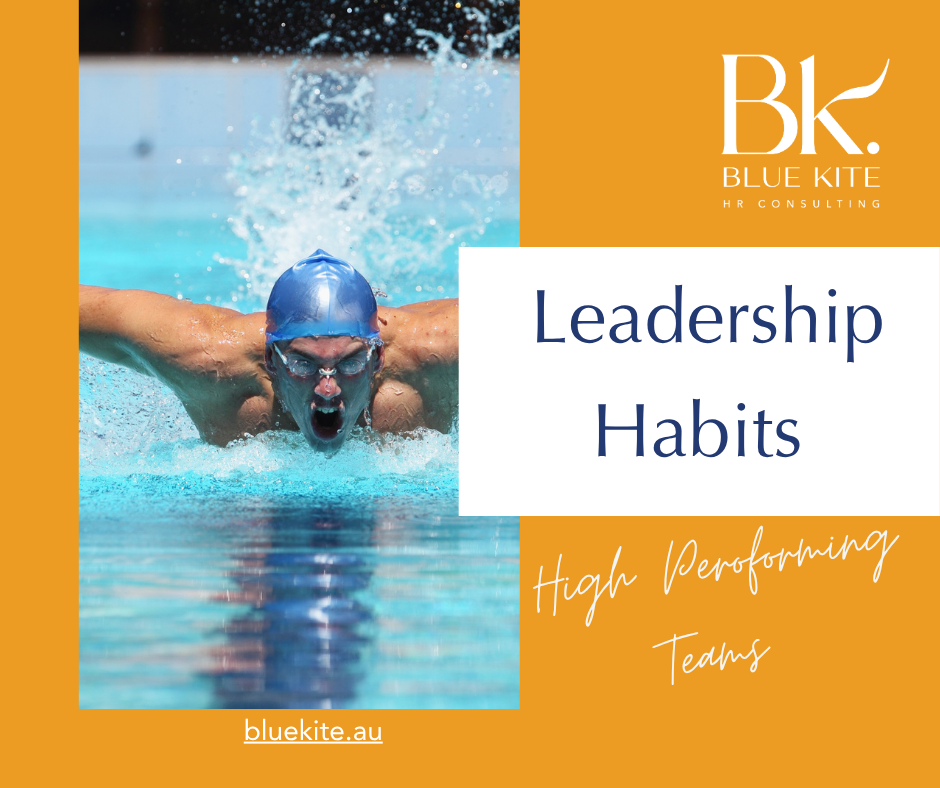
5 Leadership Habits That Build High-Performing Teams

ARTICLES

5 Leadership Habits That Build High-Performing Teams

16 August, 2026
Filed Under: Advisory and compliance, Business Update, Culture, HR essentials, Leadership, Succession Management, Workforce, Workforce Planning

Day 16 of 31 Days of Better Workplaces — high performance doesn’t happen by accident. It’s the result of consistent behaviours that leaders either build deliberately or don’t.

After more than twenty years working with leaders across industries, these are the five habits I see most consistently in the leaders who build genuinely high-performing teams.


Habit 1: They communicate context, not just tasks

High-performing team members want to understand why — why this work matters, how it connects to the bigger picture, what success looks like. The manager who only assigns tasks produces a team that executes instructions. The manager who shares context produces a team that thinks.


Habit 2: They give feedback continuously, not annually

Waiting for a formal review process to tell someone they’re doing well — or not — is a missed opportunity. Brief, specific, real-time feedback — “that was a great way to handle that client” or “I noticed this in your report, here’s what I’d suggest” — compounds over time into a team that knows where they stand and how to improve.


Habit 3: They invest in individual development

High-performing leaders know what each person on their team is working toward — professionally and personally. They look for opportunities to stretch people, give them new experiences, and connect their day-to-day work to their longer-term goals. People perform better when they can see they’re growing.


Habit 4: They protect the team’s capacity

Good leaders push back on unrealistic workloads, prioritise ruthlessly, and don’t allow their team to be pulled in twenty directions at once. They understand that sustained high performance requires sustainable conditions — and they advocate for those conditions.


Habit 5: They model the culture they wantgreement clauses that help manage workplace risk

Whatever you want your team to do, you have to do first. If you want them to be honest, be honest. If you want them to take ownership, take ownership. If you want them to prioritise wellbeing, model it. Culture is not what you mandate — it’s what you demonstrate.
The good news: these are all learnable habits. None of them require a special talent. They require intention and consistency.


Book a free 30-minute consultation at  Blue Kite HR Consulting 


BACK TO ALL ARTICLES
Screenshot 2025-11-18 164639

+61 (0) 409 545 634

cpaterson@bluekite.au

FREE CONSULTATION

  • ABOUT
  • HR SERVICES
  • COACH WITH ME
  • HEALTH & WELLBEING
  • MEDIA/PR
  • ARTICLES/BLOG
  • RESOURCES
  • CONTACT
  • PRIVACY

Blue Kite specialises in providing
HR services to support businesses
to create better workplaces.
Filed Under: Advisory and compliance, Business Update, Culture, HR essentials, Leadership, Succession Management, Workforce, Workforce Planning

15 August, 2026 by Catie Paterson Leave a Comment

Modern Awards: Are You Paying Your Team Correctly?

ARTICLES

Modern Awards: Are You Paying Your Team Correctly?

15 August, 2026
Filed Under: Advisory and compliance, Business Update, External HR Support, HR essentials, Leadership

Day 15 of 31 Days of Better Workplaces — Award compliance might be the most common and most costly gap I see when I work with businesses for the first time.

Most business owners believe they’re paying people correctly. Many of them aren’t — not because they’ve set out to underpay anyone, but because Modern Awards are complex, they’re updated regularly, and the penalties for getting it wrong accumulate over time.


What is a Modern Award?

A Modern Award is an industry or occupation-specific instrument that sets minimum employment conditions — pay rates, penalty rates, allowances, hours of work, and leave entitlements — for most Australian employees. There are more than 120 Modern Awards.

Getting the right one, and applying it correctly, matters.


Common Compliance Gaps 

Incorrect classification within the Award. Most Awards have multiple levels or classifications, with different pay rates. Employees are often misclassified, either because the classification hasn’t been reviewed when their role changed, or because it was never set correctly in the first place.
Missing penalty rates. Weekend rates, public holiday rates, overtime rates, and shift penalties are Award entitlements that cannot be offset or traded away without a proper Enterprise Agreement. If you’re paying flat rates without factoring these in, you’re likely underpaying.
Not applying Annual Wage Review increases. The Fair Work Commission reviews minimum wages annually. If you’re not updating pay rates to reflect these increases, you fall out of compliance automatically.
Overlooking allowances. Many Awards include allowances for things like vehicle use, equipment, uniforms, meals, and split shifts. These are entitlements, not discretionary benefits.


What to do

Pull up the relevant Award for your business. Check the classifications. Cross-reference your current pay rates against the Award minimum. If you’re unsure which Award applies, or you’re in an industry with multiple possible Awards, get it checked by someone who knows.
Wage theft — even unintentional — is a serious issue in Australia. Businesses have been required to repay significant back-pay amounts. Get ahead of it before someone else finds it first.

Book your free 30-minute consultation at Blue Kite HR Consulting


BACK TO ALL ARTICLES
Screenshot 2025-11-18 164639

+61 (0) 409 545 634

cpaterson@bluekite.au

FREE CONSULTATION

  • ABOUT
  • HR SERVICES
  • COACH WITH ME
  • HEALTH & WELLBEING
  • MEDIA/PR
  • ARTICLES/BLOG
  • RESOURCES
  • CONTACT
  • PRIVACY

Blue Kite specialises in providing
HR services to support businesses
to create better workplaces.
Filed Under: Advisory and compliance, Business Update, External HR Support, HR essentials, Leadership

14 August, 2026 by Bronwyn Coulthart Leave a Comment

Wellbeing at Work Is No Longer Optional

ARTICLES

Wellbeing at Work Is No Longer Optional.

14 August, 2026
Filed Under: Advisory and compliance, Culture, External HR Support, HR essentials, Leadership, Workforce

Here’s Where the Conversation Is Heading — and What It Means for Your Business.

Day 14 of 31 Days of Better Workplaces — workplace wellbeing. I want to go beyond the programmes and frameworks and tell you what I’m seeing at the leading edge of where this is all heading.

The fruit bowls and mindfulness apps are not the story. They never were. They were the beginning of a conversation — and that conversation has moved significantly.

Where we’ve arrived

Burnout has been recognised by the World Health Organisation as an occupational phenomenon — not a personal failing, a character weakness, or a lifestyle problem. It is a chronic workplace stress response that hasn’t been successfully managed. The burden of responsibility sits with the employer, not the employee.
In Australia, this is increasingly reflected in WorkCover claims, Fair Work applications, and the legal obligation to manage psychosocial hazards I covered on Day 11. The financial exposure from unmanaged burnout — in workers compensation premiums, lost productivity, turnover, and potential litigation — is substantial.

What the data is showing 

Microsoft’s Work Trend Index and Gallup’s State of the Global Workplace consistently show that a large proportion of workers — in some surveys, more than half — report feeling burnt out. For SMEs, this isn’t abstract. It shows up in sick leave patterns, in the quality of work declining before someone resigns, in “quiet quitting” — the disengaged employee who is technically present but has long since checked out.

What forward-thinking businesses are doing

They’ve stopped treating wellbeing as a programme you bolt on and started treating it as a condition you create.
They’re designing work differently — looking at workloads, autonomy, role clarity, and flexibility as levers for psychological health, not just satisfaction.
They’re training managers to recognise the early signs of burnout: disengagement, irritability, reduced output, increased presenteeism. The manager who catches it early can intervene. The manager who misses it or dismisses it loses the person.
They’re integrating positive psychology principles — strengths use, meaning, progress, connection — into how work is designed and how people are managed. The evidence on strengths-based approaches to work design is compelling: people who use their strengths at work are more engaged, more productive, and significantly less likely to leave.


My honest view 

The SMEs that treat wellbeing as a strategic priority — not a feel-good initiative but a deliberate investment in the conditions that allow people to do their best work — are building a competitive advantage in the talent market that’s going to compound over time.
The ones that keep treating it as optional are carrying a liability they’re not yet pricing.

Book your free 30-minute consultation at Blue Kite HR Consulting 

BACK TO ALL ARTICLES
Screenshot 2025-11-18 164639

+61 (0) 409 545 634

cpaterson@bluekite.au

FREE CONSULTATION

  • ABOUT
  • HR SERVICES
  • COACH WITH ME
  • HEALTH & WELLBEING
  • MEDIA/PR
  • ARTICLES/BLOG
  • RESOURCES
  • CONTACT
  • PRIVACY

Blue Kite specialises in providing
HR services to support businesses
to create better workplaces.
Filed Under: Advisory and compliance, Culture, External HR Support, HR essentials, Leadership, Workforce

13 August, 2026 by Bronwyn Coulthart Leave a Comment

Coaching vs. Managing: Knowing When to Use Each Approach

ARTICLES

Coaching vs. Managing: Knowing When to Use Each Approach

13 August, 2026
Filed Under: Advisory and compliance, Business Update, Change management, Culture, HR essentials, Leadership, Workforce

Day 13 of 31 Days of Better Workplaces — one of the most powerful shifts a manager can make is learning when to stop managing and start coaching.

Both approaches have their place. The challenge is that most managers default to managing — directing, instructing, problem-solving — even in situations where a coaching approach would be more effective and produce better long-term outcomes.

What’s the difference?

Managing is telling. Coaching is asking. Managing solves the immediate problem. Coaching builds the capability to solve it next time without you.

When to manage

A new employee who genuinely doesn’t yet have the knowledge or skill to operate independently needs clear direction and instruction. In a genuine crisis or time-sensitive situation where there’s no room for exploration. When safety is at stake.

When to coach

A capable team member who keeps coming to you for decisions they could be making themselves. Someone who’s stuck on a problem they have the skill to solve if they think it through. Any situation where you want to build someone’s confidence and capability rather than just solve today’s problem.

What coaching actually looks like in practice

Instead of answering the question, ask one. “What have you tried so far?” “What do you think the options are?” “What would you do if I wasn’t available?” These questions are not deflection — they’re development. You’re building the thinking process, not just solving the task.

The manager who can coach well will consistently outperform the one who can only direct. Their team will take more initiative, solve more problems independently, and stay longer — because they’re growing.

Book your free 30-minute consultation at Blue Kite HR Consulting

BACK TO ALL ARTICLES
Screenshot 2025-11-18 164639

+61 (0) 409 545 634

cpaterson@bluekite.au

FREE CONSULTATION

  • ABOUT
  • HR SERVICES
  • COACH WITH ME
  • HEALTH & WELLBEING
  • MEDIA/PR
  • ARTICLES/BLOG
  • RESOURCES
  • CONTACT
  • PRIVACY

Blue Kite specialises in providing
HR services to support businesses
to create better workplaces.

Filed Under: Advisory and compliance, Business Update, Change management, Culture, HR essentials, Leadership, Workforce

12 August, 2026 by Bronwyn Coulthart Leave a Comment

Succession Planning: Why Businesses Leave It Too Late

ARTICLES

Succession Planning: Why Businesses Leave It Too Late

12 August, 2026
Filed Under: Advisory and compliance, Business Update, Career Planning, Change management, Culture, External HR Support, HR essentials, Leadership, Succession Management, Workforce, Workforce Planning

Day 12 of 31 Days of Better Workplaces — succession planning is something most business owners know they should be doing. Most of them aren’t.

The conversation usually goes one of two ways. Either the business owner thinks succession planning is only for large corporations, or they plan to “deal with it when the time comes.” Both positions create significant risk.


What succession planning actually is for a business

It’s not a corporate exercise involving lengthy documentation and committee reviews. For a business, succession planning is about understanding which roles are critical to the business continuing to function, identifying the risks if those roles suddenly became vacant, and having a plan, even a simple one, for what happens if they do.


The most common risk most businesses carry

Key person dependency. One person,  often the owner, or a long-tenured operations manager, or the one person who “knows how everything works”, holds knowledge, relationships, and capability that exists nowhere else in the business. When they leave — and eventually they will — the disruption can be significant.


Three things to do this week 

First

Identify your critical roles. Not just seniority, actual criticality. Which positions, if they became vacant tomorrow with no notice, would cause the most operational damage?

Second

Assess your bench. For each critical role, is there anyone in the business who could step into it, even partially? What would it take to get them ready? That gap analysis is the starting point for your succession plan.

Third

Capture critical knowledge. Start a simple process of documentation, key contacts, processes, passwords, client relationships for your highest-risk roles. This alone reduces the impact of an unexpected departure significantly.


The thing no one says out loud

Succession planning also applies to the owner. If something happened to you tomorrow, what would happen to your business? Your team? Your clients? A succession plan is also a contingency plan, and it’s one of the most responsible things you can build.

Book a free 30-minute consultation at Blue Kite HR Consulting 

BACK TO ALL ARTICLES
Screenshot 2025-11-18 164639

+61 (0) 409 545 634

cpaterson@bluekite.au

FREE CONSULTATION

  • ABOUT
  • HR SERVICES
  • COACH WITH ME
  • HEALTH & WELLBEING
  • MEDIA/PR
  • ARTICLES/BLOG
  • RESOURCES
  • CONTACT
  • PRIVACY

Blue Kite specialises in providing
HR services to support businesses
to create better workplaces.

Filed Under: Advisory and compliance, Business Update, Career Planning, Change management, Culture, External HR Support, HR essentials, Leadership, Succession Management, Workforce, Workforce Planning

  • « Go to Previous Page
  • Page 1
  • Interim pages omitted …
  • Page 6
  • Page 7
  • Page 8
  • Page 9
  • Page 10
  • Interim pages omitted …
  • Page 21
  • Go to Next Page »

Copyright © 2026 · Executive Pro on Genesis Framework · WordPress · Log in koopo

  • HOME
  • ABOUT US
  • HR SERVICES
  • COACH WITH ME
  • HEALTH & WELLBEING
  • MEDIA/PR
    • – Articles/Blogs
    • – Keynote Speaking Events
    • – Podcast Interviews
    • – Ticker Interviews
  • BLOG
  • RESOURCES
  • CONTACT