
• Skip to primary navigation
  • Skip to main content

BlueKite HR

  • HOME
  • ABOUT US
  • HR SERVICES
  • COACH WITH ME
  • HEALTH & WELLBEING
  • MEDIA/PR
    • – Articles/Blogs
    • – Keynote Speaking Events
    • – Podcast Interviews
    • – Ticker Interviews
  • BLOG
  • RESOURCES
  • CONTACT

Advisory and compliance

20 September, 2026 by Catie Paterson Leave a Comment

Building Team Cohesion in a Hybrid Workplace

ARTICLES

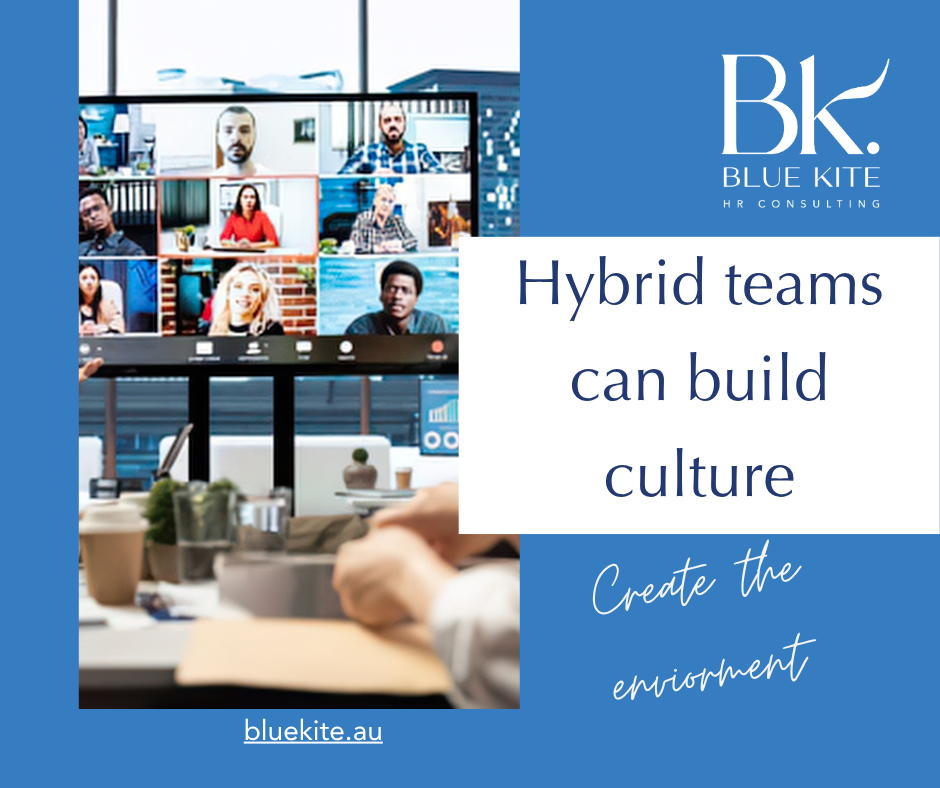
Building Team Cohesion in a Hybrid Workplace
20 September, 2026
Filed Under: Advisory and compliance, Business Update, Career Planning, Culture, External HR Support, HR essentials, Leadership

A marketing agency ran a two-speed team for eight months without realising it. Their in-office employees got the informal context, the side conversations, the spontaneous ideas, the relationship with the director. Their remote employees got the formal meetings and the documented outcomes.


Both sides were working hard. But the remote team was slowly becoming a vendor relationship — high quality outputs delivered at arm’s length — rather than an integrated team. Nobody had intended it. But the design of the workday had produced it anyway.

Team cohesion in a hybrid workplace doesn’t happen by default. In a fully co-located team, connection builds through physical proximity and the cumulative effect of shared space and incidental interaction. Remove that and you’re left with whatever you’ve deliberately engineered to replace it.

Most businesses haven’t engineered much. They’ve kept the same meeting structure, the same communication channels, and the same management practices — and then added some people who work from home. The result is a team that technically functions but lacks the cohesion that makes people genuinely effective together.


The Two-Tier Problem

The most persistent and damaging cohesion challenge in hybrid teams is what researchers call proximity bias — the systematic advantage experienced by those who are physically present. In-office employees are more visible to leadership, more included in informal decision-making, more likely to receive development opportunities, and more likely to be considered for advancement.

This happens even when leaders explicitly don’t intend it. Proximity to decision-makers creates advantage simply because it provides access. When those advantages compound over time, you end up with a workforce that is technically hybrid but culturally divided.

The practical solution requires active counterbalancing: ensuring remote employees have equivalent access to key conversations, decisions, and development opportunities — not through surveillance or compensatory check-ins, but through genuinely inclusive practices.


What High-Cohesion Teams Do Differently

They design for equity of experience, not equality of presence. The question isn’t “can the remote person dial in?” but “is the remote person genuinely part of the conversation?” That requires meeting design, facilitation, and norms that actively include distributed participants rather than simply tolerating them.

They protect the quality of connection. Cohesion is built through depth of relationship, not frequency of interaction. Shorter, more intentional one-on-ones, team rituals that create genuine moments of connection, and shared projects where mixed in-office and remote groups work closely together all contribute more than daily video calls with cameras off.

They use in-person time strategically. Hybrid businesses that bring teams together periodically for collaboration, planning, and genuine social time consistently report better cohesion than those who let in-person days be determined by individual preference. What you do with the in-person time matters more than how much of it there is.

And they make the norms explicit. How do we communicate? What’s expected of managers in terms of visibility across in-office and remote team members? What decisions happen in-person and which ones wait until everyone can participate? Unwritten rules always advantage those who already know them.


Ready to build a better workplace? Book your free 30-minute consultation at Blue Kite HR Consulting
 

BACK TO ALL ARTICLES
Screenshot 2025-11-18 164639

+61 (0) 409 545 634

cpaterson@bluekite.au

FREE CONSULTATION

  • ABOUT
  • HR SERVICES
  • COACH WITH ME
  • HEALTH & WELLBEING
  • MEDIA/PR
  • ARTICLES/BLOG
  • RESOURCES
  • CONTACT
  • PRIVACY

Blue Kite specialises in providing
HR services to support businesses
to create better workplaces.
Filed Under: Advisory and compliance, Business Update, Career Planning, Culture, External HR Support, HR essentials, Leadership

19 September, 2026 by Catie Paterson Leave a Comment

The Return-to-Office Debate: How to Make a Decision Your Team Will Accept

ARTICLES

The Return-to-Office Debate: How to Make a Decision Your Team Will Accept

19 September, 2026
Filed Under: Advisory and compliance, Business Update, Change management, Culture, External HR Support, HR essentials, Leadership

In 2023 and 2024, the return-to-office mandates from some of Australia’s largest employers made headlines. What rarely made headlines was the follow-up data: elevated turnover at many of those organisations, particularly among high performers who had more options than those who stayed. The mandate was enforced. The resentment was real.

For small and medium businesses navigating the same question — how many days in the office, if any — the stakes are different but the underlying dynamics are similar. Get this wrong and you don’t just manage compliance. You manage morale, trust, and your ability to retain the people you most want to keep.

There’s no universally correct answer to how much in-person work a business should require. But there are better and worse ways to make the decision, and they make a significant difference to how it lands.


Why the ‘How’ Matters as Much as the “What”

Employees don’t respond only to the content of decisions. They respond to the process by which decisions are made. Research on procedural justice — the perceived fairness of decision-making processes — consistently shows that people are more likely to accept outcomes they disagree with when they believe the process was fair and their input was considered.

An in-office requirement communicated suddenly, without clear rationale, and without any consultation is experienced as an exercise of control. The same requirement, arrived at through genuine dialogue about business needs and individual circumstances, with clear reasons and some flexibility built in, lands very differently — even if the outcome is identical.


What a Good Decision Process Looks Like

Start by being clear about what problem you’re trying to solve. Is in-person presence genuinely necessary for the work — for collaboration, client interaction, mentoring, or team cohesion? Or is the driver something less specific, like a preference for visibility, a concern about productivity that isn’t supported by data, or pressure from clients who expect to see staff in the office?

The answers shape what a proportionate response looks like. If collaboration is the genuine need, a structured approach to in-person days for collaboration purposes makes sense. A blanket five-day requirement for roles that don’t require it doesn’t.

Involve your team in designing the approach. This doesn’t mean a vote — you’re allowed to have a business position. But consultation means genuinely asking what’s working, what isn’t, and what would make in-person requirements feel reasonable and purposeful. People are far more likely to accept constraints they’ve had input into.

Be clear about the rationale and honest about what’s flexible and what isn’t. Ambiguity about whether the policy is firm creates constant low-level friction. Clarity, even when people disagree with it, lets people make decisions about whether this arrangement works for them.

And — critically — apply it consistently. Nothing erodes trust faster than a return-to-office requirement that applies to some roles and not others without clear reasoning.


Ready to build a better workplace? Book your free 30-minute consultation at Blue Kite HR Consulting 


BACK TO ALL ARTICLES
Screenshot 2025-11-18 164639

+61 (0) 409 545 634

cpaterson@bluekite.au

FREE CONSULTATION

  • ABOUT
  • HR SERVICES
  • COACH WITH ME
  • HEALTH & WELLBEING
  • MEDIA/PR
  • ARTICLES/BLOG
  • RESOURCES
  • CONTACT
  • PRIVACY

Blue Kite specialises in providing
HR services to support businesses
to create better workplaces.
Filed Under: Advisory and compliance, Business Update, Change management, Culture, External HR Support, HR essentials, Leadership

17 September, 2026 by Catie Paterson Leave a Comment

Autonomy and Trust: The Science of Letting People Work Their Way

ARTICLES

Autonomy and Trust: The Science of Letting People Work Their Way

17 September, 2026
Filed Under: Advisory and compliance, Business Update, Change management, Culture, External HR Support, HR essentials, Leadership

An operations manager at a logistics company introduced a rule: all team members had to use the same planning template, follow the same sequence of steps, and route every non-standard decision through her. Her reasoning was sound — consistency and quality control. The result was a team that did exactly what they were told, no more. Initiative disappeared. Problem-solving dried up. When she was unavailable, work stopped.

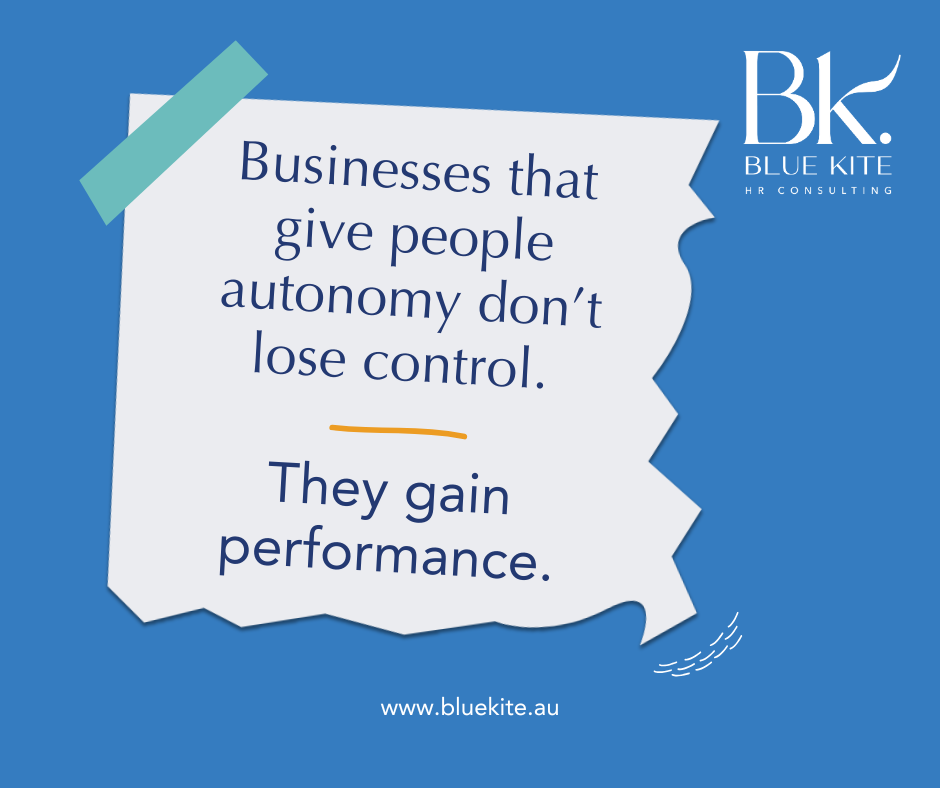
Autonomy — the degree to which people have control over how, when, and where they do their work — is one of the best-researched predictors of employee engagement, motivation, and wellbeing. The evidence is consistent across industries, business sizes, and cultural contexts: people who experience greater autonomy are more productive, more creative, more satisfied with their work, and significantly less likely to leave.

This creates a genuine tension for many business owners and managers, who rightly care about quality and consistency. The challenge is in understanding what autonomy actually means — and what it doesn’t.


What Autonomy Is and Isn’t 

Autonomy doesn’t mean absence of expectations. It means giving people meaningful control over how they meet those expectations. There’s a critical difference between “here’s the outcome we need, by when, and here’s the quality standard” and “here’s the exact process you must follow at every step.”

The first approach sets people up for accountability within genuine freedom. The second turns adults into machines and guarantees the most capable ones will look for somewhere that doesn’t.

The research on self-determination theory, developed by psychologists Edward Deci and Richard Ryan, identifies autonomy as one of three core psychological needs at work — alongside competence and relatedness. When these needs are met, intrinsic motivation flourishes. When they’re frustrated, motivation becomes purely extrinsic — which is both less effective and more fragile.


Trust as a Business Strategy

Trust is not naivety. It’s a deliberate investment in people’s capability and judgement. And like all investments, it requires evidence and calibration — you extend trust appropriate to someone’s demonstrated competence, and you increase it as that competence grows.

The mistake is treating all employees as though they’re at the beginning of this journey regardless of their experience and track record. A person who has delivered consistently excellent results for three years doesn’t need the same level of oversight as someone in their first month. Treating them as though they do is insulting — and it drives them out.

Building trust as a formal management practice means being explicit about what decisions people can make without approval, what outcomes they’re responsible for, and how you’ll know if something is going wrong. It means being honest when trust is reduced — rather than silently adding oversight — and clear about how it can be rebuilt.


The Practical Application

Audit your current management practices for unnecessary control. Where are you requiring sign-off on things that could reasonably be delegated? Where are you prescribing process when only the outcome matters? Start small — extend autonomy in one area, observe the results, and build from there.

Done well, this doesn’t create risk. It creates a team that can operate without you — which is what any well-functioning business needs.


Ready to build a better worlpalce? Book your free 30-minute consultation at Blue Kite HR Consulting


BACK TO ALL ARTICLES
Screenshot 2025-11-18 164639

+61 (0) 409 545 634

cpaterson@bluekite.au

FREE CONSULTATION

  • ABOUT
  • HR SERVICES
  • COACH WITH ME
  • HEALTH & WELLBEING
  • MEDIA/PR
  • ARTICLES/BLOG
  • RESOURCES
  • CONTACT
  • PRIVACY

Blue Kite specialises in providing
HR services to support businesses
to create better workplaces.
Filed Under: Advisory and compliance, Business Update, Change management, Culture, External HR Support, HR essentials, Leadership

16 September, 2026 by Catie Paterson Leave a Comment

How to Keep High-Potential Employees Challenged and Retained

ARTICLES

How to Keep High-Potential Employees Challenged and Retained

16 September, 2026
Filed Under: Advisory and compliance, Business Update, Career Planning, Change management, Culture, External HR Support, HR essentials, Leadership

In a professional services firm, a financial analyst everyone described as “exceptional” handed in her notice after two years. She was 28, sharp, ambitious, and thoroughly bored. She’d been given more of the same work since her first six months, praised consistently, and paid fairly. What she hadn’t been given was anything genuinely difficult. “I stopped learning,” she said simply.

High-potential employees — people with the capability and ambition to take on significantly greater responsibility over time — are your greatest competitive advantage and your highest flight risk. They’re typically harder to replace, take on more than their formal role, and disproportionately influence team performance and culture. They’re also far more likely to leave if they’re not challenged, developed, and given a reason to stay.


What High-Potential Employees Actually Need 

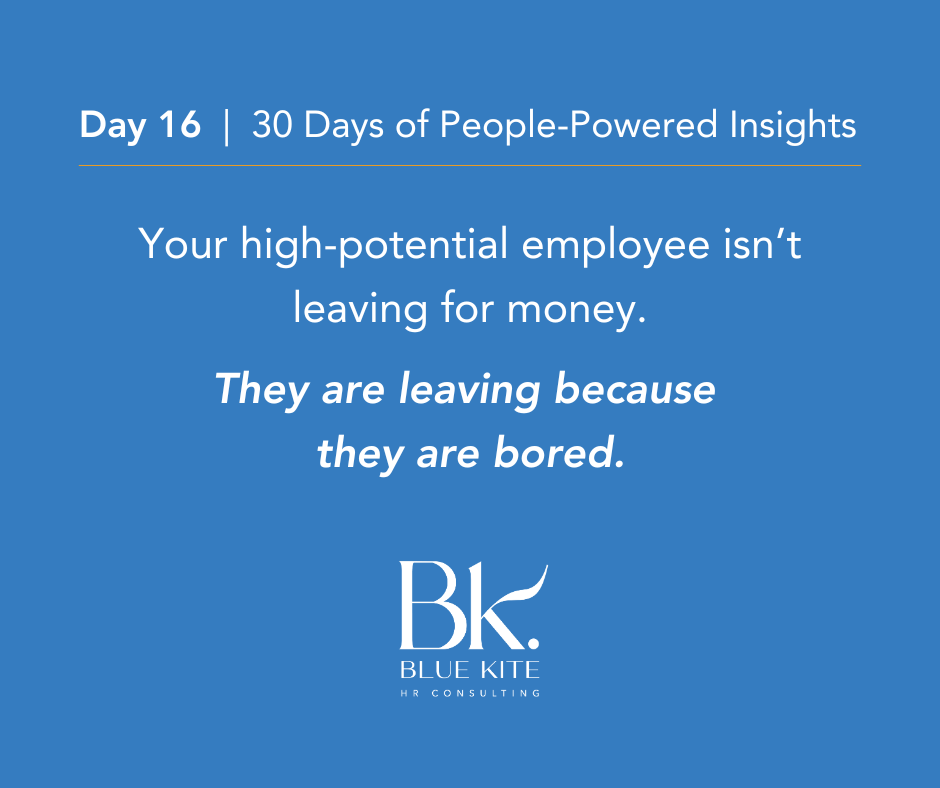
Money matters. But for high-potential people, compensation beyond a fair market rate is rarely the primary retention factor — it’s necessary but not sufficient. What drives these employees is the nature of the work itself: difficulty, autonomy, growth, and a sense that their contribution is visible and valued.

They need stretch assignments — work that genuinely requires them to develop new capabilities, not just apply existing ones at higher speed. They need access to interesting problems and, ideally, access to senior decision-makers. They need honest feedback that treats them as capable of handling reality. And they need a credible answer to the question they’re always quietly asking: “Is there a future for me here?”


What Businesses Get Wrong

The most damaging mistake is the “we can’t afford to lose them” trap. Managers who are worried about losing a high performer often keep them in their current role because they’re performing well there, and because moving them would create a gap. This reasoning makes sense in the very short term and is catastrophic over two to three years.

Giving more of the same work to someone who’s mastered it is not development. It’s stagnation with a positive performance review attached to it.

The second error is over-promising and under-delivering. “There will be opportunities down the track” is a common placeholder answer to the growth question. High-potential people have good instincts for what’s genuine and what’s a deflection. If the opportunities aren’t real, they’ll figure it out faster than you think.


Practical Strategies for Smaller Businesses 

You don’t need a formal talent program or a corporate development budget to retain high-potential employees effectively.

Start with a genuine career conversation — not a performance review, but a real discussion about what they’re interested in, where they want to go, and what kind of challenges they’re looking for. Build a development plan that’s specific: particular projects, skills to develop, people to connect with.

Cross-functional exposure is powerful in small businesses. Moving a high performer into a project, client relationship, or area outside their usual domain keeps the work interesting and builds the breadth of capability that makes them even more valuable. Giving them responsibility for leading something — even a small initiative — before they’re technically “ready” is often the fastest path to genuine development.

And have the long-term conversation honestly. If there isn’t a senior role on the horizon, say so — but be clear about what is available and why it’s worth staying.


Ready to build a better workplace? Book your free 30-minute consultation at Blue Kite HR Consulting 


BACK TO ALL ARTICLES
Screenshot 2025-11-18 164639

+61 (0) 409 545 634

cpaterson@bluekite.au

FREE CONSULTATION

  • ABOUT
  • HR SERVICES
  • COACH WITH ME
  • HEALTH & WELLBEING
  • MEDIA/PR
  • ARTICLES/BLOG
  • RESOURCES
  • CONTACT
  • PRIVACY

Blue Kite specialises in providing
HR services to support businesses
to create better workplaces.

Filed Under: Advisory and compliance, Business Update, Career Planning, Change management, Culture, External HR Support, HR essentials, Leadership

15 September, 2026 by Catie Paterson Leave a Comment

Using People Data to Make Better HR Decisions (Without an HR Team)

ARTICLES

Using People Data to Make Better HR Decisions (Without an HR Team)

15 September, 2026
Filed Under: Advisory and compliance, Business Update, Change management, Culture, External HR Support, HR essentials, Leadership

When a business owner was asked why they’d let a particularly strong employee leave without a counteroffer, the answer was: “I didn’t see it coming.” The warning signs were all there — a string of absences, a drop in the quality of work, disengaged responses in team meetings. But they hadn’t been tracked or noticed as a pattern. They were just noise.

One of the most significant shifts in people management over the past decade has been the availability of data to small and medium businesses. The kind of workforce analytics once reserved for large organisations with dedicated HR information systems is now accessible through the tools many businesses already use — payroll software, rostering platforms, performance tracking, even simple spreadsheets.

The challenge isn’t access to data. It’s knowing which data matters, and building the habit of actually using it.


The People Metrics That Predict Problems

Not all HR data is equally useful. Some of the most commercially relevant metrics for SMEs are also the simplest to track.

Turnover rate — the percentage of your workforce that leaves over a given period — is a starting point. But voluntary turnover (people who choose to leave) tells you something different from involuntary turnover (people you asked to leave). Tracking them separately gives you more useful information. Industry benchmarks are available through Fair Work and sector associations, and they’re worth knowing.

Absence rates are an early indicator of disengagement, workload problems, or cultural issues. An individual absence here and there tells you very little. A pattern — particularly in a specific team or following a particular event — tells you something meaningful.

Time-to-fill for vacancies tells you about your attractiveness as an employer and the efficiency of your recruitment process. Time-to-productivity for new hires tells you about the quality of your onboarding. Both have direct commercial implications.


Common Mistakes When Using People Data

The most common mistake is using data retrospectively — looking at it only after a problem has become serious. The value of people data is in its early warning potential, which requires building the habit of reviewing it regularly rather than only in response to a crisis.

The second mistake is using metrics in isolation. High turnover in one team might reflect a management problem, a market factor, or a role design issue. The data tells you there’s a pattern worth investigating; it doesn’t tell you why. Combining data with qualitative information — exit interviews, one-on-ones, team conversations — gives you a much fuller picture.

The third is tracking data without acting on it. Measuring without responding is a waste of time and, when employees notice that feedback or patterns are collected but ignored, it erodes trust.


Getting Started Simply

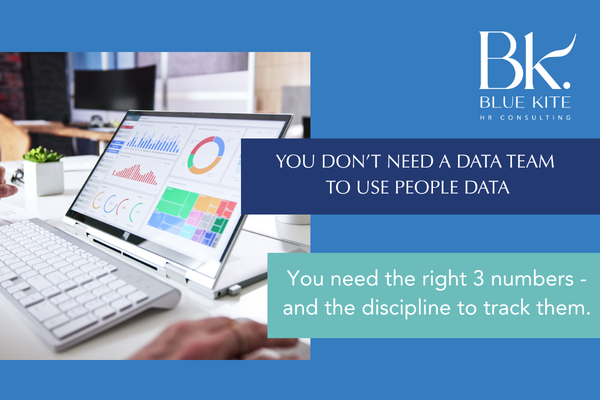
You don’t need HR software to start using people data effectively. A simple spreadsheet tracking headcount, voluntary departures, average tenure, and absence rates — reviewed quarterly — will surface patterns that are genuinely useful for business decisions. Start small, build the habit, and add complexity only when you have a specific question the current data can’t answer.


Ready to build a better workplace? Book your free 30-minute consultation at Blue Kite HR Consulting 


BACK TO ALL ARTICLES
Screenshot 2025-11-18 164639

+61 (0) 409 545 634

cpaterson@bluekite.au

FREE CONSULTATION

  • ABOUT
  • HR SERVICES
  • COACH WITH ME
  • HEALTH & WELLBEING
  • MEDIA/PR
  • ARTICLES/BLOG
  • RESOURCES
  • CONTACT
  • PRIVACY

Blue Kite specialises in providing
HR services to support businesses
to create better workplaces.

Filed Under: Advisory and compliance, Business Update, Change management, Culture, External HR Support, HR essentials, Leadership

14 September, 2026 by Catie Paterson Leave a Comment

The Four-Day Work Week: What the Evidence Says for Business

ARTICLES

The Four-Day Work Week: What the Evidence Says for Business

14 September, 2026
Filed Under: Advisory and compliance, Business Update, Change management, Culture, External HR Support, HR essentials, Leadership

In 2022, the largest four-day work week trial ever conducted ran across sixty-one companies in the UK, involving around 2,900 employees. The results were striking: revenue stayed the same. Most businesses decided not to go back. Employee wellbeing improved substantially. Recruitment became significantly easier.

The four-day work week has moved from thought experiment to operational reality for a growing number of businesses globally — including a small but increasing number in Australia. If you’ve been curious about whether it could work for your business, or dismissing it as a concept only viable for tech companies and progressives, the evidence deserves a closer look.


What the Research Actually Shows

The core argument for a four-day week — most commonly structured as 100% pay, 80% time, 100% output — is that productive work time and hours at work are not the same thing. The research from the UK trial, and subsequent studies in Iceland, Ireland, and Australia, consistently finds that employees produce the same or more output in four days when the reduction in hours is accompanied by genuine work redesign.

The caveats matter. The four-day week doesn’t work without deliberate effort to reduce low-value activity: unnecessary meetings, inefficient processes, unclear priorities. If you simply compress the same work into fewer days, you create stress and burnout rather than wellbeing. The hours reduction is the catalyst, not the solution.

In the Australian context, some small businesses — particularly in professional services, consulting, and knowledge work — have successfully implemented versions of this model. In hospitality, manufacturing, and customer-facing retail, the logistics are considerably more complex, and the model typically requires more creative structuring.


What it Can and Can’t Solve

A four-day week can genuinely improve employee attraction and retention, reduce burnout, and force productive conversations about what work actually matters. It tends to improve focus and reduce presenteeism — the phenomenon of people being physically present but mentally disengaged.

It is not a substitute for addressing structural problems. If your team is overworked because roles are badly designed, workloads are unmanageable, or the business model requires constant overtime, a day off per week doesn’t fix the underlying issues. It compresses them.


How to Explore it for Your Business

If you’re interested in testing the model, start with a structured pilot rather than a permanent switch. Run it for a defined period — three months is common — with a clear framework for measuring whether productivity, client satisfaction, and employee wellbeing have held or improved.

Involve your team in the design. The best versions of the four-day week are built collaboratively, with employees identifying where their time goes and what could be redesigned. It’s as much a culture intervention as a scheduling one.

It won’t work for every business. But dismissing it without genuinely examining the evidence means potentially missing one of the more powerful tools available for attracting and keeping good people in an increasingly competitive market.

Ready to build a better workplace? Book your free-30minute consultation at Blue Kite HR Consulting 


BACK TO ALL ARTICLES
Screenshot 2025-11-18 164639

+61 (0) 409 545 634

cpaterson@bluekite.au

FREE CONSULTATION

  • ABOUT
  • HR SERVICES
  • COACH WITH ME
  • HEALTH & WELLBEING
  • MEDIA/PR
  • ARTICLES/BLOG
  • RESOURCES
  • CONTACT
  • PRIVACY

Blue Kite specialises in providing
HR services to support businesses
to create better workplaces.

Filed Under: Advisory and compliance, Business Update, Change management, Culture, External HR Support, HR essentials, Leadership

  • « Go to Previous Page
  • Page 1
  • Page 2
  • Page 3
  • Page 4
  • Page 5
  • Interim pages omitted …
  • Page 21
  • Go to Next Page »

Copyright © 2026 · Executive Pro on Genesis Framework · WordPress · Log in koopo

  • HOME
  • ABOUT US
  • HR SERVICES
  • COACH WITH ME
  • HEALTH & WELLBEING
  • MEDIA/PR
    • – Articles/Blogs
    • – Keynote Speaking Events
    • – Podcast Interviews
    • – Ticker Interviews
  • BLOG
  • RESOURCES
  • CONTACT