
• Skip to primary navigation
  • Skip to main content

BlueKite HR

  • HOME
  • ABOUT US
  • HR SERVICES
  • COACH WITH ME
  • HEALTH & WELLBEING
  • MEDIA/PR
    • – Articles/Blogs
    • – Keynote Speaking Events
    • – Podcast Interviews
    • – Ticker Interviews
  • BLOG
  • RESOURCES
  • CONTACT

Advisory and compliance

6 September, 2026 by Catie Paterson Leave a Comment

Pay Transparency: Should You Share Salary Ranges?

ARTICLES

Pay Transparency: Should You Share Salary Ranges?

6 September, 2026
Filed Under: Advisory and compliance, Business Update, Career Planning, Change management, Culture, External HR Support, HR essentials, Leadership

When a mid-sized Melbourne professional services firm first advertised a role with a salary range, their HR manager braced for awkward conversations with existing staff. What she didn’t expect was that the applications were significantly stronger, the time-to-hire dropped, and three current employees who had been quietly job-hunting came off the market because seeing the range confirmed they were being paid fairly.

Pay transparency is having a moment. Several Australian states have introduced or are considering legislation affecting how pay is discussed in workplaces, and the federal government has strengthened protections against pay secrecy clauses under recent Fair Work changes. Employees now have an explicit right to discuss their pay with colleagues if they choose, and employers cannot lawfully include clauses that prohibit this in employment contracts.

That doesn’t mean you’re required to publish salaries. But it does mean the question of how much transparency you want — and whether it’s working for you — is more pressing than it used to be.


The Case For Sharing Ranges

The strongest argument for pay transparency is trust. When employees don’t know whether they’re paid fairly relative to their colleagues and the market, they fill the uncertainty with assumptions — and those assumptions are often negative. Pay secrecy doesn’t prevent comparison; it just makes comparison less accurate and more anxiety-inducing.

Sharing ranges, particularly in job advertisements, also tends to improve application quality. Candidates self-select more accurately. You get fewer people who are fundamentally misaligned on compensation expectations, which saves everyone time.

For businesses with genuine gender or diversity pay gaps, transparency creates accountability. It’s harder to let gaps persist when they’re visible.


The Legitimate Concerns

There are real reasons why some businesses are cautious. If your pay structure has inconsistencies — people in similar roles earning different amounts for reasons that aren’t clearly defensible — transparency will surface that. That can create short-term tension.

In smaller businesses where every compensation decision is essentially an individual negotiation, publishing ranges can make every salary review a comparison exercise. Managing that requires more rigour and process than some SMEs currently have in place.

The practical middle ground for most small and medium businesses isn’t full public disclosure — it’s building a pay structure that you’d be comfortable defending, and then gradually increasing transparency as your confidence in that structure grows. Start by sharing ranges in job ads. Then work towards being able to explain to any employee how their pay was determined. Neither requires publishing everyone’s salary.


What Australian Requires

Under the Fair Work Act as updated through recent legislation, pay secrecy clauses in employment contracts are not enforceable. An employee cannot be disciplined or disadvantaged for disclosing or asking about their own pay. You can still ask employees to exercise discretion, but you cannot require it. Getting your contracts reviewed for legacy pay secrecy clauses is a practical step worth taking.

Pay transparency isn’t just a trend. It’s a direction the market and the legislation are both moving. Getting ahead of it now is considerably less disruptive than being caught on the back foot later.

Ready to build a better workplace? Book your free 30-minute consultation at  Blue Kite HR Consulting 
 

BACK TO ALL ARTICLES
Screenshot 2025-11-18 164639

+61 (0) 409 545 634

cpaterson@bluekite.au

FREE CONSULTATION

  • ABOUT
  • HR SERVICES
  • COACH WITH ME
  • HEALTH & WELLBEING
  • MEDIA/PR
  • ARTICLES/BLOG
  • RESOURCES
  • CONTACT
  • PRIVACY

Blue Kite specialises in providing
HR services to support businesses
to create better workplaces.
Filed Under: Advisory and compliance, Business Update, Career Planning, Change management, Culture, External HR Support, HR essentials, Leadership

5 September, 2026 by Catie Paterson Leave a Comment

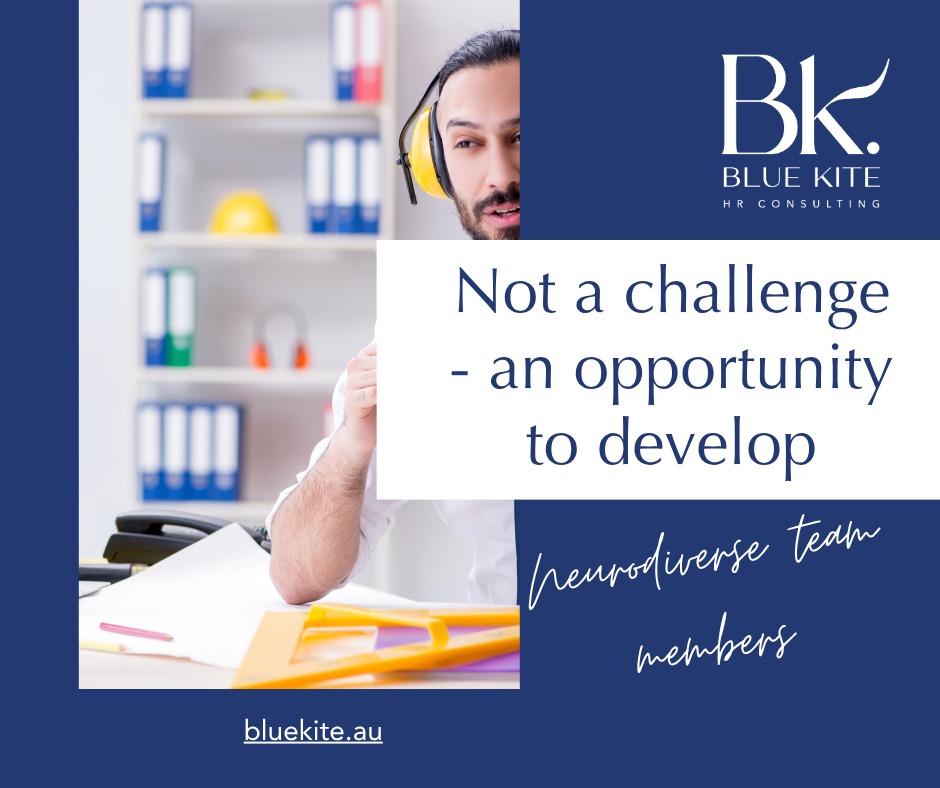
Neurodiversity at Work: Building a Genuinely Inclusive Team

ARTICLES

Neurodiversity at Work: Building a Genuinely Inclusive Team

5 September, 2026
Filed Under: Advisory and compliance, Business Update, Career Planning, Change management, Culture, External HR Support, HR essentials, Leadership

A food manufacturing business in Adelaide had a warehouse worker who was brilliant at picking errors in the production line — faster and more accurate than anyone else on the floor. He was also frequently in trouble for not following the team communication protocols. His supervisor described him as “difficult.” His colleagues thought he was “a bit odd.” What nobody had noticed, or asked about, was that he was autistic.

Once that was understood and accommodated — simple adjustments to how tasks were briefed and feedback was given — he became one of the highest performers in the operation. Nothing changed about his capability. Everything changed about how the environment was set up for him.

Neurodiversity refers to the natural variation in how human brains process information. It includes autism spectrum conditions, ADHD, dyslexia, dyspraxia, dyscalculia, and a range of other conditions. Around one in seven Australians is considered neurodivergent. In any team of reasonable size, you almost certainly already have neurodivergent employees — whether or not anyone knows it.


Why Standard Workplaces Miss Neurodivergent Talent

Most Australian workplaces are designed around a fairly narrow set of assumptions: that people communicate in particular ways, process information at roughly the same pace, work well in open-plan environments, handle ambiguity comfortably, and manage the unwritten rules of professional interaction without difficulty. For neurodivergent people, many of these assumptions don’t hold.

The result is that genuinely talented people struggle — not because they can’t do the work, but because the environment creates unnecessary friction. They may be labelled as “not a team player,” “poor communicator,” or “inconsistent performer” when the actual issue is a mismatch between how they work and how the workplace is structured.

The Fair Work Act prohibits discrimination on the basis of disability, which in many cases covers neurodivergent conditions. But compliance is a floor, not a ceiling. Building an environment where neurodivergent people can genuinely thrive requires going further.


What Inclusive Workpalces Actually Do Differently

The adjustments that make workplaces more accessible for neurodivergent employees tend to benefit everyone. Clear, written instructions rather than verbal-only briefings. Explicit expectations rather than assumed cultural knowledge. Structured agendas for meetings. Quiet spaces available alongside collaborative areas. Flexibility in how work is delivered rather than rigidity around the method.

These aren’t expensive. They’re mostly about clarity and choice.

The most important step is normalising the conversation. When employees feel they can disclose a condition without it affecting how they’re treated or perceived, you get honest information that lets you support them effectively. When disclosure feels risky, people mask — and masking is exhausting, damaging, and costs you their best work.


What To Start With

If you haven’t thought about neurodiversity in your business before, start here: audit your communication practices for unnecessary ambiguity. Look at your physical or remote work environment for sensory overload. Review how you give feedback and whether it’s explicit enough. And create a way for employees to share needs without it becoming a performance management issue.

You’re not trying to fix people. You’re trying to build a workplace that works for more of them.


Ready to build a better workplace? Book your free 30-minute consultation at Blue Kite HR Consulting 


BACK TO ALL ARTICLES
Screenshot 2025-11-18 164639

+61 (0) 409 545 634

cpaterson@bluekite.au

FREE CONSULTATION

  • ABOUT
  • HR SERVICES
  • COACH WITH ME
  • HEALTH & WELLBEING
  • MEDIA/PR
  • ARTICLES/BLOG
  • RESOURCES
  • CONTACT
  • PRIVACY

Blue Kite specialises in providing
HR services to support businesses
to create better workplaces.
Filed Under: Advisory and compliance, Business Update, Career Planning, Change management, Culture, External HR Support, HR essentials, Leadership

4 September, 2026 by Catie Paterson Leave a Comment

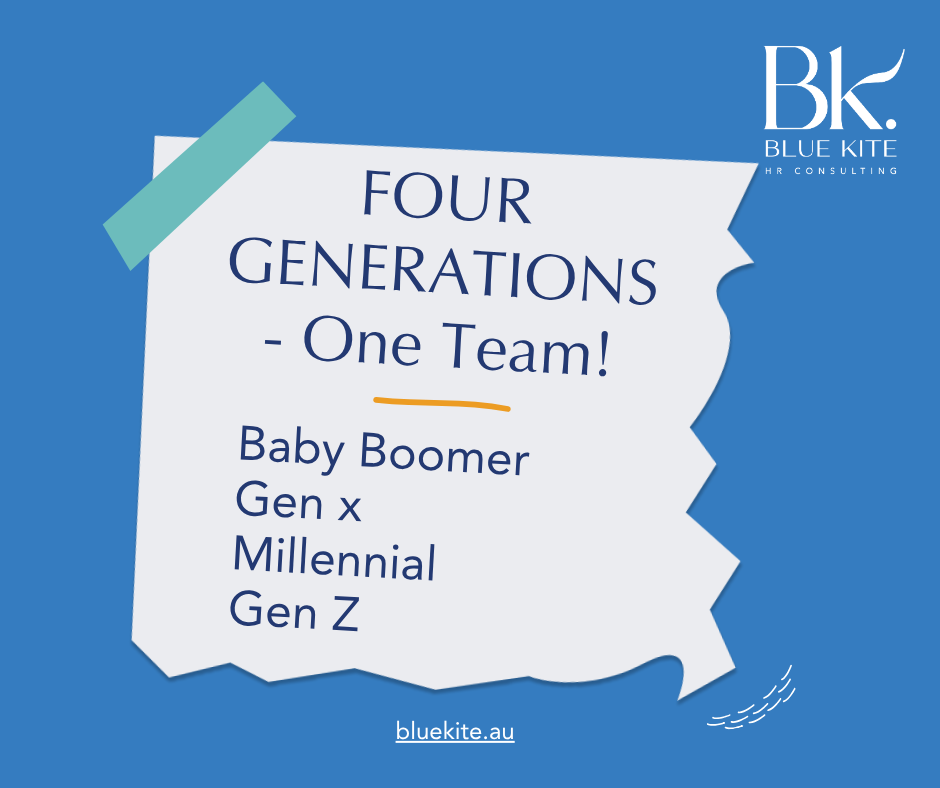
Managing a Multigenerational Workforce

ARTICLES

Managing a Multigenerational Workforce

4 September, 2026
Filed Under: Advisory and compliance, Business Update, Change management, Culture, External HR Support, HR essentials, Leadership

In one Sydney IT services company, a 32-year-old project manager complained that her 58-year-old senior developer “couldn’t communicate.” He thought she “made decisions without proper process.” Meanwhile, the two 24-year-old graduates were frustrated that nobody used Slack properly and kept calling meetings that could have been messages. All three complaints were valid. None of them were actually about age.

Australia’s workforce spans more generations than at any point in history. Baby Boomers are working longer. Gen X leads a significant portion of management. Millennials now make up the largest cohort in most organisations. Gen Z is entering the workforce fast. For small and medium businesses, that range of experience, expectation, and working style shows up in the day-to-day in ways that can either be a real asset — or a persistent friction point.


What the Research Actually Says

There’s a lot of noise about generational differences — and a lot of it is oversimplified. The evidence is clearer than the stereotypes suggest: people’s work preferences are shaped far more by their life stage, personal circumstances, and individual personality than by their birth year.

That said, there are some patterns worth noting. Older workers often bring institutional knowledge, stability, and a preference for face-to-face communication and structured processes. Younger workers frequently prioritise flexibility, feedback, purpose-driven work, and digital-first communication. Neither is better. Both are useful. And both exist on a spectrum.

Where the research does land consistently is that mixed-age teams, when managed well, outperform homogeneous ones. The combination of experience and fresh thinking, of process knowledge and innovation, produces better outcomes. The challenge is in the “managed well” part.


Where Generational Friction Comes From

Most generational conflict at work isn’t really about values. It’s about unspoken expectations that haven’t been surfaced or negotiated.

Different expectations about communication are a common trigger. One person expects a response within the hour; another considers same-day a reasonable timeframe. One team member writes brief, informal messages; another interprets that as dismissive. These aren’t generational problems — they’re communication norm problems, and they’re solvable.

Feedback preferences are another flashpoint. Older workers may have grown up in environments where feedback was rare and formal. Younger workers often expect regular, informal input. When a manager doesn’t naturally give either type, both groups feel unsupported — just for different reasons.

Building a Team That Uses the Difference 

The practical move is to stop trying to manage generational differences and start managing individual preferences. Don’t assume what someone wants based on their age. Ask. Make it a normal part of how you get people set up in a role — “what does good communication look like to you?” and “how do you prefer to get feedback?” are questions that work for everyone.

Create conditions where different working styles are respected, not ranked. Flexibility for a 28-year-old managing childcare looks the same as flexibility for a 55-year-old managing an ageing parent. Don’t assign virtue to one and reluctance to the other.

And invest in creating genuine connection across the team. Mixed-age mentoring — in both directions — is one of the most underused tools in Australian SMEs. The reverse mentoring model, where younger workers share digital and emerging-trend knowledge with senior staff, is increasingly valuable and costs nothing but time.

Ready to build a better workplace? Book your free 30-minute consultation at Blue Kite HR Consulting 


BACK TO ALL ARTICLES
Screenshot 2025-11-18 164639

+61 (0) 409 545 634

cpaterson@bluekite.au

FREE CONSULTATION

  • ABOUT
  • HR SERVICES
  • COACH WITH ME
  • HEALTH & WELLBEING
  • MEDIA/PR
  • ARTICLES/BLOG
  • RESOURCES
  • CONTACT
  • PRIVACY

Blue Kite specialises in providing
HR services to support businesses
to create better workplaces.

Filed Under: Advisory and compliance, Business Update, Change management, Culture, External HR Support, HR essentials, Leadership

3 September, 2026 by Catie Paterson Leave a Comment

Job Design: How You Structure Roles Affects Whether People Stay

ARTICLES

Job Design: How You Structure Roles Affects Whether People Stay

3 September, 2026
Filed Under: Advisory and compliance, Business Update, Change management, Culture, External HR Support, HR essentials, Leadership

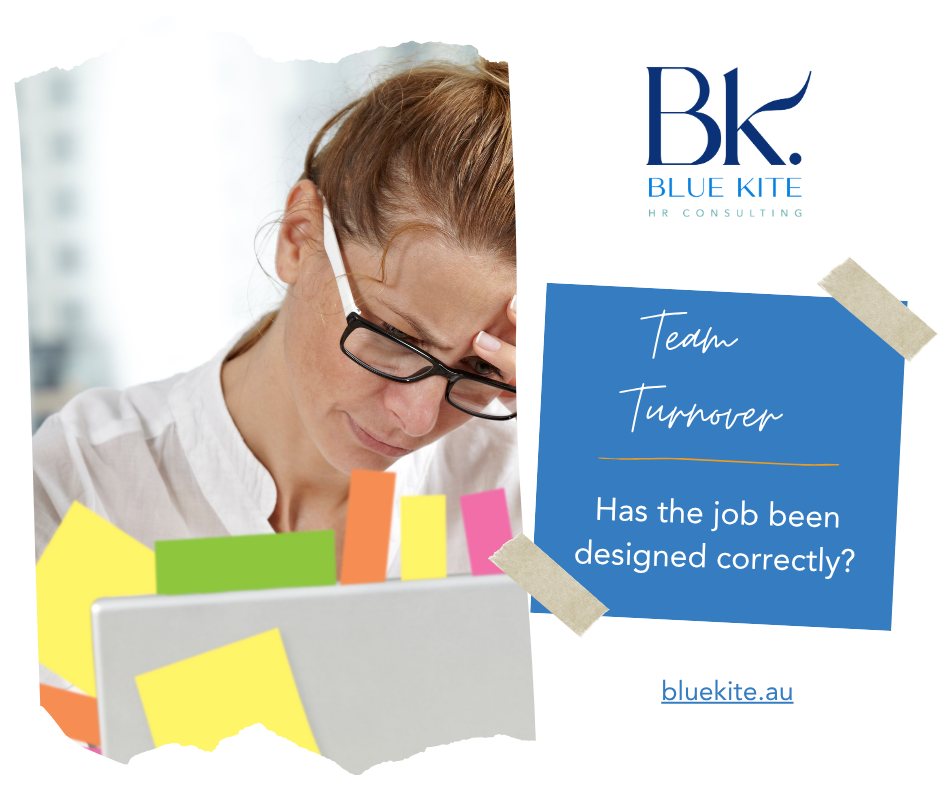
A Brisbane logistics company kept losing warehouse supervisors. Every exit interview pointed to the same thing: the role was impossible. The supervisors were expected to manage a team of twelve, run daily operations, handle all supplier escalations, cover rostering across three shifts, and also be on the tools when anyone called in sick. On paper, it was one job. In practice, it was three.

Job design doesn’t get nearly enough attention in small and medium businesses. When a role needs filling, the instinct is to write a job ad around what the business needs done — then work backwards to find someone who can do all of it. The problem is that badly designed roles drive people out faster than almost anything else.


What Job Design Actually Covers

Job design is the deliberate structuring of a role: what tasks it includes, how much autonomy the person has, how varied the work is, how clearly the role connects to larger business outcomes, and how much capacity actually exists to do the job well.

When a role is well-designed, the person in it has enough variety to stay engaged, enough clarity to manage their workload, enough autonomy to feel trusted, and enough scope to grow. When it’s poorly designed, you get overload, confusion, disengagement — and eventually, resignation.

The Fair Work Act and National Employment Standards govern a lot of the formal aspects of employment — hours, classifications, minimum entitlements — but they don’t prevent businesses from designing roles that are fundamentally unworkable. That’s a management problem, not a legal one.


The Most Common Job Design Mistakes 

Overloading a role is the most prevalent issue, particularly as businesses grow. Tasks get added incrementally — “can you just handle this too?” — until a role that started as one thing has quietly become three. The person holding it never pushes back because they want to be seen as capable. Eventually they burn out or leave.

Role ambiguity is equally damaging. If someone doesn’t understand what decisions they’re authorised to make, where their responsibilities end and someone else’s begin, or what success actually looks like in their job, they’ll spend enormous energy navigating uncertainty rather than getting work done. That’s exhausting — and unnecessary.

On the other end of the spectrum, under-designed roles create boredom. A smart, capable person given work that’s too narrow or too repetitive will start looking for the next challenge — somewhere else.


How to Audit the Roles in Your Business

You don’t need a formal job design exercise to improve this. Start by asking the people in each role a few honest questions: What takes up most of your time that probably shouldn’t? What do you not have enough time to do well? What decisions do you have to escalate that you should probably be able to make yourself?

The answers will tell you quickly whether a role is overloaded, misaligned, or missing something critical. From there, you can make targeted changes — whether that’s redistributing tasks, rewriting a position description, or hiring to fill a genuine gap rather than a wish list.

Well-designed roles are one of the most powerful, and least talked about, tools for keeping good people. They’re also one of the clearest signals to candidates that your business is serious about the people who work there.


Ready to build a better workplace? Book your free 30-minute consultation at  Blue Kite HR Consulting 


BACK TO ALL ARTICLES
Screenshot 2025-11-18 164639

+61 (0) 409 545 634

cpaterson@bluekite.au

FREE CONSULTATION

  • ABOUT
  • HR SERVICES
  • COACH WITH ME
  • HEALTH & WELLBEING
  • MEDIA/PR
  • ARTICLES/BLOG
  • RESOURCES
  • CONTACT
  • PRIVACY

Blue Kite specialises in providing
HR services to support businesses
to create better workplaces.
Filed Under: Advisory and compliance, Business Update, Change management, Culture, External HR Support, HR essentials, Leadership

2 September, 2026 by Catie Paterson Leave a Comment

Employer Branding on a Small Budget

ARTICLES


Employer Branding on a Small Budget

2 September, 2026
Filed Under: Advisory and compliance, Business Update, Career Planning, Culture, External HR Support, HR essentials, Leadership

Here’s a thought experiment. When someone who worked for you five years ago runs into an old colleague at a networking event, what do they say about your business? That one conversation — unprompted, unscripted, completely out of your control — is employer branding in action.

Most small business owners hear “employer branding” and immediately think: that’s for big companies. The ones with recruitment marketing teams and LinkedIn career pages with professional photography. But the reality is that your employer brand already exists. The question is whether you’re shaping it, or leaving it entirely to chance.


The Difference Between Perception and Promotion

Employer branding isn’t about running ads. It’s about the gap — or the alignment — between how you want to be seen as an employer and how you’re actually perceived by people who work there, have worked there, or might one day apply.

For a small or medium business, that perception is built almost entirely through experience and word of mouth. Someone who had a great experience in your hiring process tells their friend. Someone who felt undervalued on their way out tells three people. You don’t have to spend money to influence this. You have to be intentional about the experience you’re creating at every touchpoint.

That said, there are also a few very low-cost, high-impact things you can do to actively build visibility.


Practical Ways to Build Your Brand Without Spending Too Much

Your current employees are your most credible employer brand ambassadors. A genuine LinkedIn post from a team member sharing something they worked on, learned, or experienced is worth more than any paid ad. You can’t manufacture this — but you can create an environment where people want to share, and where sharing feels natural rather than forced.

Make your hiring process reflect your culture. A slow, disorganised, or impersonal process sends a message before anyone has even started. Even a small business can send timely responses, give candidates a real sense of who they’d be working with, and follow up properly after interviews. These things cost nothing.

Use your own platforms to be honest and specific. Instead of posting generic “great place to work” content, share real things: a challenge the team solved, a project you’re proud of, how you handled a difficult year. Authenticity reads very differently to promotion — and audiences, especially candidates, can tell the difference immediately.

Respond to reviews. If your business has a Glassdoor or Indeed presence, or even Google reviews that touch on employment, engage thoughtfully. A professional, considered response to a negative review demonstrates maturity and care. Ignoring them does the opposite.


Where Most Businesess Fall Short

The most common mistake is inconsistency. Businesses spend time crafting a great job ad, then drop the ball on the follow-up. Or they have a brilliant onboarding week and then leave new starters to figure things out alone. Your brand is built through repeated, consistent experience — not a single impressive moment.

The other mistake is focusing only on attraction, not retention. An employer brand is just as relevant to the people already in the building. How your team feels about working there shapes everything from their productivity to what they say when they leave.

You don’t need a big budget to have a strong employer brand. You need clarity about what you offer, consistency in how you deliver it, and enough self-awareness to know the difference.

Ready to build a better workplace? Book ypour free 30-minute consultation at  Blue Kite HR Consulting


BACK TO ALL ARTICLES
Screenshot 2025-11-18 164639

+61 (0) 409 545 634

cpaterson@bluekite.au

FREE CONSULTATION

  • ABOUT
  • HR SERVICES
  • COACH WITH ME
  • HEALTH & WELLBEING
  • MEDIA/PR
  • ARTICLES/BLOG
  • RESOURCES
  • CONTACT
  • PRIVACY

Blue Kite specialises in providing
HR services to support businesses
to create better workplaces.

Filed Under: Advisory and compliance, Business Update, Career Planning, Culture, External HR Support, HR essentials, Leadership

1 September, 2026 by Catie Paterson Leave a Comment

The Employee Value Proposition: What Makes People Choose Your Business

ARTICLES

The Employee Value Proposition: What Makes People Choose Your Business

1 September, 2026
Filed Under: Advisory and compliance, Business Update, Culture, External HR Support, HR essentials, Leadership

Last year, a Melbourne-based accounting firm lost three strong candidates to competitors offering the same salary. The difference? The competitors could clearly articulate what it was like to work there. This firm couldn’t. When asked “why should I join you?”, the answer was essentially “good team, steady work.” That’s not a value proposition. That’s a shrug.


Your Employee Value Proposition — your EVP — is the answer to the question every candidate is really asking: what’s in it for me, beyond the pay cheque? It’s the full picture of what your business offers as an employer. And in a market where skilled Australians have real options, getting this right isn’t a nice-to-have. It’s a competitive advantage.


What an EVP Actually is (and Isn’t) 

An EVP isn’t a tagline. “Join our family” or “work somewhere amazing” tells a candidate nothing. A genuine EVP is specific, honest, and grounded in what’s actually true about working at your business.

It typically includes several elements: the work itself (meaningful, challenging, varied?), the people and culture (how do teams actually operate?), growth and development (will I learn here?), flexibility and lifestyle factors (how does this job fit around my life?), and the basics — pay, benefits, location.

What makes it powerful is that it reflects reality. An inflated EVP that doesn’t match the actual experience damages trust fast. Employees talk. Glassdoor exists. LinkedIn exists. If you promise collaboration and deliver silos, people notice — and they leave.


How to Build One Without a Marketing Team 

You don’t need a brand consultant or a six-figure budget to develop a strong EVP. You need honest answers to a few direct questions.

Start by asking your current employees — ideally in a short conversation or anonymous survey — what they value most about working there, what they’d tell a friend who asked about the job, and what could be better. The answers will surprise you. What you think is the drawcard (the office? the salary?) is often not what people actually value (flexibility? the quality of the work? who they work alongside?).


Then cross-reference that with what you’re genuinely able to offer. A small business often can’t match a corporate salary or a career progression ladder. But it can offer direct access to leadership, meaningful work, fast decision-making, and genuine flexibility. Own those things rather than trying to pretend you’re something you’re not.

Condense what you learn into a few clear, honest sentences you can use consistently — in job ads, in conversations, and in how you talk about your business publicly.


Early Warning Signs Your EVP Isn’t Working

If you’re getting applications but not from the right people, your EVP may be attracting volume but not fit. If candidates accept offers and then disengage quickly, there’s likely a gap between what you promised and what you delivered. If turnover clusters in the first six to twelve months, the problem is almost always a mismatch between expectations set during hiring and the reality of the job.

The good news: you can fix all of this. An EVP isn’t set in stone. It should evolve as your business grows, as your workforce changes, and as what your people value shifts.

Taking the time to define yours — even in simple, informal terms — gives every person in your business a consistent story to tell. That consistency is what wins candidates over, and keeps them once they arrive.


Ready to build a better workplace? Book your free 30-minute consultation at Blue Kite HR Consulting 


BACK TO ALL ARTICLES
Screenshot 2025-11-18 164639

+61 (0) 409 545 634

cpaterson@bluekite.au

FREE CONSULTATION

  • ABOUT
  • HR SERVICES
  • COACH WITH ME
  • HEALTH & WELLBEING
  • MEDIA/PR
  • ARTICLES/BLOG
  • RESOURCES
  • CONTACT
  • PRIVACY

Blue Kite specialises in providing
HR services to support businesses
to create better workplaces.

Filed Under: Advisory and compliance, Business Update, Culture, External HR Support, HR essentials, Leadership

  • « Go to Previous Page
  • Page 1
  • Interim pages omitted …
  • Page 3
  • Page 4
  • Page 5
  • Page 6
  • Page 7
  • Interim pages omitted …
  • Page 21
  • Go to Next Page »

Copyright © 2026 · Executive Pro on Genesis Framework · WordPress · Log in koopo

  • HOME
  • ABOUT US
  • HR SERVICES
  • COACH WITH ME
  • HEALTH & WELLBEING
  • MEDIA/PR
    • – Articles/Blogs
    • – Keynote Speaking Events
    • – Podcast Interviews
    • – Ticker Interviews
  • BLOG
  • RESOURCES
  • CONTACT