
• Skip to primary navigation
  • Skip to main content

BlueKite HR

  • HOME
  • ABOUT US
  • HR SERVICES
  • COACH WITH ME
  • HEALTH & WELLBEING
  • MEDIA/PR
    • – Articles/Blogs
    • – Keynote Speaking Events
    • – Podcast Interviews
    • – Ticker Interviews
  • BLOG
  • RESOURCES
  • CONTACT

Career Planning

2 September, 2026 by Catie Paterson Leave a Comment

Employer Branding on a Small Budget

ARTICLES


Employer Branding on a Small Budget

2 September, 2026
Filed Under: Advisory and compliance, Business Update, Career Planning, Culture, External HR Support, HR essentials, Leadership

Here’s a thought experiment. When someone who worked for you five years ago runs into an old colleague at a networking event, what do they say about your business? That one conversation — unprompted, unscripted, completely out of your control — is employer branding in action.

Most small business owners hear “employer branding” and immediately think: that’s for big companies. The ones with recruitment marketing teams and LinkedIn career pages with professional photography. But the reality is that your employer brand already exists. The question is whether you’re shaping it, or leaving it entirely to chance.


The Difference Between Perception and Promotion

Employer branding isn’t about running ads. It’s about the gap — or the alignment — between how you want to be seen as an employer and how you’re actually perceived by people who work there, have worked there, or might one day apply.

For a small or medium business, that perception is built almost entirely through experience and word of mouth. Someone who had a great experience in your hiring process tells their friend. Someone who felt undervalued on their way out tells three people. You don’t have to spend money to influence this. You have to be intentional about the experience you’re creating at every touchpoint.

That said, there are also a few very low-cost, high-impact things you can do to actively build visibility.


Practical Ways to Build Your Brand Without Spending Too Much

Your current employees are your most credible employer brand ambassadors. A genuine LinkedIn post from a team member sharing something they worked on, learned, or experienced is worth more than any paid ad. You can’t manufacture this — but you can create an environment where people want to share, and where sharing feels natural rather than forced.

Make your hiring process reflect your culture. A slow, disorganised, or impersonal process sends a message before anyone has even started. Even a small business can send timely responses, give candidates a real sense of who they’d be working with, and follow up properly after interviews. These things cost nothing.

Use your own platforms to be honest and specific. Instead of posting generic “great place to work” content, share real things: a challenge the team solved, a project you’re proud of, how you handled a difficult year. Authenticity reads very differently to promotion — and audiences, especially candidates, can tell the difference immediately.

Respond to reviews. If your business has a Glassdoor or Indeed presence, or even Google reviews that touch on employment, engage thoughtfully. A professional, considered response to a negative review demonstrates maturity and care. Ignoring them does the opposite.


Where Most Businesess Fall Short

The most common mistake is inconsistency. Businesses spend time crafting a great job ad, then drop the ball on the follow-up. Or they have a brilliant onboarding week and then leave new starters to figure things out alone. Your brand is built through repeated, consistent experience — not a single impressive moment.

The other mistake is focusing only on attraction, not retention. An employer brand is just as relevant to the people already in the building. How your team feels about working there shapes everything from their productivity to what they say when they leave.

You don’t need a big budget to have a strong employer brand. You need clarity about what you offer, consistency in how you deliver it, and enough self-awareness to know the difference.

Ready to build a better workplace? Book ypour free 30-minute consultation at  Blue Kite HR Consulting
 

BACK TO ALL ARTICLES
Screenshot 2025-11-18 164639

+61 (0) 409 545 634

cpaterson@bluekite.au

FREE CONSULTATION

  • ABOUT
  • HR SERVICES
  • COACH WITH ME
  • HEALTH & WELLBEING
  • MEDIA/PR
  • ARTICLES/BLOG
  • RESOURCES
  • CONTACT
  • PRIVACY

Blue Kite specialises in providing
HR services to support businesses
to create better workplaces.
Filed Under: Advisory and compliance, Business Update, Career Planning, Culture, External HR Support, HR essentials, Leadership

31 August, 2026 by Catie Paterson Leave a Comment

Q3 2026 HR Health Check: 5 Things to Fix Before the Year Ends

ARTICLES

Q3 2026 HR Health Check: 5 Things to Fix Before the Year Ends

31 August, 2026
Filed Under: Advisory and compliance, Business Update, Career Planning, Change management, Culture, External HR Support, HR essentials, Leadership

Day 31 of 31 Days of Better Workplaces — the final day of the series, and I’m sending you into then last quarter of 2026 with a practical action list.

The end of August is an underutilised moment for SME leaders. You’re past the mid-year mark, the December holiday period is still far enough away to actually fix things, and Q4 is close enough that the decisions you make now will determine how you finish the year.
Here are five HR priorities worth addressing in the next eight weeks.


1. Review your employment contracts and policies

If you haven’t looked at them since before the last round of Fair Work Act changes, they need a review. Employment law has moved — pay rates, Award obligations, flexible work rights, psychosocial safety requirements. What you don’t know about is still your legal liability.


2. Address any outstanding performance issues 

If you’ve been managing a performance concern informally and it hasn’t resolved, formalise it now. A structured improvement process started in September gives you a proper timeframe to assess progress and make informed decisions before the holiday disruption of December.


3. Run retention check-ins across the team  

Have direct, genuine conversations with your key people. Not a formal survey — a human conversation. Ask how they’re going. Ask what would make their work better. Listen to the answers. People tell you when they’re thinking of leaving, if you ask the right questions and make it safe to be honest.


4. Audit your leave balances

Excessive annual leave balances are a liability on your balance sheet and, in many Awards, a compliance issue. If people are accruing significant leave entitlements, now is the time to encourage and plan leave before December when everyone wants to take it simultaneously.


5. Plan your last quarter resourcing

Are you going to need additional capacity for your busiest period? If so, the recruitment process needs to start now — not in October when you need someone by November. Identify the gaps, build the plan, start the process.


That’s 31 Days of Better Workplaces 

A full month of practical HR insight and forward-thinking perspective designed to help Australian businesses build workplaces where people actually want to work.
If any of these posts raised a question you want to dig into — or if you’ve been reading along and realising it’s time to take a closer look at your HR foundations — let’s talk.


Book a free 30-minute consultation at Blue Kite HR Consulting 


BACK TO ALL ARTICLES
Screenshot 2025-11-18 164639

+61 (0) 409 545 634

cpaterson@bluekite.au

FREE CONSULTATION

  • ABOUT
  • HR SERVICES
  • COACH WITH ME
  • HEALTH & WELLBEING
  • MEDIA/PR
  • ARTICLES/BLOG
  • RESOURCES
  • CONTACT
  • PRIVACY

Blue Kite specialises in providing
HR services to support businesses
to create better workplaces.
Filed Under: Advisory and compliance, Business Update, Career Planning, Change management, Culture, External HR Support, HR essentials, Leadership

29 August, 2026 by Catie Paterson Leave a Comment

The Hiring Myths Costing Businesses Great Candidates — and the New Thinking That’s Replacing Them

ARTICLES

The Hiring Myths Costing Businesses Great Candidates — and the New Thinking That's Replacing Them

29 August, 2026
Filed Under: Advisory and compliance, Career Planning, Change management, Culture, External HR Support, HR essentials, Leadership

Day 29 of 31 Days of Better Workplaces — hiring is the conversation that connects all the others. Get it right and you build the culture, the capability, and the team you need. Get it wrong and everything else becomes harder. 

Most businesses hire using assumptions about what good looks like that haven’t been seriously interrogated in decades. And the workforce they’re trying to hire looks nothing like it did when those assumptions were formed.


Myth 1: ‘The best CVs gets the job’ 

The CV tells you what someone has done. It tells you almost nothing about whether they can do what you need, whether they’ll fit your culture, or whether they have the capacity to grow into the role’s future demands.
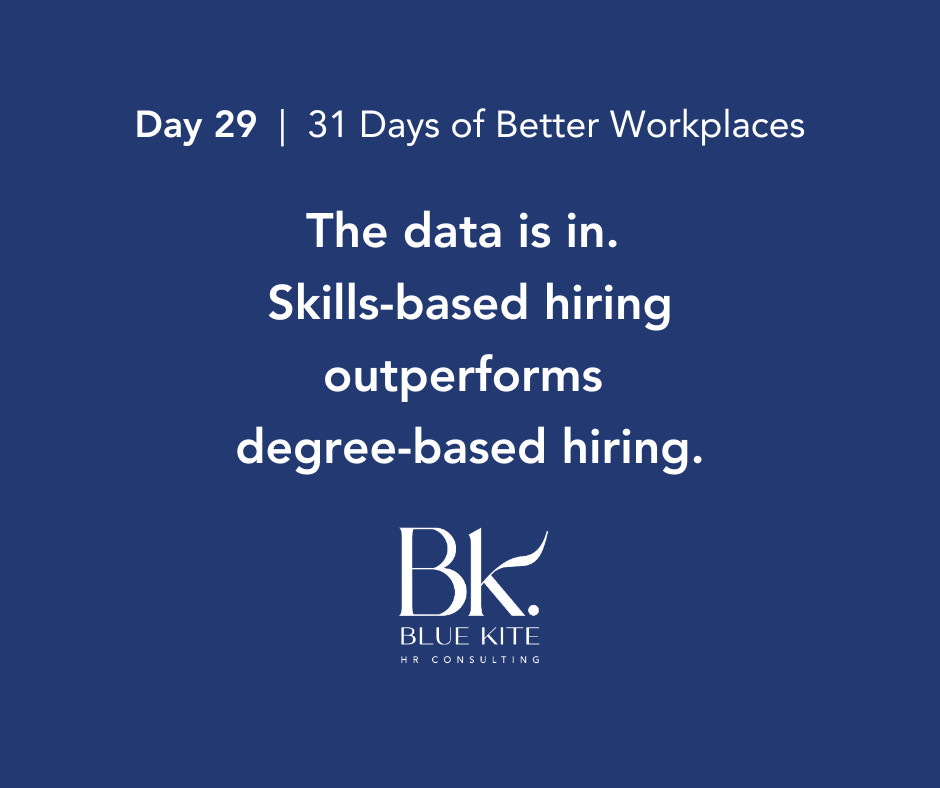
Skills-based hiring — evaluating candidates on demonstrated capabilities rather than credentials and employment history — is one of the most significant shifts happening in the global HR space right now. IBM, Apple, Dell, and the Australian Public Service have all removed degree requirements from substantial portions of their roles. The evidence is that job performance correlates poorly with where someone went to university and well with whether they can demonstrably do the work.
For SMEs, this is genuinely liberating. You’re competing for talent against companies with bigger brand names and bigger compensation budgets. A skills-based approach lets you find exceptional people that credential-focused companies are filtering out.


Myth 2: ‘We’ll know the right person when we meet them’ 

Gut-feel hiring is one of the best-documented sources of bias in the employment process. We like people who remind us of ourselves, who make us comfortable, who communicate in familiar ways. We discount people who are different — different background, different style, different way of presenting.
The research on unstructured interviews is unambiguous: they have poor predictive validity for job performance. Structured interviews — with consistent questions assessed against defined criteria — consistently outperform them. Standardised work samples and practical assessments outperform interviews.
This doesn’t mean you hire someone you don’t like. It means you separate your subjective response from your assessment of capability.


Myth 3: ‘Gen Z candidates just don’t have the work ethic’ 

This is perhaps the most damaging hiring myth circulating right now. Gen Z is the most educated, most digitally capable, most values-driven generation to enter the workforce. They have high expectations — of transparency, of purpose, of being managed well. Those expectations are not a character flaw.
The businesses that dismiss Gen Z candidates based on stereotypes are cutting themselves off from the majority of the available talent pool. The ones treating them as the discerning, capable adults they are — with clear communication about what the role involves, what the culture is like, and what development opportunities exist — are consistently reporting strong outcomes.


What smart hiring looks like now

Define the skills and capabilities the role actually requires — not just qualifications and experience — before you advertise. Build a structured process that assesses those capabilities consistently. Treat the candidate experience as a brand experience — how you hire reflects on who you are as an employer. Ask yourself honestly whether your hiring process is designed for the candidate market you have today, or the one that existed fifteen years ago.

Book your free 30-minute consultation at Blue Kite HR Consulting 


BACK TO ALL ARTICLES
Screenshot 2025-11-18 164639

+61 (0) 409 545 634

cpaterson@bluekite.au

FREE CONSULTATION

  • ABOUT
  • HR SERVICES
  • COACH WITH ME
  • HEALTH & WELLBEING
  • MEDIA/PR
  • ARTICLES/BLOG
  • RESOURCES
  • CONTACT
  • PRIVACY

Blue Kite specialises in providing
HR services to support businesses
to create better workplaces.
Filed Under: Advisory and compliance, Career Planning, Change management, Culture, External HR Support, HR essentials, Leadership

28 August, 2026 by Catie Paterson Leave a Comment

Strengths-Based Leadership: The Performance Approach That Changes Everything

ARTICLES

Strengths-Based Leadership: The Performance Approach That Changes Everything

28 August, 2026
Filed Under: Advisory and compliance, Business Update, Career Planning, Change management, Culture, External HR Support, HR essentials, Leadership

Day 28 of 31 Days of Better Workplaces — today I want to make the case for strengths-based leadership as one of the most evidence-backed and under-utilised approaches in the modern workplace. 

And I want to be honest about why it’s still underused: because most leadership systems are built around fixing weaknesses, not amplifying strengths. Performance reviews spend the majority of time on development areas. Coaching conversations default to what’s not working. Improvement plans are, by definition, focused on deficits.
This is understandable. It’s human to notice what’s wrong. But it’s also producing worse outcomes than the alternative.


What the research shows

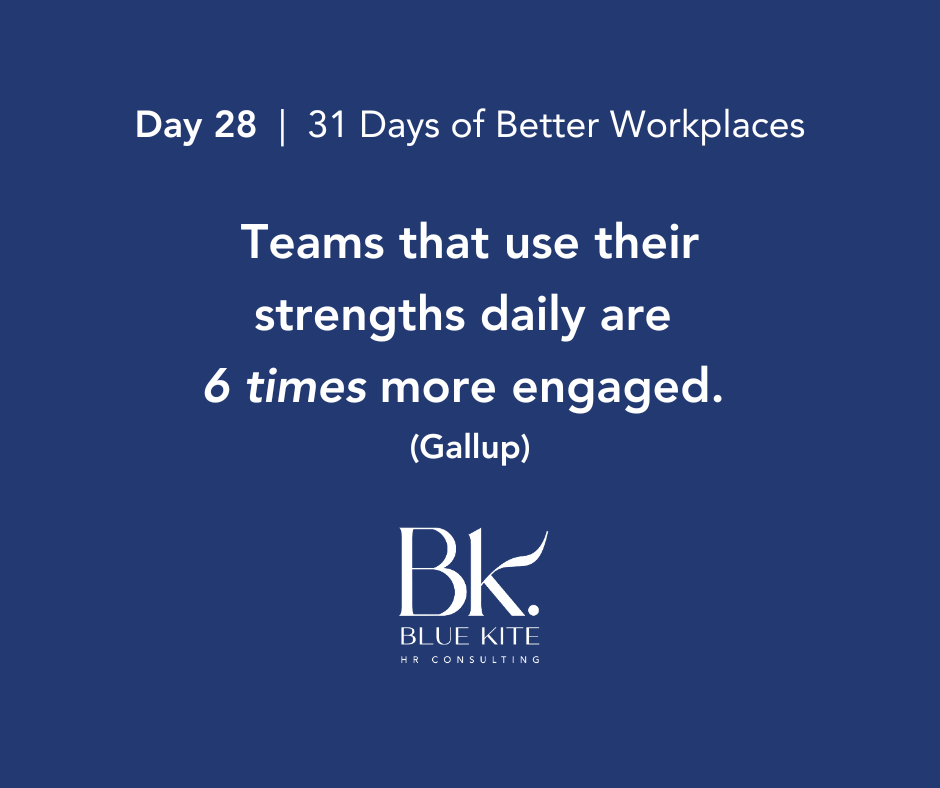
Gallup’s research — across millions of workers in dozens of countries — has produced a consistent finding: employees who use their strengths every day are six times more engaged than those who don’t. More engaged employees are more productive, have lower absenteeism, deliver better customer outcomes, and stay significantly longer.
The evidence on strengths-based interventions is also compelling in terms of performance improvement. Focusing development conversations on what someone does naturally well and building more opportunities for them to do it more produces measurably better performance outcomes than focusing exclusively on correcting weaknesses.
This does not mean ignoring genuine performance problems — and I want to be clear about that. If someone’s weaknesses are causing real harm to their work or team, those need to be addressed. Strengths-based leadership is not an excuse to avoid difficult conversations.
But it does mean rebalancing. The current default in most performance management systems is heavily deficit-focused — and the research suggests we’ve got the ratio wrong.


What’s emerging in contemporary businesses 

Strengths-based hiring: using tools like CliftonStrengths or DiSC (I’m an accredited DiSC facilitator) not just for development but to inform role design and team composition — understanding which combinations of strengths create high-performing teams.
Strengths-based job design: deliberately building roles and assignments that allow individuals to spend more of their time in areas of natural strength, rather than requiring everyone to perform identically across all dimensions.
Strengths-aware leadership conversations: leaders who understand the strengths profile of each team member and use that understanding to assign work, provide feedback, and have development conversations.


What this looks like in practice

Instead of asking “what do you need to improve?” in a performance conversation, also asking “where do you feel most energised at work, and how do we create more of that?”
Instead of designing teams for homogeneity, designing them for complementary strengths — understanding that what looks like “a difficult personality” is often a misapplied strength.
Instead of managing everyone the same way, adjusting how you communicate, delegate, and develop based on what each person naturally brings.


My view

The businesses building strengths-based cultures right now are not doing it because it feels good, although it does. They’re doing it because the data says it works. It produces better performance, better retention, and better wellbeing outcomes simultaneously — and in a tight labour market, that combination is a genuine competitive advantage.

Book your free 30-minute consultation at Blue Kite HR Consulting 


BACK TO ALL ARTICLES
Screenshot 2025-11-18 164639

+61 (0) 409 545 634

cpaterson@bluekite.au

FREE CONSULTATION

  • ABOUT
  • HR SERVICES
  • COACH WITH ME
  • HEALTH & WELLBEING
  • MEDIA/PR
  • ARTICLES/BLOG
  • RESOURCES
  • CONTACT
  • PRIVACY

Blue Kite specialises in providing
HR services to support businesses
to create better workplaces.
Filed Under: Advisory and compliance, Business Update, Career Planning, Change management, Culture, External HR Support, HR essentials, Leadership

27 August, 2026 by Catie Paterson Leave a Comment

Conflict at Work: When to Intervene and How

ARTICLES

Conflict at Work: When to Intervene and How

27 August, 2026
Filed Under: Advisory and compliance, Career Planning, Culture, External HR Support, HR essentials, Leadership

Day 27 of 31 Days of Better Workplaces — workplace conflict is inevitable. How you respond to it is not. 

Most leaders fall into one of two patterns: they intervene too early — stepping in to resolve things that the parties involved could have worked out themselves — or they wait too long, hoping things settle down and allowing conflict to escalate and damage both relationships and team performance.
Neither approach serves the business well.


The three types of conflict 

Task conflict

  • disagreement about approaches, methods, or work content.

This is actually healthy in small doses — it produces better decisions. Leaders should facilitate these conversations, not suppress them. 

Process conflict  

If employees do not feel safe to raise concerns, issues often stay hidden until they escalate. Businesses need reporting pathways that are trusted, clear, and free from fear of retaliation.

3. Workplace policies need to be lived, not just written 

  • disagreement about how work gets done, who is responsible, and what the expectations are.

This is often a management failure — unclear roles, poor processes, or misaligned expectations create the conditions for this type of conflict. The fix is usually structural, not interpersonal. 

Relationship conflict

  • personal friction between individuals.

This is the most damaging, the slowest to self-resolve, and the one that most requires active management intervention.


When to intervene

If the conflict is affecting the work, affecting other team members, or showing signs of escalating — intervene now. The “wait and see” approach for relationship conflict almost always results in a worse outcome.
Early intervention looks like: a private conversation with each person to understand their perspective, followed by a facilitated conversation between them where the goal is a workable way forward, not a declaration of who was right.


What not to do 

Don’t take sides based on seniority or performance history. Don’t discuss the conflict with other team members. Don’t make promises you can’t keep about outcomes.


When it’s beyond a conversation 

If the conflict involves allegations of bullying or harassment, it needs to be managed as a formal matter — with a proper investigation process, appropriate documentation, and adherence to your policies and the law.
Getting conflict management right protects the individuals involved, the team around them, and the culture of the business.


Book your free 30-minute consultation at Blue Kite HR Consulting 


BACK TO ALL ARTICLES
Screenshot 2025-11-18 164639

+61 (0) 409 545 634

cpaterson@bluekite.au

FREE CONSULTATION

  • ABOUT
  • HR SERVICES
  • COACH WITH ME
  • HEALTH & WELLBEING
  • MEDIA/PR
  • ARTICLES/BLOG
  • RESOURCES
  • CONTACT
  • PRIVACY

Blue Kite specialises in providing
HR services to support businesses
to create better workplaces.

Filed Under: Advisory and compliance, Career Planning, Culture, External HR Support, HR essentials, Leadership

23 August, 2026 by Catie Paterson Leave a Comment

Termination Done Right: The Legal Steps Most Businesses Skip

ARTICLES

Termination Done Right: The Legal Steps Most Businesses Skip

23 August, 2026
Filed Under: Business Update, Career Planning, Change management, Culture, External HR Support, HR essentials, Leadership

Day 23 of 31 Days of Better Workplaces — termination. It’s the part of the job nobody enjoys, and the part where the most legal mistakes are made. 

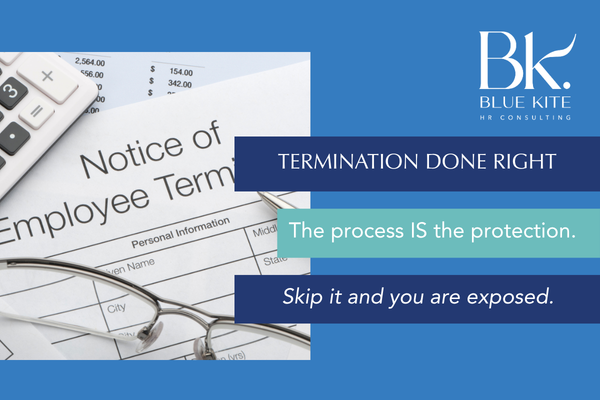
Getting termination wrong — even where the grounds for dismissal are completely valid — can convert a justified exit into an unfair dismissal or a general protections claim.


The steps most businesses skip

1. Providing a clear reason 

An employee being terminated has the right to know why. Not a vague statement about “business reasons” or “not being the right fit” — a specific, factual reason. If the termination is for performance or conduct, that reason should not be a surprise: it should have been communicated through a performance management process. 

2. Giving the opportunity to respond

Before a termination decision is finalised, the employee should be given an opportunity to respond to the reason. This doesn’t mean the decision changes — but the process requires that it’s offered. Skipping this step is one of the most common procedural failures in unfair dismissal cases.

3. Allowing a support person

Employees have the right to have a support person present in meetings where dismissal is being discussed. You don’t have to allow legal representation, but a trusted colleague or union representative is their right. Denying this, or failing to offer it, is a procedural risk.

4. Providing appropriate notice 

Termination requires the notice period specified in the contract or Award, or payment in lieu of notice. Not providing this is a breach of contract and an employment law violation.

5. Managing the final pay correctly

Final pay must be processed within a specific timeframe and must include all owed entitlements: outstanding wages, accrued annual leave, long service leave where applicable, and any other contractual entitlements. Errors in final pay are common and create additional legal exposure.


The documentation to have ready

Letter of termination, statement of the reason, final pay calculation, written record of the process followed.
Done properly, termination is clean, compliant, and defensible. Done carelessly, it creates exactly the kind of legal exposure you were trying to avoid.


Book a free 30-minute consulation at Blue Kite HR Consulting 


BACK TO ALL ARTICLES
Screenshot 2025-11-18 164639

+61 (0) 409 545 634

cpaterson@bluekite.au

FREE CONSULTATION

  • ABOUT
  • HR SERVICES
  • COACH WITH ME
  • HEALTH & WELLBEING
  • MEDIA/PR
  • ARTICLES/BLOG
  • RESOURCES
  • CONTACT
  • PRIVACY

Blue Kite specialises in providing
HR services to support businesses
to create better workplaces.

Filed Under: Business Update, Career Planning, Change management, Culture, External HR Support, HR essentials, Leadership

  • « Go to Previous Page
  • Page 1
  • Page 2
  • Page 3
  • Page 4
  • Interim pages omitted …
  • Page 7
  • Go to Next Page »

Copyright © 2026 · Executive Pro on Genesis Framework · WordPress · Log in koopo

  • HOME
  • ABOUT US
  • HR SERVICES
  • COACH WITH ME
  • HEALTH & WELLBEING
  • MEDIA/PR
    • – Articles/Blogs
    • – Keynote Speaking Events
    • – Podcast Interviews
    • – Ticker Interviews
  • BLOG
  • RESOURCES
  • CONTACT