
• Skip to primary navigation
  • Skip to main content

BlueKite HR

  • HOME
  • ABOUT US
  • HR SERVICES
  • COACH WITH ME
  • HEALTH & WELLBEING
  • MEDIA/PR
    • – Articles/Blogs
    • – Keynote Speaking Events
    • – Podcast Interviews
    • – Ticker Interviews
  • BLOG
  • RESOURCES
  • CONTACT

HR essentials

16 July, 2026 by Catie Paterson Leave a Comment

“We Treat Everyone the Same” Is Not a Fairness Strategy

ARTICLES

“We Treat Everyone the Same” Is Not a Fairness Strategy

16 July, 2026
Filed Under: Advisory and compliance, Change management, Culture, External HR Support, HR essentials, Leadership

One of the most well-intentioned and most frequently misapplied principles in management is the commitment to treating everyone the same. It comes from a genuine desire for fairness — no favouritism, no double standards, consistent application of the rules. These are admirable intentions. And the conclusion drawn from them is mistaken.

Treating people identically is not fairness. It is a shortcut that substitutes consistency of process for equity of outcome, and it disadvantages people who begin from different circumstances.

A parent returning from parental leave needs a different reintegration conversation than someone who has been working continuously. A team member managing chronic illness needs a different conversation about workload than one who is not. A person early in their career in a new industry needs a different level of support and guidance than someone with twenty years of relevant experience.

Applying the same response to all of these situations because “we treat everyone the same” does not produce fairness. It produces an appearance of fairness in the process while the outcomes quietly move in different directions.

Genuine fairness requires leaders to understand the circumstances of the individuals they manage and to calibrate their response accordingly. That is more demanding than uniform treatment. It also requires more trust,  which is why some leaders resist it. The preference for treating everyone the same can, on examination, be more about the leader’s comfort than the employee’s need.

The question is not whether a process was applied consistently. It is whether the outcome it produced was genuinely equitable.


If you want practical support your leadership development, Blue Kite HR Consulting can help you take a proactive approach before issues become bigger problems.
 

BACK TO ALL ARTICLES
Screenshot 2025-11-18 164639

+61 (0) 409 545 634

cpaterson@bluekite.au

FREE CONSULTATION

  • ABOUT
  • HR SERVICES
  • COACH WITH ME
  • HEALTH & WELLBEING
  • MEDIA/PR
  • ARTICLES/BLOG
  • RESOURCES
  • CONTACT
  • PRIVACY

Blue Kite specialises in providing
HR services to support businesses
to create better workplaces.
Filed Under: Advisory and compliance, Change management, Culture, External HR Support, HR essentials, Leadership

15 July, 2026 by Catie Paterson Leave a Comment

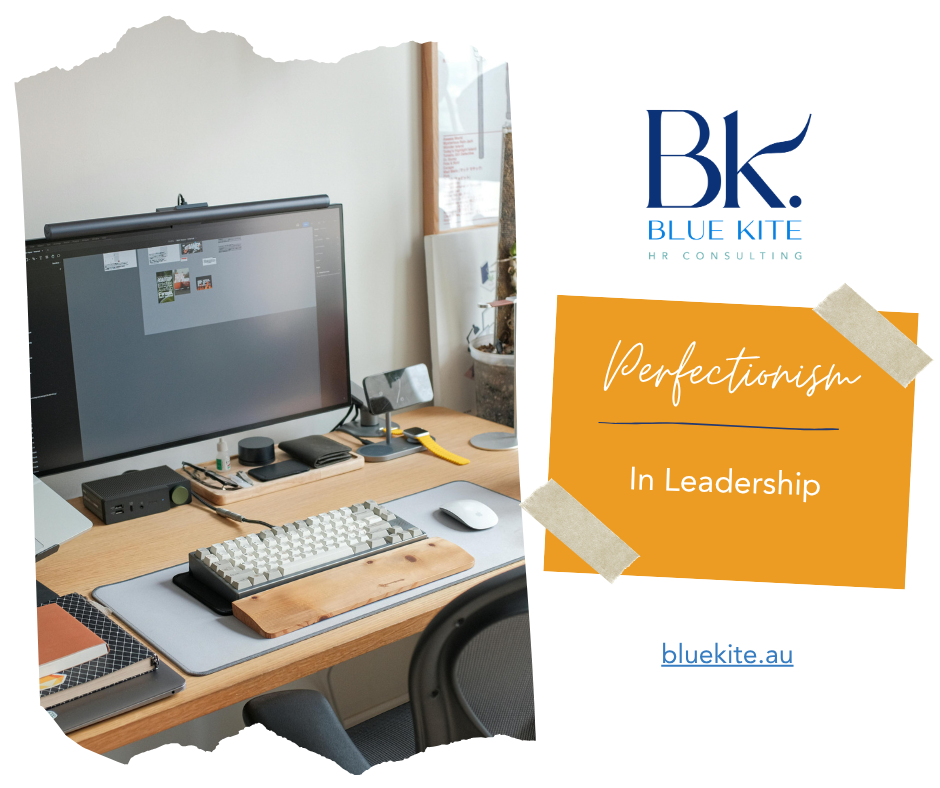
The Cost of Perfectionism in Leadership

ARTICLES

The Cost of Perfectionism in Leadership

15 July, 2026
Filed Under: Advisory and compliance, Change management, Culture, External HR Support, HR essentials, Leadership

Perfectionism is often worn as a badge of high standards in leadership. It is associated with quality, with attention to detail and with an unwillingness to accept mediocre output. These are genuine virtues. They also come with a shadow that most perfectionistic leaders do not fully see.

The cost of perfectionism is paid by the people around the leader. Teams where perfection is the implicit standard become risk-averse. People stop bringing half-formed ideas because they have learned that anything not fully developed will be dismissed. They over-invest time in tasks that require good-enough outputs, because calibrating to the leader’s standard requires certainty before anything is shared.

Perfectionistic leaders also tend to find delegation deeply uncomfortable, because handing something over means accepting that it will be done differently. That discomfort keeps them involved at a level of detail that prevents their team from developing genuine ownership.

There is also an emotional dimension. Perfectionism in leadership often signals that the leader is managing their own anxiety,  — about being wrong, about being exposed, about not being good enough,  through the quality of the work.

The standard is not set for the work’s sake. It is set for the leader’s psychological safety. And that distinction, invisible to the leader, is often felt acutely by the team.

High standards and perfectionism are not the same thing. One is about the work. The other is about the leader. Distinguishing between them — and asking which one is actually operating — is a valuable question for any leader willing to sit with an honest answer.


If you want practical support with leadership development, Blue Kite HR Consulting can help you take a proactive approach before issues become bigger problems.


BACK TO ALL ARTICLES
Screenshot 2025-11-18 164639

+61 (0) 409 545 634

cpaterson@bluekite.au

FREE CONSULTATION

  • ABOUT
  • HR SERVICES
  • COACH WITH ME
  • HEALTH & WELLBEING
  • MEDIA/PR
  • ARTICLES/BLOG
  • RESOURCES
  • CONTACT
  • PRIVACY

Blue Kite specialises in providing
HR services to support businesses
to create better workplaces.
Filed Under: Advisory and compliance, Change management, Culture, External HR Support, HR essentials, Leadership

14 July, 2026 by Catie Paterson Leave a Comment

Neurodiversity: The Competitive Advantage Most Workplaces Are Underusing

ARTICLES

Neurodiversity: The Competitive Advantage Most Workplaces Are Underusing

14 July, 2026
Filed Under: Advisory and compliance, Change management, Culture, External HR Support, HR essentials, Leadership

Neurodiversity — the natural variation in how human brains process information, communicate and engage with the world — represents one of the most underutilised sources of capability in most businesses. Not because neurodiverse individuals lack talent, but because most workplaces are not designed in ways that allow that talent to be visible or effectively deployed.   

ADHD, autism, dyslexia and other neurological differences are not deficits. They are different operating systems, each with genuine strengths alongside the challenges that most people focus on.

Pattern recognition, systems thinking, deep focus, unconventional problem-solving, exceptional memory for detail — these capabilities appear at higher rates in neurodiverse individuals and represent genuine competitive value when well-supported.

The barriers are almost always environmental. Hiring processes that screen on communication style rather than capability. Workplaces designed for one way of processing information. Management approaches that mistake difference for difficulty. Performance evaluations that measure conformity rather than contribution.

Businesses that are beginning to take neurodiversity seriously are not doing so out of compliance obligation, though legal frameworks are increasingly relevant. They are doing so because they have recognised that cognitive diversity, alongside all other forms of diversity, directly improves the quality of their collective thinking.

The investment required is primarily in awareness and in flexibility. Flexible communication methods. Interview practices that assess capability rather than social performance. Managers who understand that there is more than one effective way to be excellent at a job. These adjustments benefit the entire workforce, not only those with a formal diagnosis.

If you want practical support reviewing your workplace policies, contracts, leadership capability, or workplace culture, Blue Kite HR Consulting can help you take a proactive approach before issues become bigger problems.


BACK TO ALL ARTICLES
Screenshot 2025-11-18 164639

+61 (0) 409 545 634

cpaterson@bluekite.au

FREE CONSULTATION

  • ABOUT
  • HR SERVICES
  • COACH WITH ME
  • HEALTH & WELLBEING
  • MEDIA/PR
  • ARTICLES/BLOG
  • RESOURCES
  • CONTACT
  • PRIVACY

Blue Kite specialises in providing
HR services to support businesses
to create better workplaces.

Filed Under: Advisory and compliance, Change management, Culture, External HR Support, HR essentials, Leadership

13 July, 2026 by Catie Paterson Leave a Comment

The Micromanagement Trap (And What Drives It)

ARTICLES

The Micromanagement Trap (And What Drives It)

13 July, 2026
Filed Under: Advisory and compliance, Change management, Culture, External HR Support, HR essentials, Leadership

Micromanagement is widely understood to be damaging — to morale, to development, to the quality of an employee’s experience and to the productivity of the leader doing the managing. Most leaders who micromanage know, on some level, that they do it. Many would prefer not to.

Understanding what drives micromanagement makes it possible to address it at the source rather than simply recognising it as a bad habit.

In most cases, micromanagement is driven by anxiety — about outcomes, about accountability, about the consequences of things going wrong.

A leader who is held responsible for results, but does not trust their team’s capability to deliver them, will tend to close that gap through control rather than development. The more exposed a leader feels, the more tightly they hold.

There are also leaders who micromanage because they have not yet made the psychological transition from individual contributor to leader. Their identity is still tied to the quality of the work itself, rather than the quality of the people producing it. Letting go of the work feels like letting go of what made them valuable.

Neither of these drivers is addressed by telling someone to delegate more.

They require a genuine shift in how the leader understands their role, what they are being measured on and how much support they have in building trust in their team’s capability.

Businesses that address micromanagement through performance frameworks or management feedback without addressing the underlying anxiety tend to produce leaders who have learned to hide the control, not relinquish it.


If you want practical support rsupporting your leaders, Blue Kite HR Consulting can help you take a proactive approach before issues become bigger problems.


BACK TO ALL ARTICLES
Screenshot 2025-11-18 164639

+61 (0) 409 545 634

cpaterson@bluekite.au

FREE CONSULTATION

  • ABOUT
  • HR SERVICES
  • COACH WITH ME
  • HEALTH & WELLBEING
  • MEDIA/PR
  • ARTICLES/BLOG
  • RESOURCES
  • CONTACT
  • PRIVACY

Blue Kite specialises in providing
HR services to support businesses
to create better workplaces.

Filed Under: Advisory and compliance, Change management, Culture, External HR Support, HR essentials, Leadership

12 July, 2026 by Catie Paterson Leave a Comment

Why Policies Don’t Change Behaviour

ARTICLES

Why Policies Don’t Change Behaviour

12 July, 2026
Filed Under: Advisory and compliance, Change management, Culture, External HR Support, HR essentials, Leadership

If policies reliably changed behaviour, businesses that had the most comprehensive policy libraries would have the healthiest cultures. The evidence suggests otherwise.

Policies are necessary. They establish the standard, create legal defensibility and provide a reference point when conduct is in dispute. But knowing a policy exists does not cause someone to act in accordance with it, particularly when the culture around them signals that the policy is aspirational rather than operational.

Behaviour at work is shaped by what people observe being modelled, what they experience being rewarded and what they witness being tolerated. These three signals, operating continuously and largely informally, are far more powerful determinants of how people actually behave than any documented standard.

This means that a business can have an excellent anti-bullying policy and a bullying culture. It can have a thorough performance management framework and almost no honest performance conversations. It can espouse values it consistently undermines through the conduct it permits.

Closing the gap between policy and practice is a leadership challenge, not a documentation one.

It requires leaders to model the behaviours the policy describes, to address deviations clearly and consistently and to create the conditions in which the formal standard and the informal norm are actually the same thing.

Adding more policies to a culture that is not acting on the ones it already has solves nothing. The question is never whether the standard is written down. It is whether the people with the most influence in the organisation are visibly living it.


If you want practical support reviewing your workplace policies, contracts, leadership capability, or workplace culture, Blue Kite HR Consulting can help you take a proactive approach before issues become bigger problems.


BACK TO ALL ARTICLES
Screenshot 2025-11-18 164639

+61 (0) 409 545 634

cpaterson@bluekite.au

FREE CONSULTATION

  • ABOUT
  • HR SERVICES
  • COACH WITH ME
  • HEALTH & WELLBEING
  • MEDIA/PR
  • ARTICLES/BLOG
  • RESOURCES
  • CONTACT
  • PRIVACY

Blue Kite specialises in providing
HR services to support businesses
to create better workplaces.

Filed Under: Advisory and compliance, Change management, Culture, External HR Support, HR essentials, Leadership

11 July, 2026 by Catie Paterson Leave a Comment

Conflict Is Information

ARTICLES

Conflict Is Information

11 July, 2026
Filed Under: Advisory and compliance, Business Update, Change management, Culture, External HR Support, HR essentials, Leadership

The instinct in most workplaces is to treat conflict as a problem to be resolved as quickly and quietly as possible. Get the parties in a room, reach an agreement, close the file and move on. The discomfort of interpersonal friction, the disruption it creates and the time it absorbs make it genuinely difficult to think of conflict as anything other than a failure to be corrected.

But conflict is also information. And businesses that treat it only as a problem consistently miss what it is trying to tell them.

When conflict appears between two people, it is worth asking what conditions made that conflict possible. Unclear role boundaries. Competing incentives. A process that forces two parts of the business into opposition. A leadership absence that allowed tension to build without intervention. These are not always the cause, but they are often a contributing factor, and they are worth examining regardless of how the immediate dispute is resolved.

Recurring conflict in the same team or between the same functions is almost always an organisational signal rather than an interpersonal one. The people may change; the pattern persists. Addressing the individuals without examining the system produces a temporary resolution that will be replaced by the same pattern with different people.

The businesses that learn the most from conflict are the ones willing to ask not just “how do we resolve this?” but “what is this telling us about how we are structured, led and designed?” That question requires more intellectual courage. It also produces far more durable answers.

If you want practical support reviewing your workplace policies, contracts, leadership capability, or workplace culture, Blue Kite HR Consulting can help you take a proactive approach before issues become bigger problems.


BACK TO ALL ARTICLES
Screenshot 2025-11-18 164639

+61 (0) 409 545 634

cpaterson@bluekite.au

FREE CONSULTATION

  • ABOUT
  • HR SERVICES
  • COACH WITH ME
  • HEALTH & WELLBEING
  • MEDIA/PR
  • ARTICLES/BLOG
  • RESOURCES
  • CONTACT
  • PRIVACY

Blue Kite specialises in providing
HR services to support businesses
to create better workplaces.

Filed Under: Advisory and compliance, Business Update, Change management, Culture, External HR Support, HR essentials, Leadership

  • « Go to Previous Page
  • Page 1
  • Interim pages omitted …
  • Page 11
  • Page 12
  • Page 13
  • Page 14
  • Page 15
  • Interim pages omitted …
  • Page 24
  • Go to Next Page »

Copyright © 2026 · Executive Pro on Genesis Framework · WordPress · Log in koopo

  • HOME
  • ABOUT US
  • HR SERVICES
  • COACH WITH ME
  • HEALTH & WELLBEING
  • MEDIA/PR
    • – Articles/Blogs
    • – Keynote Speaking Events
    • – Podcast Interviews
    • – Ticker Interviews
  • BLOG
  • RESOURCES
  • CONTACT