
• Skip to primary navigation
  • Skip to main content

BlueKite HR

  • HOME
  • ABOUT US
  • HR SERVICES
  • COACH WITH ME
  • HEALTH & WELLBEING
  • MEDIA/PR
    • – Articles/Blogs
    • – Keynote Speaking Events
    • – Podcast Interviews
    • – Ticker Interviews
  • BLOG
  • RESOURCES
  • CONTACT

Workforce

9 August, 2026 by Bronwyn Coulthart Leave a Comment

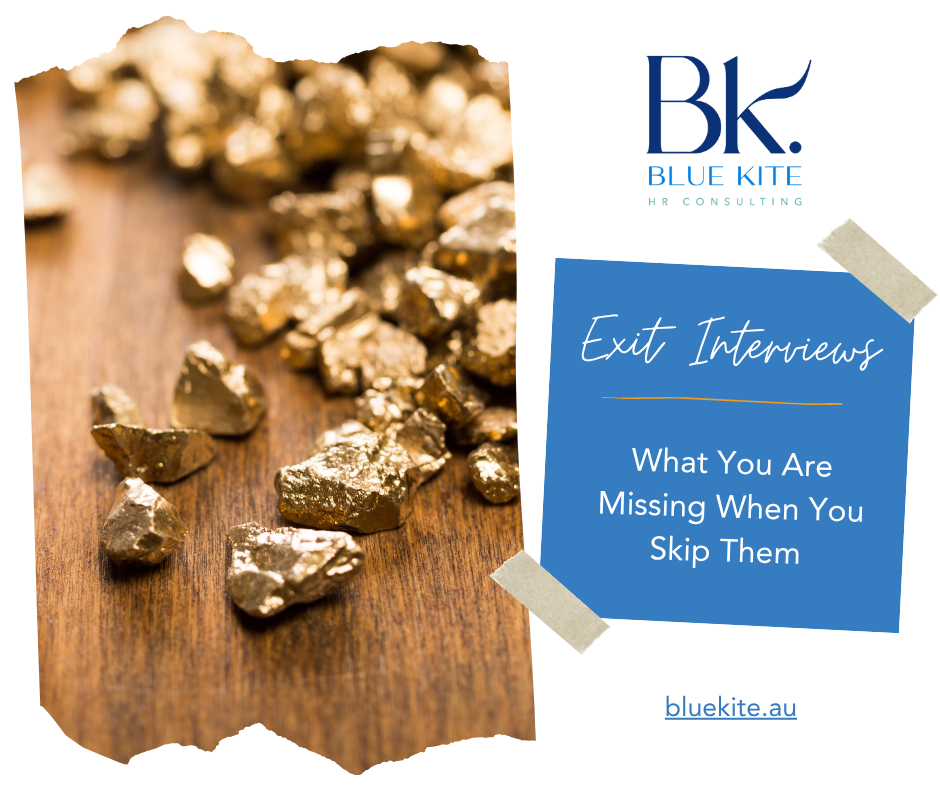
Exit Interviews: Why You’re Missing Gold When You Skip Them

ARTICLES

Exit Interviews: Why You're Missing Gold When You Skip Them
9 August, 2026
Filed Under: Advisory and compliance, Business Update, Change management, Culture, External HR Support, HR essentials, Leadership, Workforce

Exit interviews are one of the most underused tools in a businesses HR toolkit.  

Most businesses skip them entirely. Some do them but don’t act on what they hear. A small number use them really well — and those businesses consistently have lower turnover than their peers.
Here’s what you’re missing when someone walks out the door without an exit interview.


The real reason why they are leaving 

The stated reason for resignation is almost never the whole picture. “A better opportunity” often means “I was looking for something better because I wasn’t happy here.” An exit interview, done well and done safely, surfaces the real driver — and that information is invaluable.

Patterns you can’t see 

Individual exit interviews tell you one person’s experience. Aggregate data from multiple exits tells you something systemic — a manager who consistently features in exit conversations, a team with retention problems, a policy or practice that’s driving people away.

Intelligence on market position 

Departing employees often know what your competitors are offering, what the market rate is, and what alternative employers are doing that you’re not. That’s genuinely useful business intelligence.

How to make them work 

Conduct them as a conversation, not a form. Use a short, structured survey if you’re worried about time — but follow it up with a brief conversation where possible.
Do them with someone other than the person’s direct leader. People will not be honest about their experience if the person they’re talking to is part of the problem.
Keep them confidential. If people think what they say will be used against them or shared indiscriminately, they’ll tell you nothing useful.
Act on what you hear. The quickest way to make exit interviews worthless is to do them and do nothing with the information. Share themes with leadership, track patterns, and show the remaining team that feedback gets taken seriously.
A departing employee is one of the most honest sources of information about your business you’ll ever have. Don’t let them leave without asking the right questions.

Book a free 30-minute consultation at Blue Kite HR Consulting 
BACK TO ALL ARTICLES
Screenshot 2025-11-18 164639

+61 (0) 409 545 634

cpaterson@bluekite.au

FREE CONSULTATION

  • ABOUT
  • HR SERVICES
  • COACH WITH ME
  • HEALTH & WELLBEING
  • MEDIA/PR
  • ARTICLES/BLOG
  • RESOURCES
  • CONTACT
  • PRIVACY

Blue Kite specialises in providing
HR services to support businesses
to create better workplaces.

Filed Under: Advisory and compliance, Business Update, Change management, Culture, External HR Support, HR essentials, Leadership, Workforce

8 August, 2026 by Bronwyn Coulthart Leave a Comment

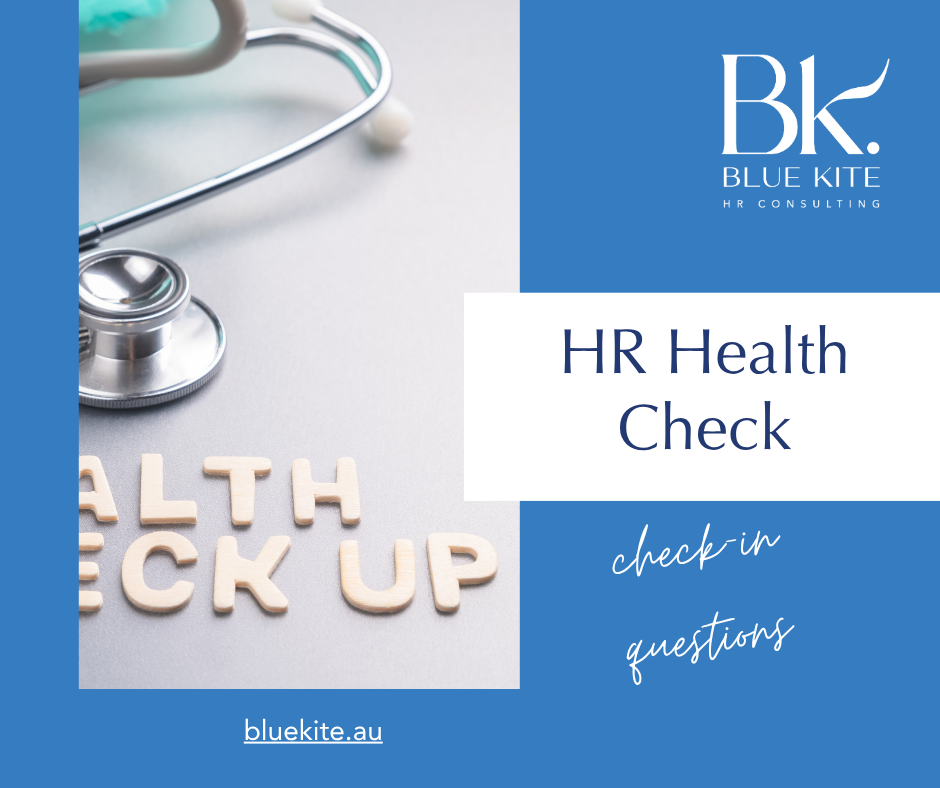
HR Health Check: 8 Questions Every Business Should Ask Themselves

ARTICLES

HR Health Check: 8 Questions Every SME Should Ask Themselves

8 August, 2026
Filed Under: Advisory and compliance, Business Update, Change management, Culture, External HR Support, HR essentials, Leadership, Workforce, Workforce Planning

Day 8 of 31 Days of Better Workplaces — today is a self-audit. Answer these eight questions honestly and you’ll know exactly where your HR priorities need to be.


 1. Are your employment contracts up to date? 

Have they been reviewed in the last 18 months? Do they reflect current roles and obligations? If you’re using the same template you’ve had for three years, the answer is probably no.

2. Are you paying people correctly under their Award?

Modern Award compliance is one of the most common — and most expensive — gaps for busiensses. Incorrect classifications, missed penalty rates, and outdated pay rates are all serious risks.

3. Do you have compliant policies in place? 

At minimum: a bullying and harassment policy, a WHS policy, a social media policy, and a leave policy. If you don’t have documented policies, you’re managing by word of mouth — and that doesn’t hold up when something goes wrong. 

4. Are your position descriptions current and accurate? 

Outdated position descriptions create confusion about responsibilities, make performance management harder, and create compliance risks if a role’s actual duties don’t match what’s on paper.

5. Do your leaders know how to have a performance conversation?

Most performance problems escalate because managers don’t address them early. Do your team leaders have the skills and the confidence to have these conversations? If not, that’s a significant risk.

6. Do you have a documented onboarding process? 

Not a loose collection of tasks — an actual structured process. If every new person’s onboarding depends on who happens to be available that week, you’re leaving retention to chance.

7. When did you last review your workplace culture? 

Not guessed at — actually assessed. Exit interview data, turnover rates, absenteeism patterns, and team engagement tell you things that gut feel doesn’t.

8. Do you have a clear process for handling complaints?

If an employee came to you today with a complaint about a colleague or manager, would you know exactly how to handle it? If the answer involves a lot of “we’d work it out,” you need a process.
Score yourself honestly. Three or more concerns means it’s time for a proper HR audit — before any of these become a costly problem.

Book your free 30-minute consultation at Blue Kite HR Consulting

BACK TO ALL ARTICLES
Screenshot 2025-11-18 164639

+61 (0) 409 545 634

cpaterson@bluekite.au

FREE CONSULTATION

  • ABOUT
  • HR SERVICES
  • COACH WITH ME
  • HEALTH & WELLBEING
  • MEDIA/PR
  • ARTICLES/BLOG
  • RESOURCES
  • CONTACT
  • PRIVACY

Blue Kite specialises in providing
HR services to support businesses
to create better workplaces.
Filed Under: Advisory and compliance, Business Update, Change management, Culture, External HR Support, HR essentials, Leadership, Workforce, Workforce Planning

6 August, 2026 by Bronwyn Coulthart Leave a Comment

Difficult Conversations

ARTICLES

Difficult Conversations

6 August, 2026
Filed Under: Advisory and compliance, Change management, Culture, External HR Support, HR essentials, Leadership, Workforce

If there’s one skill that separates effective leaders from struggling ones, it’s the ability to have a difficult conversation without either avoiding it or handling it so poorly it makes things worse. 

Most people don’t avoid difficult conversations because they don’t care. They avoid them because they don’t know how to structure them, they’re worried about the reaction, or they’ve had experiences in the past where it went badly.
Here’s a framework that works.

Before the conversation

Get clear on what you’re actually trying to achieve. Is this about a specific behaviour that needs to change? A performance issue? A cultural concern? The clearer you are, the more effective the conversation will be. Gather your facts. Stick to observable behaviour, not character assessments.

Opening the Conversation

Be direct. Don’t soften it so much the message gets lost, but don’t lead with accusation either. Try: “I want to talk to you about something I’ve noticed and get your perspective.” That’s an honest opening that signals both what the conversation is about and that you’re interested in hearing their side.

During the conversation

State what you’ve observed specifically and concisely. Then stop talking and listen. Ask questions. “Can you help me understand what’s happening from your perspective?” often reveals context you didn’t have. Don’t fill every silence — give them space to respond.

The agreement 

Be clear about what needs to change and by when. Don’t leave the conversation vague. Both parties should leave with the same understanding of what was discussed and what happens next.

After the conversation

Follow up. Check in within a week. Acknowledge improvement when you see it. Document what was discussed if the issue is serious enough to warrant it.

The rule I give leaders 

If you’ve been thinking about having a conversation for more than two weeks, you’ve waited too long. The longer an issue sits, the harder the conversation becomes and the more resentment builds on both sides.

Done early, done respectfully, and done well — a difficult conversation is one of the most caring things a manager can do.

Book a free 30-minute consultation at Blue Kite HR Consulting 

BACK TO ALL ARTICLES
Screenshot 2025-11-18 164639

+61 (0) 409 545 634

cpaterson@bluekite.au

FREE CONSULTATION

  • ABOUT
  • HR SERVICES
  • COACH WITH ME
  • HEALTH & WELLBEING
  • MEDIA/PR
  • ARTICLES/BLOG
  • RESOURCES
  • CONTACT
  • PRIVACY

Blue Kite specialises in providing
HR services to support businesses
to create better workplaces.
Filed Under: Advisory and compliance, Change management, Culture, External HR Support, HR essentials, Leadership, Workforce

5 August, 2026 by Bronwyn Coulthart Leave a Comment

Good Managers Don’t Develop Themselves by Accident

ARTICLES

Good Managers Don't Develop Themselves by Accident

5 August, 2026
Filed Under: Advisory and compliance, Business Update, Change management, Culture, External HR Support, HR essentials, Leadership, Workforce, Workforce Planning

Here’s What the Research Says They Do Differently — and Why Your Business Depends on It.


Day 5 of 31 Days of Better Workplaces — today, leadership development. And I want to get specific about what’s changing.

For years, we’ve assumed that people become good managers through experience and instinct. You put someone in a leadership role, they figure it out, and the ones with natural talent rise.

That assumption is producing management teams that are ill-equipped for the workforce they’re now leading.

What’s shifted  

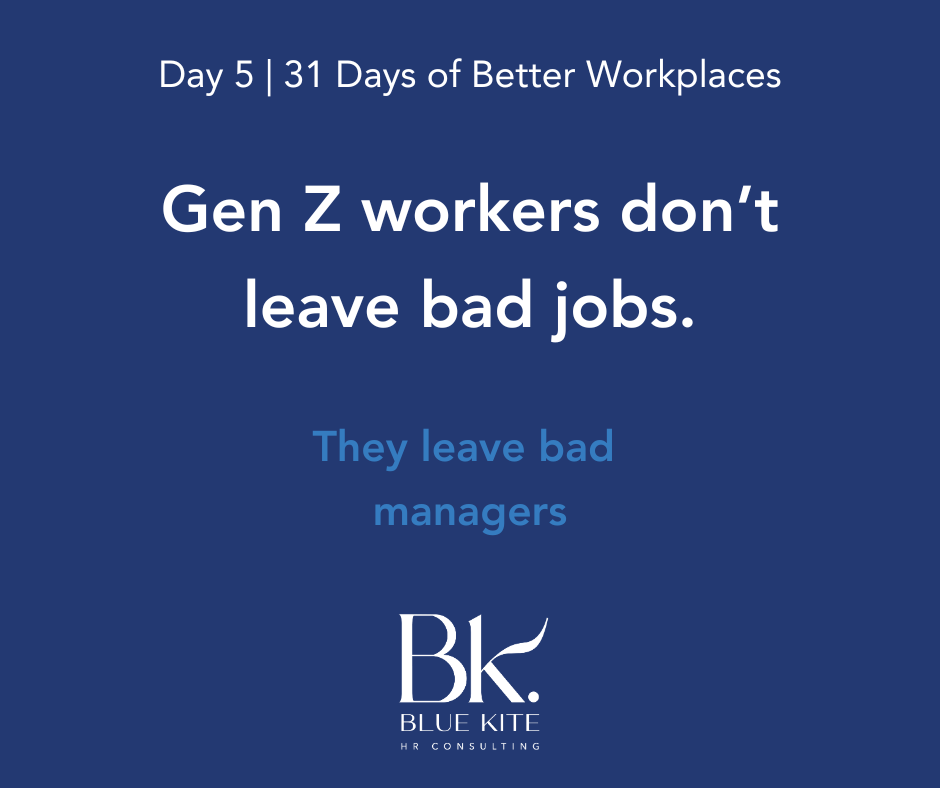
The workforce entering management now spans four generations, with Gen Z now making up a significant and growing share of most SME teams. The expectations they bring are not a phase — they’re a permanent recalibration of what employees want from work and from managers.
Gen Z, in particular, want managers who explain the why, who give honest and regular feedback (not just annual reviews), who engage with them as individuals, and who model the work-life boundaries they’re being told to maintain. They have low tolerance for ambiguity, low tolerance for inconsistency, and a strong radar for inauthenticity.
This isn’t criticism — it’s a description of a workforce that grew up with access to information and expects transparency as a default.

What’s good managers are doing differently right now

They are developing coaching capability — learning how to ask questions before providing answers, how to develop capability in others rather than just directing tasks. This is not a soft skill; it drives measurable productivity improvements.
They are building emotional intelligence as a conscious practice — not as a personality trait but as a set of skills: recognising their own patterns under pressure, staying regulated in difficult conversations, understanding what’s driving behaviour in others.
They are creating individual connection — knowing what motivates each person on their team, what their development goals are, what’s happening in their life that affects their work. Not as an intrusion, but as genuine interest.

What smart SMEs are doing now

They’re investing in leadership development before they need it — not after a leadership failure forces the issue. The businesses getting ahead are building management capability systematically, not waiting for it to emerge.
My own leadership program works precisely because it treats leadership as a learnable, practiceable discipline — not a personality trait you either have or you don’t.
The question isn’t whether your managers need development. It’s whether you’re going to address that now, while there’s time, or react to it after your best people leave.

Book a 30-minute free consultation at Blue Kite HR Consulting 

BACK TO ALL ARTICLES
Screenshot 2025-11-18 164639

+61 (0) 409 545 634

cpaterson@bluekite.au

FREE CONSULTATION

  • ABOUT
  • HR SERVICES
  • COACH WITH ME
  • HEALTH & WELLBEING
  • MEDIA/PR
  • ARTICLES/BLOG
  • RESOURCES
  • CONTACT
  • PRIVACY

Blue Kite specialises in providing
HR services to support businesses
to create better workplaces.
Filed Under: Advisory and compliance, Business Update, Change management, Culture, External HR Support, HR essentials, Leadership, Workforce, Workforce Planning

4 August, 2026 by Bronwyn Coulthart Leave a Comment

Performance Management: 5 Steps Every Business Needs

ARTICLES

Performance Management: 5 Steps Every Business Needs

4 August, 2026
Filed Under: Business Update, Career Planning, Change management, Culture, External HR Support, HR essentials, Leadership, Media Appearances, Succession Management, Workforce

Performance management is the topic most managers dread. But when it’s done right, it’s one of the most powerful tools you have. 


The goal of performance management isn’t to build a paper trail for termination. It’s to help people do their best work and to address problems early, before they become serious. Most  businesses either avoid it entirely — hoping problems resolve themselves — or jump to formal processes too late.
Here’s a straightforward five-step framework:


Step 1. Be clear about expectations from the start 

You cannot manage performance against expectations that were never clearly communicated. Every role needs clear KPIs, responsibilities, and standards. If yours don’t have them, that’s your starting point.


Step 2. Have regular one-on-ones

Performance issues rarely emerge overnight. They develop over time — and regular check-ins allow you to catch early signs, give real-time feedback, and maintain the relationship that makes difficult conversations easier.


Step 3. Address issues early and informally 

When you notice a performance concern, address it quickly and informally first. A brief, direct conversation — “I’ve noticed this, I want to understand what’s happening” — is far more effective than letting it build until a formal process is required.


Step 4. Document what matters 

If a performance issue is ongoing, start keeping brief notes. Date, what was observed, what was discussed, what was agreed. This isn’t about catching someone out — it’s about creating a clear record that protects both of you.


Step 5. Move to a formal process when informal hasn’t worked

A formal performance improvement plan (PIP) should be used when informal conversations haven’t produced improvement. It should be clear, time-bound, specific, and — critically — include genuine support for the person to succeed.
The Fair Work Act has specific requirements around procedural fairness. Get the process right, and you protect the business. Get it wrong, and a


Book a free 30-minute consultation at bluekite.au

BACK TO ALL ARTICLES
Screenshot 2025-11-18 164639

+61 (0) 409 545 634

cpaterson@bluekite.au

FREE CONSULTATION

  • ABOUT
  • HR SERVICES
  • COACH WITH ME
  • HEALTH & WELLBEING
  • MEDIA/PR
  • ARTICLES/BLOG
  • RESOURCES
  • CONTACT
  • PRIVACY

Blue Kite specialises in providing
HR services to support businesses
to create better workplaces.

Filed Under: Business Update, Career Planning, Change management, Culture, External HR Support, HR essentials, Leadership, Media Appearances, Succession Management, Workforce

30 June, 2026 by Bronwyn Coulthart Leave a Comment

HR as a Growth Engine: Moving Beyond Risk Management

ARTICLES

HR as a Growth Engine: Moving Beyond Risk Management

30 June, 2026
Filed Under: Advisory and compliance, Business Update, Career Planning, Change management, Culture, HR essentials, Onboarding, Workforce, Workforce Planning

HR has traditionally been associated with risk management—ensuring compliance, managing employee relations and maintaining policies. While these responsibilities remain important, they represent only part of HR’s potential contribution to a business.

Increasingly, organisations are recognising HR as a driver of growth. When aligned with business objectives, HR can influence leadership capability, workforce effectiveness and overall performance.

A growth-focused HR function looks beyond processes and considers how people practices support business outcomes. This may involve developing leadership capability, improving performance management, strengthening culture or enhancing the employee experience.

For example, effective leadership development can improve decision-making and team performance. Clear performance management processes can support accountability and productivity. A strong culture can enhance engagement and retention.

To operate in this way, HR needs to be involved in strategic decision-making. This requires a clear understanding of the business, its objectives and the role people play in achieving them.

Importantly, this shift is not solely about HR. It requires leaders across the business to engage with people practices as a core part of business performance.

HR is not only there to manage risk. When used effectively, it can support growth, strengthen capability and contribute to long-term success.

Get on the waitlist for my Blue Kite HR Advisory Portal, here.

BACK TO ALL ARTICLES
Screenshot 2025-11-18 164639

+61 (0) 409 545 634

cpaterson@bluekite.au

FREE CONSULTATION

  • ABOUT
  • HR SERVICES
  • COACH WITH ME
  • HEALTH & WELLBEING
  • MEDIA/PR
  • ARTICLES/BLOG
  • RESOURCES
  • CONTACT
  • PRIVACY

Blue Kite specialises in providing
HR services to support businesses
to create better workplaces.

Filed Under: Advisory and compliance, Business Update, Career Planning, Change management, Culture, HR essentials, Onboarding, Workforce, Workforce Planning

  • « Go to Previous Page
  • Page 1
  • Page 2
  • Page 3
  • Page 4
  • Interim pages omitted …
  • Page 8
  • Go to Next Page »

Copyright © 2026 · Executive Pro on Genesis Framework · WordPress · Log in koopo

  • HOME
  • ABOUT US
  • HR SERVICES
  • COACH WITH ME
  • HEALTH & WELLBEING
  • MEDIA/PR
    • – Articles/Blogs
    • – Keynote Speaking Events
    • – Podcast Interviews
    • – Ticker Interviews
  • BLOG
  • RESOURCES
  • CONTACT