
• Skip to primary navigation
  • Skip to main content

BlueKite HR

  • HOME
  • ABOUT US
  • HR SERVICES
  • COACH WITH ME
  • HEALTH & WELLBEING
  • MEDIA/PR
    • – Articles/Blogs
    • – Keynote Speaking Events
    • – Podcast Interviews
    • – Ticker Interviews
  • BLOG
  • RESOURCES
  • CONTACT

Catie Paterson

17 August, 2026 by Catie Paterson Leave a Comment

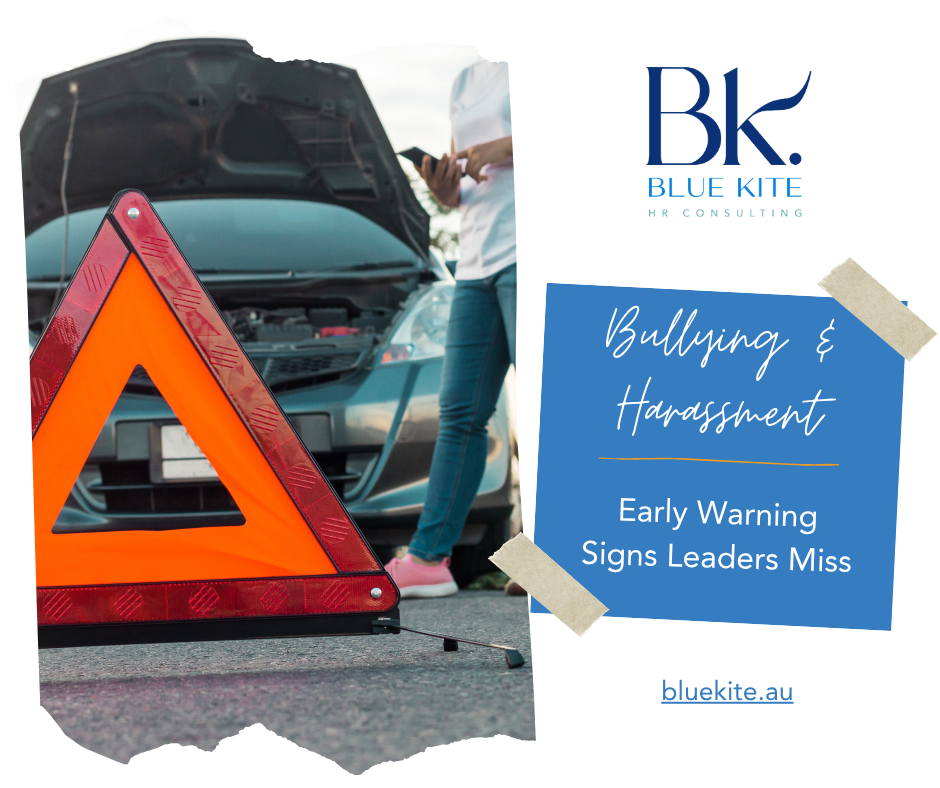
Bullying and Harassment: Early Warning Signs Leaders Miss

ARTICLES

Bullying and Harassment: Early Warning Signs Leaders Miss
17 August, 2026
Filed Under: Advisory and compliance, Business Update, Culture, External HR Support, HR essentials, Leadership

Day 17 of 31 Days of Better Workplaces — bullying and harassment in the workplace aren’t always obvious. By the time a formal complaint is made, the situation has usually been building for a long time — and there were signs that, in hindsight, a leader could have acted on earlier.

Here are the warning signs that most managers miss:


Changes in team dynamics

Sudden shifts in who talks to whom. An individual who was previously engaged becoming quiet and withdrawn. Teams that previously collaborated becoming siloed or tense. These behavioural changes are often the first visible indicator that something is wrong.


Absenteeism and sick leave patterns

Frequent short-term absences — particularly on Mondays, or before and after specific events — can indicate that someone is avoiding a person or situation. A previously reliable employee who starts calling in sick regularly deserves a genuine check-in, not an assumption about work ethic.


The person who always needs to “check with” someone else

An employee who is capable of independent decision-making but consistently defers to or seeks approval from a specific colleague — sometimes excessively, sometimes anxiously — may be navigating a dynamic they haven’t felt safe to raise.


Complaints that don’t come through formal channels

Informal mentions — “so-and-so is a bit difficult to work with” or “I just try to avoid certain situations” — are often the only signal someone will give before they resign. Take them seriously and ask a second question.


High turnover in a specific team or under a specific manager

If people keep leaving one area of the business, and the business keeps attributing it to external factors, it’s worth looking at what those leavers have in common. Often the answer is a single person.


What to do when you see these signs

Don’t wait for a formal complaint. Have a quiet, private conversation. Create a safe space for someone to tell you what’s actually happening. You’re not launching an investigation — you’re doing your job as a leader, which includes paying attention.
Early intervention protects individuals, teams, and the business.


Book a free 30-minute consultattion at Blue Kite HR Consulting 
 

BACK TO ALL ARTICLES
Screenshot 2025-11-18 164639

+61 (0) 409 545 634

cpaterson@bluekite.au

FREE CONSULTATION

  • ABOUT
  • HR SERVICES
  • COACH WITH ME
  • HEALTH & WELLBEING
  • MEDIA/PR
  • ARTICLES/BLOG
  • RESOURCES
  • CONTACT
  • PRIVACY

Blue Kite specialises in providing
HR services to support businesses
to create better workplaces.
Filed Under: Advisory and compliance, Business Update, Culture, External HR Support, HR essentials, Leadership

16 August, 2026 by Catie Paterson Leave a Comment

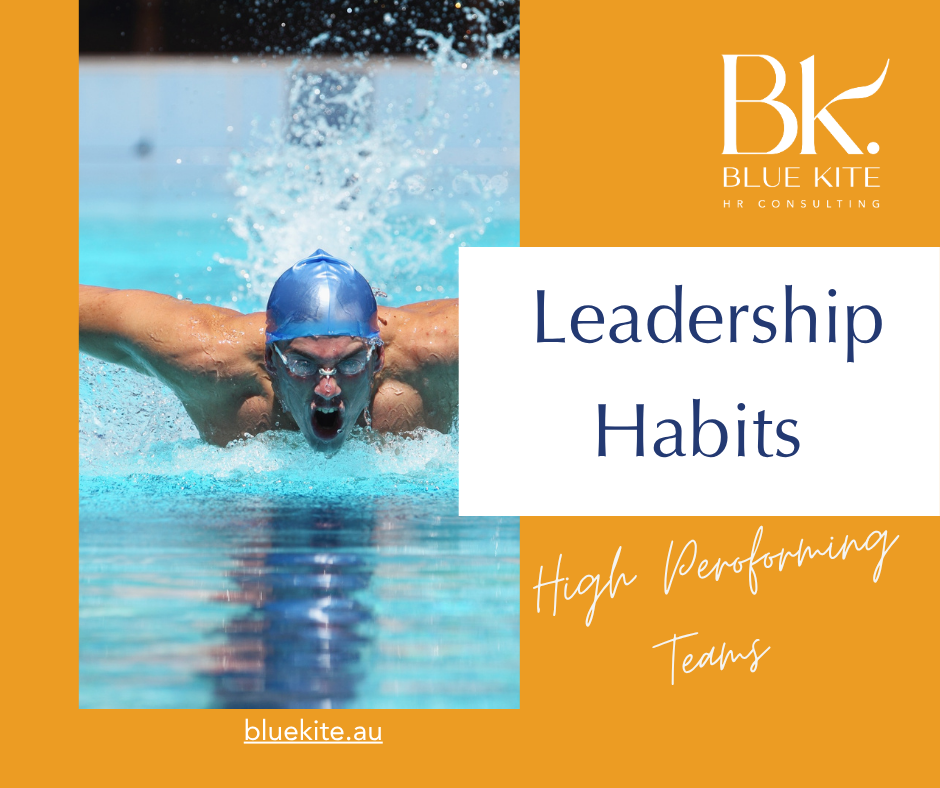
5 Leadership Habits That Build High-Performing Teams

ARTICLES

5 Leadership Habits That Build High-Performing Teams

16 August, 2026
Filed Under: Advisory and compliance, Business Update, Culture, HR essentials, Leadership, Succession Management, Workforce, Workforce Planning

Day 16 of 31 Days of Better Workplaces — high performance doesn’t happen by accident. It’s the result of consistent behaviours that leaders either build deliberately or don’t.

After more than twenty years working with leaders across industries, these are the five habits I see most consistently in the leaders who build genuinely high-performing teams.


Habit 1: They communicate context, not just tasks

High-performing team members want to understand why — why this work matters, how it connects to the bigger picture, what success looks like. The manager who only assigns tasks produces a team that executes instructions. The manager who shares context produces a team that thinks.


Habit 2: They give feedback continuously, not annually

Waiting for a formal review process to tell someone they’re doing well — or not — is a missed opportunity. Brief, specific, real-time feedback — “that was a great way to handle that client” or “I noticed this in your report, here’s what I’d suggest” — compounds over time into a team that knows where they stand and how to improve.


Habit 3: They invest in individual development

High-performing leaders know what each person on their team is working toward — professionally and personally. They look for opportunities to stretch people, give them new experiences, and connect their day-to-day work to their longer-term goals. People perform better when they can see they’re growing.


Habit 4: They protect the team’s capacity

Good leaders push back on unrealistic workloads, prioritise ruthlessly, and don’t allow their team to be pulled in twenty directions at once. They understand that sustained high performance requires sustainable conditions — and they advocate for those conditions.


Habit 5: They model the culture they wantgreement clauses that help manage workplace risk

Whatever you want your team to do, you have to do first. If you want them to be honest, be honest. If you want them to take ownership, take ownership. If you want them to prioritise wellbeing, model it. Culture is not what you mandate — it’s what you demonstrate.
The good news: these are all learnable habits. None of them require a special talent. They require intention and consistency.


Book a free 30-minute consultation at  Blue Kite HR Consulting 


BACK TO ALL ARTICLES
Screenshot 2025-11-18 164639

+61 (0) 409 545 634

cpaterson@bluekite.au

FREE CONSULTATION

  • ABOUT
  • HR SERVICES
  • COACH WITH ME
  • HEALTH & WELLBEING
  • MEDIA/PR
  • ARTICLES/BLOG
  • RESOURCES
  • CONTACT
  • PRIVACY

Blue Kite specialises in providing
HR services to support businesses
to create better workplaces.
Filed Under: Advisory and compliance, Business Update, Culture, HR essentials, Leadership, Succession Management, Workforce, Workforce Planning

15 August, 2026 by Catie Paterson Leave a Comment

Modern Awards: Are You Paying Your Team Correctly?

ARTICLES

Modern Awards: Are You Paying Your Team Correctly?

15 August, 2026
Filed Under: Advisory and compliance, Business Update, External HR Support, HR essentials, Leadership

Day 15 of 31 Days of Better Workplaces — Award compliance might be the most common and most costly gap I see when I work with businesses for the first time.

Most business owners believe they’re paying people correctly. Many of them aren’t — not because they’ve set out to underpay anyone, but because Modern Awards are complex, they’re updated regularly, and the penalties for getting it wrong accumulate over time.


What is a Modern Award?

A Modern Award is an industry or occupation-specific instrument that sets minimum employment conditions — pay rates, penalty rates, allowances, hours of work, and leave entitlements — for most Australian employees. There are more than 120 Modern Awards.

Getting the right one, and applying it correctly, matters.


Common Compliance Gaps 

Incorrect classification within the Award. Most Awards have multiple levels or classifications, with different pay rates. Employees are often misclassified, either because the classification hasn’t been reviewed when their role changed, or because it was never set correctly in the first place.
Missing penalty rates. Weekend rates, public holiday rates, overtime rates, and shift penalties are Award entitlements that cannot be offset or traded away without a proper Enterprise Agreement. If you’re paying flat rates without factoring these in, you’re likely underpaying.
Not applying Annual Wage Review increases. The Fair Work Commission reviews minimum wages annually. If you’re not updating pay rates to reflect these increases, you fall out of compliance automatically.
Overlooking allowances. Many Awards include allowances for things like vehicle use, equipment, uniforms, meals, and split shifts. These are entitlements, not discretionary benefits.


What to do

Pull up the relevant Award for your business. Check the classifications. Cross-reference your current pay rates against the Award minimum. If you’re unsure which Award applies, or you’re in an industry with multiple possible Awards, get it checked by someone who knows.
Wage theft — even unintentional — is a serious issue in Australia. Businesses have been required to repay significant back-pay amounts. Get ahead of it before someone else finds it first.

Book your free 30-minute consultation at Blue Kite HR Consulting


BACK TO ALL ARTICLES
Screenshot 2025-11-18 164639

+61 (0) 409 545 634

cpaterson@bluekite.au

FREE CONSULTATION

  • ABOUT
  • HR SERVICES
  • COACH WITH ME
  • HEALTH & WELLBEING
  • MEDIA/PR
  • ARTICLES/BLOG
  • RESOURCES
  • CONTACT
  • PRIVACY

Blue Kite specialises in providing
HR services to support businesses
to create better workplaces.
Filed Under: Advisory and compliance, Business Update, External HR Support, HR essentials, Leadership

3 August, 2026 by Catie Paterson Leave a Comment

What is Psychological Safety and Why Should You Care?

ARTICLES

What is Psychological Safety and Why Should You Care?

3 August, 2026
Filed Under: Leadership

Psychological safety isn’t a corporate buzzword. It’s the difference between a team that flags problems early and one that lets them blow up.

The term was coined by Harvard researcher Amy Edmondson and has since been backed by extensive research — including Google’s famous Project Aristotle, which found it was the number one predictor of high-performing teams. In simple terms, psychological safety is when people feel they can speak up, ask questions, admit mistakes, and raise concerns without fear of being punished or embarrassed.


Why it matters for your business 

If your team doesn’t feel safe raising issues, those issues don’t disappear. They go underground. Compliance risks, customer complaints, quality problems, and team tensions all fester when people don’t feel they can speak up. By the time they surface, they’ve usually grown.


Signs your workplace may lack psychological safety

  • Meetings are quiet — people agree with the boss and say nothing
  • Errors get hidden rather than reported
  • Feedback only flows downward
  • High performers leave without giving real reasons

What can you do right now

  • Model vulnerability yourself — acknowledge when you don’t have the answer
  • Respond to bad news with curiosity, not blame
  • Actively invite dissenting views in meetings
  • Follow up when someone does speak up, so they know it mattered


Building psychological safety isn’t a program or a policy. It’s a pattern of small, consistent behaviours from leaders. Start there.


Book a free 30-minute consultation at Blue Kite HR Consulting 


BACK TO ALL ARTICLES
Screenshot 2025-11-18 164639

+61 (0) 409 545 634

cpaterson@bluekite.au

FREE CONSULTATION

  • ABOUT
  • HR SERVICES
  • COACH WITH ME
  • HEALTH & WELLBEING
  • MEDIA/PR
  • ARTICLES/BLOG
  • RESOURCES
  • CONTACT
  • PRIVACY

Blue Kite specialises in providing
HR services to support businesses
to create better workplaces.
Filed Under: Leadership

2 August, 2026 by Catie Paterson Leave a Comment

The Real Cost of Skipping Onboarding

ARTICLES

The Real Cost of Skipping Onboarding

2 August, 2026
Filed Under: Advisory and compliance, Business Update, Culture, External HR Support, HR essentials, Leadership

You spent time and money finding the right person. Don’t lose them in the first 90 days because onboarding was an afterthought.

Research consistently shows that employees who go through a structured onboarding process are significantly more likely to still be with you at the 12-month mark. For small businesses, losing a new hire within that first year isn’t just frustrating — it’s costly. Recruitment fees, training time, and lost productivity add up quickly.


What poor onboarding looks like

  • The new employee’s first day involves waiting around for a laptop and a stack of paperwork
  • No one is clear on what “good” looks like in their first 30, 60, or 90 days
  • The manager is too busy to check in regularly
  • Cultural expectations and team norms are never explicitly explained.


What structured onboarding looks like instead

  • A clear pre-start checklist so they arrive to a ready workspace
  • A 30-60-90 day plan with specific expectations for each phase
  • Regular check-ins built into the calendar from day one
  • An introduction to team culture, values, and how decisions get made.

You don’t need an HR department to do this well. A simple, customised onboarding framework — tailored to your business — can turn a chaotic first week into a confident start, and a confident start into a long-term employee.


The investment is small. The return in retention is significant.


Book a free 30-minute consultation at Blue Kite HR Consulting.


BACK TO ALL ARTICLES
Screenshot 2025-11-18 164639

+61 (0) 409 545 634

cpaterson@bluekite.au

FREE CONSULTATION

  • ABOUT
  • HR SERVICES
  • COACH WITH ME
  • HEALTH & WELLBEING
  • MEDIA/PR
  • ARTICLES/BLOG
  • RESOURCES
  • CONTACT
  • PRIVACY

Blue Kite specialises in providing
HR services to support businesses
to create better workplaces.

Filed Under: Advisory and compliance, Business Update, Culture, External HR Support, HR essentials, Leadership

1 August, 2026 by Catie Paterson Leave a Comment

Is Your Employment Contract Actually Protecting You?

ARTICLES

Is Your Employment Contract Actually Protecting You?

1 August, 2026
Filed Under: Advisory and compliance, Business Update, Culture, External HR Support, HR essentials

Most small business owners don’t realise their employment contracts are out of date until something goes wrong — and by then, it’s expensive.

Employment law in Australia moves fast. Changes to the Fair Work Act, updated award conditions, and new rights around flexible work mean that a contract written three years ago may no longer reflect your actual legal obligations. The gap between what your contract says and what the law requires is exactly where disputes start.

Here’s what to check right now 

  • Does your contract reference the correct Modern Award (and the current version)?
  • Have you included the right provisions around casual conversion and flexible work requests?
  • Is your termination clause consistent with the National Employment Standards?
  • Are your policies referenced in the contract actually up to date?

If you’re not sure, that’s a red flag in itself. Contracts that are vague, outdated, or silent on key issues don’t protect your business — they create ambiguity that employees and their representatives can exploit.

The fix is simpler that what you think

An employment contract review doesn’t have to take weeks. A focused HR audit can identify gaps across your agreements, policies, and onboarding documents in a single session, and a template update can be customised to your business within days.

Don’t wait for a termination dispute or an unfair dismissal claim to find out your paperwork wasn’t up to scratch. Get ahead of it now.

Book a free 30-minute cosultation at Blue Kite HR Consulting 


BACK TO ALL ARTICLES
Screenshot 2025-11-18 164639

+61 (0) 409 545 634

cpaterson@bluekite.au

FREE CONSULTATION

  • ABOUT
  • HR SERVICES
  • COACH WITH ME
  • HEALTH & WELLBEING
  • MEDIA/PR
  • ARTICLES/BLOG
  • RESOURCES
  • CONTACT
  • PRIVACY

Blue Kite specialises in providing
HR services to support businesses
to create better workplaces.

Filed Under: Advisory and compliance, Business Update, Culture, External HR Support, HR essentials

  • « Go to Previous Page
  • Page 1
  • Interim pages omitted …
  • Page 10
  • Page 11
  • Page 12
  • Page 13
  • Page 14
  • Interim pages omitted …
  • Page 18
  • Go to Next Page »

Copyright © 2026 · Executive Pro on Genesis Framework · WordPress · Log in koopo

  • HOME
  • ABOUT US
  • HR SERVICES
  • COACH WITH ME
  • HEALTH & WELLBEING
  • MEDIA/PR
    • – Articles/Blogs
    • – Keynote Speaking Events
    • – Podcast Interviews
    • – Ticker Interviews
  • BLOG
  • RESOURCES
  • CONTACT