
• Skip to primary navigation
  • Skip to main content

BlueKite HR

  • HOME
  • ABOUT US
  • HR SERVICES
  • COACH WITH ME
  • HEALTH & WELLBEING
  • MEDIA/PR
    • – Articles/Blogs
    • – Keynote Speaking Events
    • – Podcast Interviews
    • – Ticker Interviews
  • BLOG
  • RESOURCES
  • CONTACT

Business Update

30 July, 2026 by Catie Paterson Leave a Comment

Humour at Work: Taken More Seriously Than You’d Think

ARTICLES

Humour at Work: Taken More Seriously Than You’d Think

30 July, 2026
Filed Under: Business Update, Change management, Culture, External HR Support, HR essentials, Leadership

Humour in the workplace is rarely discussed in leadership development. It tends to be treated as a personality trait — some people have it, some people do not — and therefore outside the scope of culture strategy. This is a mistake.

Workplace humour, when it is inclusive and genuinely shared, is one of the most powerful signals of psychological safety in a team. It indicates that people feel sufficiently comfortable with each other and within the environment to be playful — that the stakes are not so high, and the threat of judgment not so great, that every interaction doesn’t need to be managed carefully. Teams that laugh together tend to be teams that trust each other and that communicate more openly.

The distinction between humour that builds, and humour that damages is important. Inclusive humour, that finds ground in shared situations, in the work, in the absurdity of common experiences, creates connection. Exclusive humour that targets individuals, relies on hierarchy or punches down, creates the reverse. It narrows who feels included, reinforces informal power structures and signals, who belongs and who does not.

Leaders who can use humour well, who can bring genuine lightness to a difficult meeting or acknowledge the absurdity of a situation with warmth, build a particular kind of trust with their teams. It signals humanity, not just capability. And it creates a permission structure for the team to be human in return.

Culture is not only built in serious conversations. Some of it is built in laughter. That is worth taking seriously.


If you want practical support reviewing your workplace policies, contracts, leadership capability, or workplace culture, Blue Kite HR Consulting can help you take a proactive approach before issues become bigger problems.
 

BACK TO ALL ARTICLES
Screenshot 2025-11-18 164639

+61 (0) 409 545 634

cpaterson@bluekite.au

FREE CONSULTATION

  • ABOUT
  • HR SERVICES
  • COACH WITH ME
  • HEALTH & WELLBEING
  • MEDIA/PR
  • ARTICLES/BLOG
  • RESOURCES
  • CONTACT
  • PRIVACY

Blue Kite specialises in providing
HR services to support businesses
to create better workplaces.

Filed Under: Business Update, Change management, Culture, External HR Support, HR essentials, Leadership

29 July, 2026 by Catie Paterson Leave a Comment

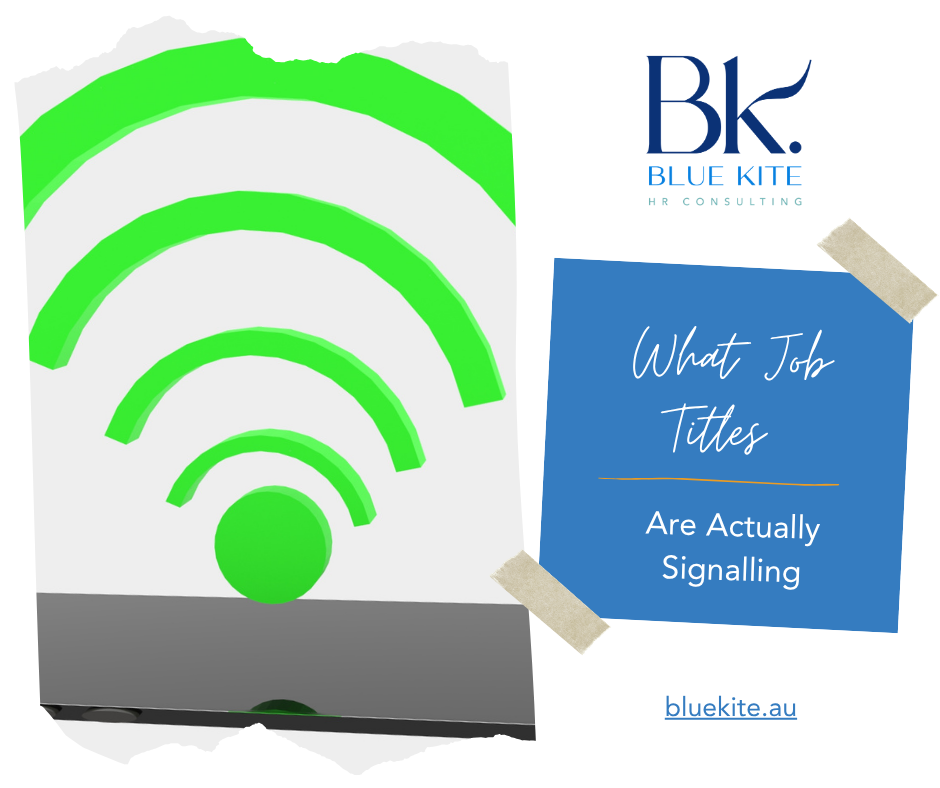
What Job Titles Are Actually Signalling

ARTICLES

What Job Titles Are Actually Signalling

29 July, 2026
Filed Under: Advisory and compliance, Business Update, Change management, Culture, External HR Support, HR essentials, Leadership

Titles signal status. In hierarchical businesses, the gap between titles at different levels communicates something about who is valued, whose judgment counts and whose contribution is considered strategic versus operational. When the most junior people in a business carry the most generic titles — “coordinator,” “associate,” “assistant” — regardless of the complexity or impact of their work, the signal is not subtle.

Titles also shape identity and self-perception. Research on role identity suggests that what people are called influences how they think about the scope of their contribution. A person whose title reflects the strategic dimension of their work thinks about their role differently from someone whose title describes only the functional one.

And titles shape external perception in ways that affect an businesses ability to attract and retain people. Candidates compare titles across businesses as a proxy for seniority and progression opportunity. A title that is generic relative to market equivalents can make a role look less advanced than it is, and can affect both who applies and whether a strong candidate accepts.

None of this suggests that title inflation,  escalating everyone’s title regardless of responsibility, is the answer. It suggests that businesses should be deliberate about what their titling conventions are communicating, and whether that communication is serving their business, people and their culture.


If you want practical support reviewing your workplace policies, contracts, leadership capability, or workplace culture, Blue Kite HR Consulting can help you take a proactive approach before issues become bigger problems.


BACK TO ALL ARTICLES
Screenshot 2025-11-18 164639

+61 (0) 409 545 634

cpaterson@bluekite.au

FREE CONSULTATION

  • ABOUT
  • HR SERVICES
  • COACH WITH ME
  • HEALTH & WELLBEING
  • MEDIA/PR
  • ARTICLES/BLOG
  • RESOURCES
  • CONTACT
  • PRIVACY

Blue Kite specialises in providing
HR services to support businesses
to create better workplaces.
Filed Under: Advisory and compliance, Business Update, Change management, Culture, External HR Support, HR essentials, Leadership

26 July, 2026 by Catie Paterson Leave a Comment

The Generational Stereotype Doing More Harm Than Good

ARTICLES

The Generational Stereotype Doing More Harm Than Good

26 July, 2026
Filed Under: Advisory and compliance, Business Update, Change management, Culture, External HR Support, HR essentials, Leadership

The generational narrative in workplace management — Baby Boomers value loyalty, Gen X value autonomy, Millennials want purpose, Gen Z demand flexibility — is one of the most persistently repeated and most poorly evidenced frameworks in HR.

The research on whether generational membership predicts meaningful workplace preferences or behaviours is, at best, mixed. Studies that adequately cover age, career stages and the broader historical information, consistently find that the generational effect is smaller than claimed, and the individual and role-level variation is larger. People differ far more within generations than between them.

What the generational infromation usefully describes is not generational character, it is the historical enviornment. Different age groups entered the workforce under different economic conditions, different technological realities and different social norms. Those experiences shaped expectations and reference points. But those reference points vary enormously within that group, and they constantly change basd on individual experience.

The practical cost of generational stereotyping in management is that it replaces curiosity with assumption. A leader who has decided they know what a 25-year-old employee wants has an answer that prevents them from asking a question.

And the question — what do you actually need from this role and this working relationship? — is the one most likely to produce useful information.

Managing to the individual rather than to the generation label is better practice. It is also, in most cases, simply more accurate.

If you want practical support reviewing your workplace policies, contracts, leadership capability, or workplace culture, Blue Kite HR Consulting can help you take a proactive approach before issues become bigger problems.


BACK TO ALL ARTICLES
Screenshot 2025-11-18 164639

+61 (0) 409 545 634

cpaterson@bluekite.au

FREE CONSULTATION

  • ABOUT
  • HR SERVICES
  • COACH WITH ME
  • HEALTH & WELLBEING
  • MEDIA/PR
  • ARTICLES/BLOG
  • RESOURCES
  • CONTACT
  • PRIVACY

Blue Kite specialises in providing
HR services to support businesses
to create better workplaces.

Filed Under: Advisory and compliance, Business Update, Change management, Culture, External HR Support, HR essentials, Leadership

25 July, 2026 by Catie Paterson Leave a Comment

Rethinking What Leadership Looks Like

ARTICLES

Rethinking What Leadership Looks Like

25 July, 2026
Filed Under: Advisory and compliance, Business Update, Change management, Culture, External HR Support, HR essentials, Leadership

The default image of leadership in most organisations is extroverted, vocal and visible. The leader who drives the room, commands attention in a meeting, articulates a vision in a way that generates energy. This is one version of effective leadership. It is not the only one, and defaulting to it as the model excludes a significant proportion of genuinely capable leaders.

Introversion — the tendency to draw energy from reflection and focused engagement rather than from social interaction — is associated with leadership styles that are consistently undervalued despite strong evidence of their effectiveness. Introverted leaders tend to listen more carefully, make decisions more deliberately and create more space for the ideas of the people around them. They are less likely to dominate the conversation and more likely to draw out contributions from those who would be overshadowed in a more extrovert-led dynamic.

The research on team performance suggests that introverted leaders are particularly effective with proactive, high-initiative teams, because they do not compete for the leadership space and instead amplify the team’s own direction.

The problem is not that introverted leadership is less effective. The problem is that most organisations assess leadership potential through visibility, through the very qualities that favour extroverts in observational settings. Promotion decisions, leadership assessments and development investments are shaped by a mental model of what a leader looks and sounds like.

Broadening that model is not just about inclusion. It is about accessing the full range of leadership capability available in an organisation, and building the culture that allows it to be expressed.


If you want practical support reviewing your workplace policies, contracts, leadership capability, or workplace culture, Blue Kite HR Consulting can help you take a proactive approach before issues become bigger problems.


BACK TO ALL ARTICLES
Screenshot 2025-11-18 164639

+61 (0) 409 545 634

cpaterson@bluekite.au

FREE CONSULTATION

  • ABOUT
  • HR SERVICES
  • COACH WITH ME
  • HEALTH & WELLBEING
  • MEDIA/PR
  • ARTICLES/BLOG
  • RESOURCES
  • CONTACT
  • PRIVACY

Blue Kite specialises in providing
HR services to support businesses
to create better workplaces.
Filed Under: Advisory and compliance, Business Update, Change management, Culture, External HR Support, HR essentials, Leadership

24 July, 2026 by Catie Paterson Leave a Comment

Hiring for Behaviour

ARTICLES

Hiring for Behaviour

24 July, 2026
Filed Under: Advisory and compliance, Business Update, Change management, External HR Support, HR essentials, Leadership

There is an ongoing debate in hiring about whether behaviour or technical capability should be weighted more heavily. Most hiring processes answer this question implicitly by spending the majority of their assessment time on skills and the minority on values, judgment and interpersonal integrity.

The argument for reversing that emphasis is not idealistic. It is practical.

Skills can be developed. The technical gap between a candidate who is a strong hire and one who is an excellent hire can, in many roles, be closed through training, mentoring and experience within the business. The behaviour gap — between someone who operates with genuine integrity and someone who does not — is far more resistant to change. You can teach someone a process. You cannot easily teach them to be honest when it is inconvenient, to take accountability for failure or to treat people with consistent respect regardless of their seniority or usefulness.

This does not mean ignoring technical capability. It means being rigorous about both — and being honest about which of the two a business is typically better at assessing.

Most hiring processes are designed to assess what is most easily assessed. Work samples, technical exercises and competency interviews are well-established. Probing for genuine behaviour — how someone makes decisions under pressure, how they handle situations where the ethical path is harder than the easy one, how they treat people who have no power over them — requires more deliberate interview design and greater interviewer skill.

The businesses that hire for behaviour as seriously as they hire for capability have significantly lower rates of the kind of cultural damage that most businesses spend disproportionate leadership energy managing.

If you want practical support reviewing your workplace policies, contracts, leadership capability, or workplace culture, Blue Kite HR Consulting can help you take a proactive approach before issues become bigger problems.


BACK TO ALL ARTICLES
Screenshot 2025-11-18 164639

+61 (0) 409 545 634

cpaterson@bluekite.au

FREE CONSULTATION

  • ABOUT
  • HR SERVICES
  • COACH WITH ME
  • HEALTH & WELLBEING
  • MEDIA/PR
  • ARTICLES/BLOG
  • RESOURCES
  • CONTACT
  • PRIVACY

Blue Kite specialises in providing
HR services to support businesses
to create better workplaces.

Filed Under: Advisory and compliance, Business Update, Change management, External HR Support, HR essentials, Leadership

23 July, 2026 by Catie Paterson Leave a Comment

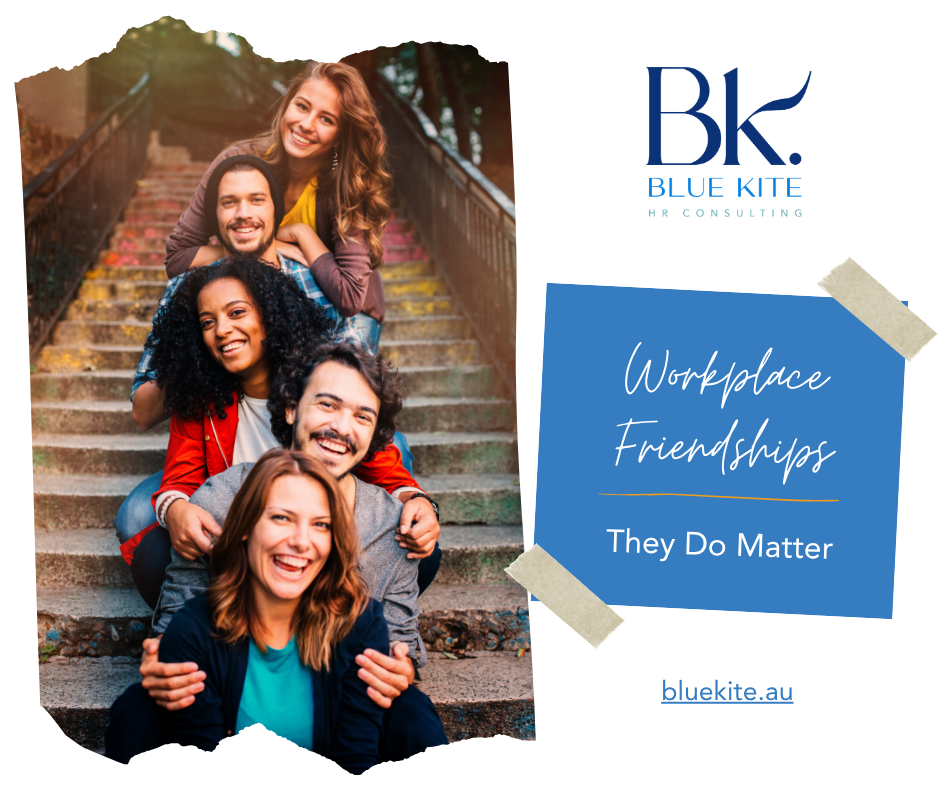
Workplace Friendships and Why They Actually Matter

ARTICLES

Workplace Friendships and Why They Actually Matter

23 July, 2026
Filed Under: Advisory and compliance, Business Update, Change management, Culture, External HR Support, HR essentials, Leadership

The professional advice to keep personal relationships separate from work has a long history. And in some respects it is sensible — boundary clarity matters, dual relationships can complicate professional judgment and the workplace is not a social club.

But the research on workplace friendships paints a picture that is worth sitting with. Employees who report having a genuine friend at work, someone they trust, who knows them, whom they would seek out when something is difficult, are significantly more engaged, more productive and more likely to stay.

This is not a soft finding. It connects to some fundamental human needs: the sense of belonging, of being known and of genuine social connection. When those needs are met at work, the experience of working there is transformed.

The implications for businesses are underappreciated. Culture is not just the sum of leader behaviours and HR policies. It is also the quality of the peer relationships that develop within it. Teams that know each other well, not just professionally, but as people, communicate more openly, collaborate more effectively and are more likely to surface problems early rather than managing them quietly.

The barrier for many businesses is the idea that fostering workplace friendships is outside the scope of leadership and culture strategy. In reality, the conditions that enable genuine connection — time, psychological safety, shared experience and a culture that values the person alongside the performance — are exactly the same conditions that enable everything else that organisations say they want.

Connection is not a peripheral concern. It is part of the foundation.

If you want practical support reviewing your workplace policies, contracts, leadership capability, or workplace culture, Blue Kite HR Consulting can help you take a proactive approach before issues become bigger problems.


BACK TO ALL ARTICLES
Screenshot 2025-11-18 164639

+61 (0) 409 545 634

cpaterson@bluekite.au

FREE CONSULTATION

  • ABOUT
  • HR SERVICES
  • COACH WITH ME
  • HEALTH & WELLBEING
  • MEDIA/PR
  • ARTICLES/BLOG
  • RESOURCES
  • CONTACT
  • PRIVACY

Blue Kite specialises in providing
HR services to support businesses
to create better workplaces.

Filed Under: Advisory and compliance, Business Update, Change management, Culture, External HR Support, HR essentials, Leadership

  • « Go to Previous Page
  • Page 1
  • Interim pages omitted …
  • Page 7
  • Page 8
  • Page 9
  • Page 10
  • Page 11
  • Interim pages omitted …
  • Page 19
  • Go to Next Page »

Copyright © 2026 · Executive Pro on Genesis Framework · WordPress · Log in koopo

  • HOME
  • ABOUT US
  • HR SERVICES
  • COACH WITH ME
  • HEALTH & WELLBEING
  • MEDIA/PR
    • – Articles/Blogs
    • – Keynote Speaking Events
    • – Podcast Interviews
    • – Ticker Interviews
  • BLOG
  • RESOURCES
  • CONTACT