
• Skip to primary navigation
  • Skip to main content

BlueKite HR

  • HOME
  • ABOUT US
  • HR SERVICES
  • COACH WITH ME
  • HEALTH & WELLBEING
  • MEDIA/PR
    • – Articles/Blogs
    • – Keynote Speaking Events
    • – Podcast Interviews
    • – Ticker Interviews
  • BLOG
  • RESOURCES
  • CONTACT

Business Update

16 August, 2026 by Catie Paterson Leave a Comment

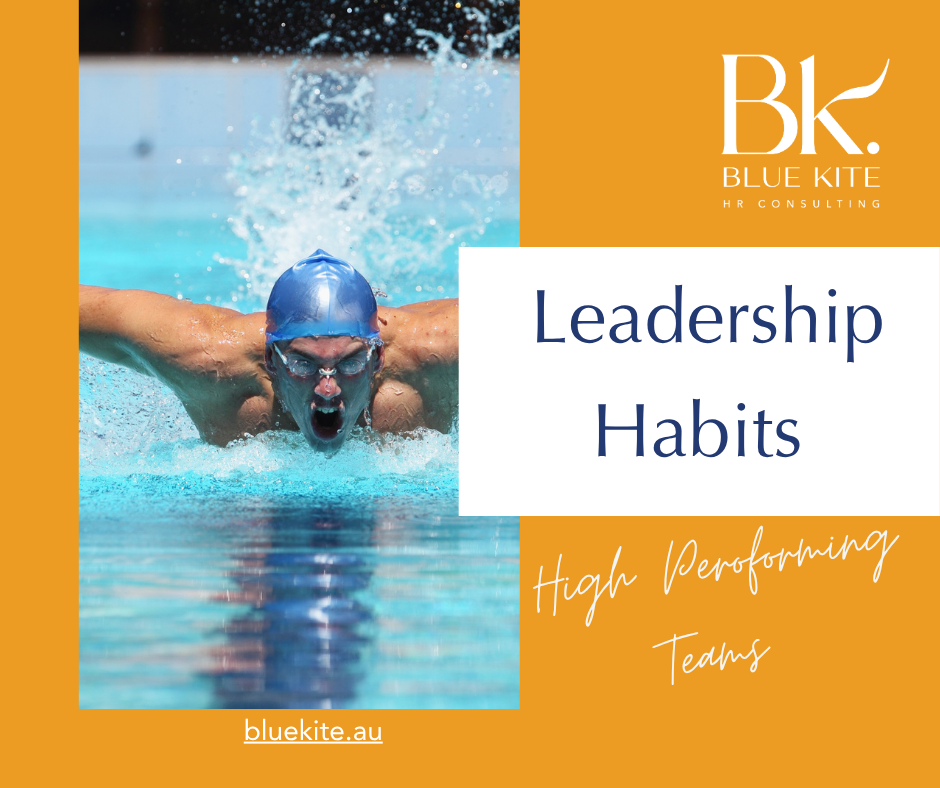
5 Leadership Habits That Build High-Performing Teams

ARTICLES

5 Leadership Habits That Build High-Performing Teams
16 August, 2026
Filed Under: Advisory and compliance, Business Update, Culture, HR essentials, Leadership, Succession Management, Workforce, Workforce Planning

Day 16 of 31 Days of Better Workplaces — high performance doesn’t happen by accident. It’s the result of consistent behaviours that leaders either build deliberately or don’t.

After more than twenty years working with leaders across industries, these are the five habits I see most consistently in the leaders who build genuinely high-performing teams.


Habit 1: They communicate context, not just tasks

High-performing team members want to understand why — why this work matters, how it connects to the bigger picture, what success looks like. The manager who only assigns tasks produces a team that executes instructions. The manager who shares context produces a team that thinks.


Habit 2: They give feedback continuously, not annually

Waiting for a formal review process to tell someone they’re doing well — or not — is a missed opportunity. Brief, specific, real-time feedback — “that was a great way to handle that client” or “I noticed this in your report, here’s what I’d suggest” — compounds over time into a team that knows where they stand and how to improve.


Habit 3: They invest in individual development

High-performing leaders know what each person on their team is working toward — professionally and personally. They look for opportunities to stretch people, give them new experiences, and connect their day-to-day work to their longer-term goals. People perform better when they can see they’re growing.


Habit 4: They protect the team’s capacity

Good leaders push back on unrealistic workloads, prioritise ruthlessly, and don’t allow their team to be pulled in twenty directions at once. They understand that sustained high performance requires sustainable conditions — and they advocate for those conditions.


Habit 5: They model the culture they wantgreement clauses that help manage workplace risk

Whatever you want your team to do, you have to do first. If you want them to be honest, be honest. If you want them to take ownership, take ownership. If you want them to prioritise wellbeing, model it. Culture is not what you mandate — it’s what you demonstrate.
The good news: these are all learnable habits. None of them require a special talent. They require intention and consistency.


Book a free 30-minute consultation at  Blue Kite HR Consulting 
 

BACK TO ALL ARTICLES
Screenshot 2025-11-18 164639

+61 (0) 409 545 634

cpaterson@bluekite.au

FREE CONSULTATION

  • ABOUT
  • HR SERVICES
  • COACH WITH ME
  • HEALTH & WELLBEING
  • MEDIA/PR
  • ARTICLES/BLOG
  • RESOURCES
  • CONTACT
  • PRIVACY

Blue Kite specialises in providing
HR services to support businesses
to create better workplaces.
Filed Under: Advisory and compliance, Business Update, Culture, HR essentials, Leadership, Succession Management, Workforce, Workforce Planning

15 August, 2026 by Catie Paterson Leave a Comment

Modern Awards: Are You Paying Your Team Correctly?

ARTICLES

Modern Awards: Are You Paying Your Team Correctly?

15 August, 2026
Filed Under: Advisory and compliance, Business Update, External HR Support, HR essentials, Leadership

Day 15 of 31 Days of Better Workplaces — Award compliance might be the most common and most costly gap I see when I work with businesses for the first time.

Most business owners believe they’re paying people correctly. Many of them aren’t — not because they’ve set out to underpay anyone, but because Modern Awards are complex, they’re updated regularly, and the penalties for getting it wrong accumulate over time.


What is a Modern Award?

A Modern Award is an industry or occupation-specific instrument that sets minimum employment conditions — pay rates, penalty rates, allowances, hours of work, and leave entitlements — for most Australian employees. There are more than 120 Modern Awards.

Getting the right one, and applying it correctly, matters.


Common Compliance Gaps 

Incorrect classification within the Award. Most Awards have multiple levels or classifications, with different pay rates. Employees are often misclassified, either because the classification hasn’t been reviewed when their role changed, or because it was never set correctly in the first place.
Missing penalty rates. Weekend rates, public holiday rates, overtime rates, and shift penalties are Award entitlements that cannot be offset or traded away without a proper Enterprise Agreement. If you’re paying flat rates without factoring these in, you’re likely underpaying.
Not applying Annual Wage Review increases. The Fair Work Commission reviews minimum wages annually. If you’re not updating pay rates to reflect these increases, you fall out of compliance automatically.
Overlooking allowances. Many Awards include allowances for things like vehicle use, equipment, uniforms, meals, and split shifts. These are entitlements, not discretionary benefits.


What to do

Pull up the relevant Award for your business. Check the classifications. Cross-reference your current pay rates against the Award minimum. If you’re unsure which Award applies, or you’re in an industry with multiple possible Awards, get it checked by someone who knows.
Wage theft — even unintentional — is a serious issue in Australia. Businesses have been required to repay significant back-pay amounts. Get ahead of it before someone else finds it first.

Book your free 30-minute consultation at Blue Kite HR Consulting


BACK TO ALL ARTICLES
Screenshot 2025-11-18 164639

+61 (0) 409 545 634

cpaterson@bluekite.au

FREE CONSULTATION

  • ABOUT
  • HR SERVICES
  • COACH WITH ME
  • HEALTH & WELLBEING
  • MEDIA/PR
  • ARTICLES/BLOG
  • RESOURCES
  • CONTACT
  • PRIVACY

Blue Kite specialises in providing
HR services to support businesses
to create better workplaces.
Filed Under: Advisory and compliance, Business Update, External HR Support, HR essentials, Leadership

13 August, 2026 by Bronwyn Coulthart Leave a Comment

Coaching vs. Managing: Knowing When to Use Each Approach

ARTICLES

Coaching vs. Managing: Knowing When to Use Each Approach

13 August, 2026
Filed Under: Advisory and compliance, Business Update, Change management, Culture, HR essentials, Leadership, Workforce

Day 13 of 31 Days of Better Workplaces — one of the most powerful shifts a manager can make is learning when to stop managing and start coaching.

Both approaches have their place. The challenge is that most managers default to managing — directing, instructing, problem-solving — even in situations where a coaching approach would be more effective and produce better long-term outcomes.

What’s the difference?

Managing is telling. Coaching is asking. Managing solves the immediate problem. Coaching builds the capability to solve it next time without you.

When to manage

A new employee who genuinely doesn’t yet have the knowledge or skill to operate independently needs clear direction and instruction. In a genuine crisis or time-sensitive situation where there’s no room for exploration. When safety is at stake.

When to coach

A capable team member who keeps coming to you for decisions they could be making themselves. Someone who’s stuck on a problem they have the skill to solve if they think it through. Any situation where you want to build someone’s confidence and capability rather than just solve today’s problem.

What coaching actually looks like in practice

Instead of answering the question, ask one. “What have you tried so far?” “What do you think the options are?” “What would you do if I wasn’t available?” These questions are not deflection — they’re development. You’re building the thinking process, not just solving the task.

The manager who can coach well will consistently outperform the one who can only direct. Their team will take more initiative, solve more problems independently, and stay longer — because they’re growing.

Book your free 30-minute consultation at Blue Kite HR Consulting

BACK TO ALL ARTICLES
Screenshot 2025-11-18 164639

+61 (0) 409 545 634

cpaterson@bluekite.au

FREE CONSULTATION

  • ABOUT
  • HR SERVICES
  • COACH WITH ME
  • HEALTH & WELLBEING
  • MEDIA/PR
  • ARTICLES/BLOG
  • RESOURCES
  • CONTACT
  • PRIVACY

Blue Kite specialises in providing
HR services to support businesses
to create better workplaces.
Filed Under: Advisory and compliance, Business Update, Change management, Culture, HR essentials, Leadership, Workforce

12 August, 2026 by Bronwyn Coulthart Leave a Comment

Succession Planning: Why Businesses Leave It Too Late

ARTICLES

Succession Planning: Why Businesses Leave It Too Late

12 August, 2026
Filed Under: Advisory and compliance, Business Update, Career Planning, Change management, Culture, External HR Support, HR essentials, Leadership, Succession Management, Workforce, Workforce Planning

Day 12 of 31 Days of Better Workplaces — succession planning is something most business owners know they should be doing. Most of them aren’t.

The conversation usually goes one of two ways. Either the business owner thinks succession planning is only for large corporations, or they plan to “deal with it when the time comes.” Both positions create significant risk.


What succession planning actually is for a business

It’s not a corporate exercise involving lengthy documentation and committee reviews. For a business, succession planning is about understanding which roles are critical to the business continuing to function, identifying the risks if those roles suddenly became vacant, and having a plan, even a simple one, for what happens if they do.


The most common risk most businesses carry

Key person dependency. One person,  often the owner, or a long-tenured operations manager, or the one person who “knows how everything works”, holds knowledge, relationships, and capability that exists nowhere else in the business. When they leave — and eventually they will — the disruption can be significant.


Three things to do this week 

First

Identify your critical roles. Not just seniority, actual criticality. Which positions, if they became vacant tomorrow with no notice, would cause the most operational damage?

Second

Assess your bench. For each critical role, is there anyone in the business who could step into it, even partially? What would it take to get them ready? That gap analysis is the starting point for your succession plan.

Third

Capture critical knowledge. Start a simple process of documentation, key contacts, processes, passwords, client relationships for your highest-risk roles. This alone reduces the impact of an unexpected departure significantly.


The thing no one says out loud

Succession planning also applies to the owner. If something happened to you tomorrow, what would happen to your business? Your team? Your clients? A succession plan is also a contingency plan, and it’s one of the most responsible things you can build.

Book a free 30-minute consultation at Blue Kite HR Consulting 

BACK TO ALL ARTICLES
Screenshot 2025-11-18 164639

+61 (0) 409 545 634

cpaterson@bluekite.au

FREE CONSULTATION

  • ABOUT
  • HR SERVICES
  • COACH WITH ME
  • HEALTH & WELLBEING
  • MEDIA/PR
  • ARTICLES/BLOG
  • RESOURCES
  • CONTACT
  • PRIVACY

Blue Kite specialises in providing
HR services to support businesses
to create better workplaces.
Filed Under: Advisory and compliance, Business Update, Career Planning, Change management, Culture, External HR Support, HR essentials, Leadership, Succession Management, Workforce, Workforce Planning

9 August, 2026 by Bronwyn Coulthart Leave a Comment

Exit Interviews: Why You’re Missing Gold When You Skip Them

ARTICLES

Exit Interviews: Why You're Missing Gold When You Skip Them

9 August, 2026
Filed Under: Advisory and compliance, Business Update, Change management, Culture, External HR Support, HR essentials, Leadership, Workforce

Exit interviews are one of the most underused tools in a businesses HR toolkit.  

Most businesses skip them entirely. Some do them but don’t act on what they hear. A small number use them really well — and those businesses consistently have lower turnover than their peers.
Here’s what you’re missing when someone walks out the door without an exit interview.


The real reason why they are leaving 

The stated reason for resignation is almost never the whole picture. “A better opportunity” often means “I was looking for something better because I wasn’t happy here.” An exit interview, done well and done safely, surfaces the real driver — and that information is invaluable.

Patterns you can’t see 

Individual exit interviews tell you one person’s experience. Aggregate data from multiple exits tells you something systemic — a manager who consistently features in exit conversations, a team with retention problems, a policy or practice that’s driving people away.

Intelligence on market position 

Departing employees often know what your competitors are offering, what the market rate is, and what alternative employers are doing that you’re not. That’s genuinely useful business intelligence.

How to make them work 

Conduct them as a conversation, not a form. Use a short, structured survey if you’re worried about time — but follow it up with a brief conversation where possible.
Do them with someone other than the person’s direct leader. People will not be honest about their experience if the person they’re talking to is part of the problem.
Keep them confidential. If people think what they say will be used against them or shared indiscriminately, they’ll tell you nothing useful.
Act on what you hear. The quickest way to make exit interviews worthless is to do them and do nothing with the information. Share themes with leadership, track patterns, and show the remaining team that feedback gets taken seriously.
A departing employee is one of the most honest sources of information about your business you’ll ever have. Don’t let them leave without asking the right questions.

Book a free 30-minute consultation at Blue Kite HR Consulting 

BACK TO ALL ARTICLES
Screenshot 2025-11-18 164639

+61 (0) 409 545 634

cpaterson@bluekite.au

FREE CONSULTATION

  • ABOUT
  • HR SERVICES
  • COACH WITH ME
  • HEALTH & WELLBEING
  • MEDIA/PR
  • ARTICLES/BLOG
  • RESOURCES
  • CONTACT
  • PRIVACY

Blue Kite specialises in providing
HR services to support businesses
to create better workplaces.

Filed Under: Advisory and compliance, Business Update, Change management, Culture, External HR Support, HR essentials, Leadership, Workforce

8 August, 2026 by Bronwyn Coulthart Leave a Comment

HR Health Check: 8 Questions Every Business Should Ask Themselves

ARTICLES

HR Health Check: 8 Questions Every SME Should Ask Themselves

8 August, 2026
Filed Under: Advisory and compliance, Business Update, Change management, Culture, External HR Support, HR essentials, Leadership, Workforce, Workforce Planning

Day 8 of 31 Days of Better Workplaces — today is a self-audit. Answer these eight questions honestly and you’ll know exactly where your HR priorities need to be.


 1. Are your employment contracts up to date? 

Have they been reviewed in the last 18 months? Do they reflect current roles and obligations? If you’re using the same template you’ve had for three years, the answer is probably no.

2. Are you paying people correctly under their Award?

Modern Award compliance is one of the most common — and most expensive — gaps for busiensses. Incorrect classifications, missed penalty rates, and outdated pay rates are all serious risks.

3. Do you have compliant policies in place? 

At minimum: a bullying and harassment policy, a WHS policy, a social media policy, and a leave policy. If you don’t have documented policies, you’re managing by word of mouth — and that doesn’t hold up when something goes wrong. 

4. Are your position descriptions current and accurate? 

Outdated position descriptions create confusion about responsibilities, make performance management harder, and create compliance risks if a role’s actual duties don’t match what’s on paper.

5. Do your leaders know how to have a performance conversation?

Most performance problems escalate because managers don’t address them early. Do your team leaders have the skills and the confidence to have these conversations? If not, that’s a significant risk.

6. Do you have a documented onboarding process? 

Not a loose collection of tasks — an actual structured process. If every new person’s onboarding depends on who happens to be available that week, you’re leaving retention to chance.

7. When did you last review your workplace culture? 

Not guessed at — actually assessed. Exit interview data, turnover rates, absenteeism patterns, and team engagement tell you things that gut feel doesn’t.

8. Do you have a clear process for handling complaints?

If an employee came to you today with a complaint about a colleague or manager, would you know exactly how to handle it? If the answer involves a lot of “we’d work it out,” you need a process.
Score yourself honestly. Three or more concerns means it’s time for a proper HR audit — before any of these become a costly problem.

Book your free 30-minute consultation at Blue Kite HR Consulting

BACK TO ALL ARTICLES
Screenshot 2025-11-18 164639

+61 (0) 409 545 634

cpaterson@bluekite.au

FREE CONSULTATION

  • ABOUT
  • HR SERVICES
  • COACH WITH ME
  • HEALTH & WELLBEING
  • MEDIA/PR
  • ARTICLES/BLOG
  • RESOURCES
  • CONTACT
  • PRIVACY

Blue Kite specialises in providing
HR services to support businesses
to create better workplaces.

Filed Under: Advisory and compliance, Business Update, Change management, Culture, External HR Support, HR essentials, Leadership, Workforce, Workforce Planning

  • « Go to Previous Page
  • Page 1
  • Interim pages omitted …
  • Page 5
  • Page 6
  • Page 7
  • Page 8
  • Page 9
  • Interim pages omitted …
  • Page 19
  • Go to Next Page »

Copyright © 2026 · Executive Pro on Genesis Framework · WordPress · Log in koopo

  • HOME
  • ABOUT US
  • HR SERVICES
  • COACH WITH ME
  • HEALTH & WELLBEING
  • MEDIA/PR
    • – Articles/Blogs
    • – Keynote Speaking Events
    • – Podcast Interviews
    • – Ticker Interviews
  • BLOG
  • RESOURCES
  • CONTACT