
• Skip to primary navigation
  • Skip to main content

BlueKite HR

  • HOME
  • ABOUT US
  • HR SERVICES
  • COACH WITH ME
  • HEALTH & WELLBEING
  • MEDIA/PR
    • – Articles/Blogs
    • – Keynote Speaking Events
    • – Podcast Interviews
    • – Ticker Interviews
  • BLOG
  • RESOURCES
  • CONTACT

Change management

10 July, 2026 by Catie Paterson Leave a Comment

The Rules Nobody Wrote Down

ARTICLES

The Rules Nobody Wrote Down
10 July, 2026
Filed Under: Advisory and compliance, Business Update, Change management, Culture, External HR Support, HR essentials, Leadership

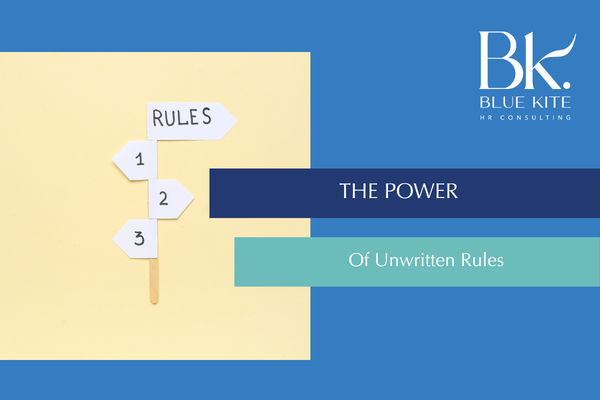
Every business has two sets of rules. The ones in the policies and procedures manual — and the ones that everyone actually follows.

The unwritten rules of a workplace are often more powerful than the formal ones. They govern how decisions are really made, whose opinion actually counts in a meeting, how much autonomy people genuinely have, which mistakes are forgiven and which are remembered. They are the invisible architecture of the business culture, and they shape behaviour far more reliably than any documented process.

The problem is that unwritten rules are learned through observation and experience, which means they are absorbed unevenly, often disadvantaging those who are newer, more junior or less culturally similar to the dominant group.

Someone who did not grow up navigating that particular culture, or who does not have a mentor to decode it, may find themselves inadvertently violating norms they did not know existed.

The more significant problem is that businesses often have no awareness of what their unwritten rules actually are. Leaders who have been in the business for years have internalised them so completely that they have become invisible — obvious to everyone inside, opaque to those trying to navigate from the outside.

Making the unwritten rules explicit through honest cultural conversations, through leadership modelling and through the willingness to ask “why do we actually do it that way?”, is one of the more valuable and underused tools in organisational development. It brings the shadow culture into the light where it can be examined, questioned and, where necessary, changed.

If you want practical support reviewing your workplace policies, contracts, leadership capability, or workplace culture, Blue Kite HR Consulting can help you take a proactive approach before issues become bigger problems.
 

BACK TO ALL ARTICLES
Screenshot 2025-11-18 164639

+61 (0) 409 545 634

cpaterson@bluekite.au

FREE CONSULTATION

  • ABOUT
  • HR SERVICES
  • COACH WITH ME
  • HEALTH & WELLBEING
  • MEDIA/PR
  • ARTICLES/BLOG
  • RESOURCES
  • CONTACT
  • PRIVACY

Blue Kite specialises in providing
HR services to support businesses
to create better workplaces.

Filed Under: Advisory and compliance, Business Update, Change management, Culture, External HR Support, HR essentials, Leadership

9 July, 2026 by Catie Paterson Leave a Comment

The Invisible Toll of Too Much Change

ARTICLES

The Invisible Toll of Too Much Change

9 July, 2026
Filed Under: Advisory and compliance, Career Planning, Change management, Culture, External HR Support, HR essentials, Leadership

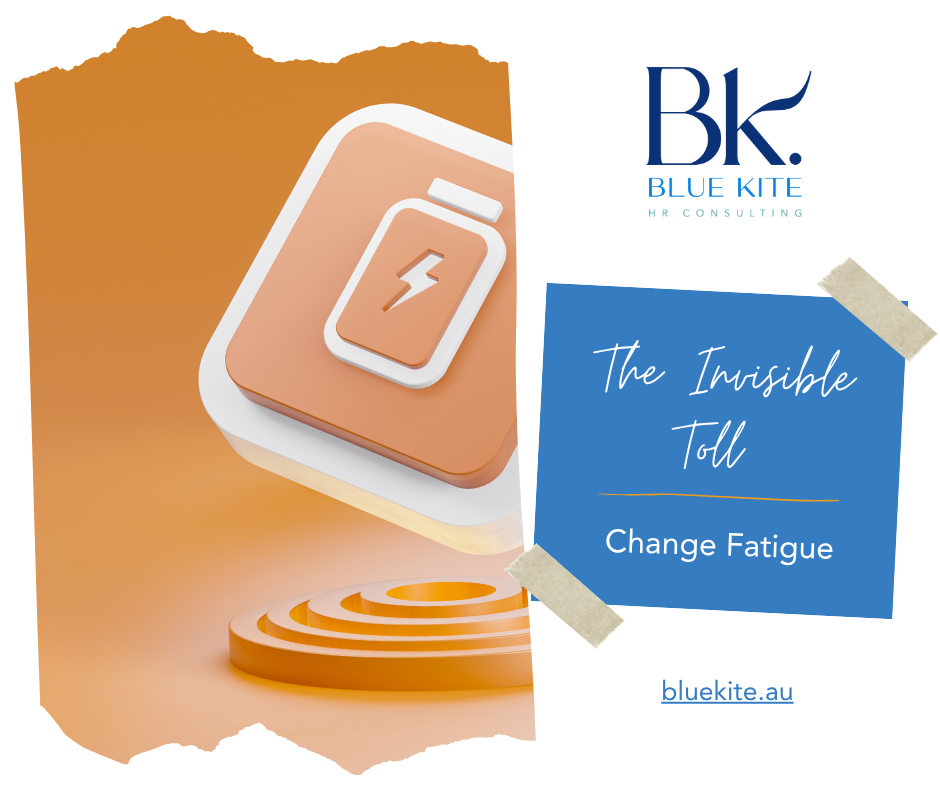
Most businesses understand that change is necessary. Fewer appreciate that there is a capacity limit for how much change people can absorb, and it has consequences that look, on the surface, very much like disengagement. 

Change fatigue describes the state of exhaustion and resistance that accumulates when people have been subjected to sustained, overlapping or poorly managed organisational change. It is not a character flaw or a resistance to progress.

It is a physiological and psychological response to chronic uncertainty — the mental load of constantly adapting to new structures, new systems, new expectations and new leaders.

The symptoms look similar to low engagement: reduced discretionary effort, increased cynicism, declining participation in initiatives and a subtle but pervasive sense that nothing announced today will still be true in six months. Leaders sometimes interpret this as apathy. In most cases it is self-protection.

The businesses that manage change most effectively are not the ones that move most slowly. They are the ones that move most deliberately. They communicate the purpose of change clearly before announcing the mechanism. They acknowledge the cost of transition honestly rather than relentlessly emphasising the upside. They create genuine space for people to process and respond, rather than moving straight from announcement to implementation.

And critically, they allow some things to remain stable. Predictability in some dimensions creates the psychological safety to tolerate disruption in others. When everything is changing at once, the capacity to adapt is overwhelmed. The art is knowing which stability to protect.


If you want practical support reviewing your workplace policies, contracts, leadership capability, or workplace culture, Blue Kite HR Consulting can help you take a proactive approach before issues become bigger problems.


BACK TO ALL ARTICLES
Screenshot 2025-11-18 164639

+61 (0) 409 545 634

cpaterson@bluekite.au

FREE CONSULTATION

  • ABOUT
  • HR SERVICES
  • COACH WITH ME
  • HEALTH & WELLBEING
  • MEDIA/PR
  • ARTICLES/BLOG
  • RESOURCES
  • CONTACT
  • PRIVACY

Blue Kite specialises in providing
HR services to support businesses
to create better workplaces.
Filed Under: Advisory and compliance, Career Planning, Change management, Culture, External HR Support, HR essentials, Leadership

4 July, 2026 by Catie Paterson Leave a Comment

What Your Meetings Are Actually Telling You

ARTICLES

What Your Meetings are Actually Telling You

4 July, 2026
Filed Under: Advisory and compliance, Business Update, Change management, Culture, External HR Support, HR essentials, Leadership

Meetings have been the subject of endless critique — too many, too long, too unfocused. But the more interesting question about meeting culture is not how to have fewer of them. It is what they reveal about how a business actually operates.

A meeting where the same two or three people do all the talking is telling you something about whose voices are considered valuable.

A meeting where decisions are announced rather than made is telling you something about how much input people are actually invited to provide.

A meeting that could have been an email, run by a leader who needs an audience, is telling you something about where accountability for people’s time sits.

Meeting culture is a mirror. It reflects the power dynamics, the communication norms and the psychological safety of the organisation with unusual clarity — precisely because it is the context in which all of those things are on display simultaneously.

The businesses with the most effective meeting cultures are not the ones that have banned meetings or mandated standing-only formats. They are the ones where the purpose of each meeting is clear, the right people are in the room, and every person in that room has been given, through repeated behavioural evidence, genuine reason to believe their contribution is welcome.

That last condition is the hardest to create. It is also the most important. Because a room full of people who do not feel safe to contribute is not a meeting. It is a performance. And the cost of that performance, multiplied across every week of the working year, is significant.


If you want practical support reviewing your workplace policies, contracts, leadership capability, or workplace culture, Blue Kite HR Consulting can help you take a proactive approach before issues become bigger problems.


BACK TO ALL ARTICLES
Screenshot 2025-11-18 164639

+61 (0) 409 545 634

cpaterson@bluekite.au

FREE CONSULTATION

  • ABOUT
  • HR SERVICES
  • COACH WITH ME
  • HEALTH & WELLBEING
  • MEDIA/PR
  • ARTICLES/BLOG
  • RESOURCES
  • CONTACT
  • PRIVACY

Blue Kite specialises in providing
HR services to support businesses
to create better workplaces.

Filed Under: Advisory and compliance, Business Update, Change management, Culture, External HR Support, HR essentials, Leadership

3 July, 2026 by Catie Paterson Leave a Comment

The Differences Between Being Liked and Being Respected

ARTICLES

The Difference Between Being Liked and Being Respected

3 July, 2026
Filed Under: Advisory and compliance, Business Update, Change management, Culture, External HR Support, Leadership

One of the most common and costly confusions in leadership is between the desire to be liked and the need to be respected. They are not the same thing, and optimising for the wrong one has predictable consequences.

Leaders who prioritise being liked make decisions shaped by the desire to avoid disapproval.

They soften feedback until it loses its meaning.

They avoid addressing performance issues because the conversation might create discomfort.

They agree when they should push back, and they stay quiet when they should name something difficult.

Their teams appreciate the easy atmosphere — until a problem appears that the leader is not equipped to handle, and the absence of honest relationship capital becomes apparent.

Respected leaders are not unkind or aloof. In many cases they are deeply liked. But the respect comes first — from being honest, from following through, from being willing to have the conversations that matter even when they are difficult. People may not always enjoy interacting with a leader who holds them to a genuine standard, but they trust them. And trust, in a leadership relationship, is far more valuable than comfort.

The shift from prioritising likability to earning respect requires a particular kind of courage — the willingness to accept temporary discomfort in service of genuine relationship. It requires a leader to hold two things simultaneously: care for the person and honesty about the situation.

That combination is what genuine leadership looks like. It cannot be faked, and it cannot be shortcut.

If you want practical support with leadership development or workplace culture, Blue Kite HR Consulting can help you take a proactive approach before issues become bigger problems.


BACK TO ALL ARTICLES
Screenshot 2025-11-18 164639

+61 (0) 409 545 634

cpaterson@bluekite.au

FREE CONSULTATION

  • ABOUT
  • HR SERVICES
  • COACH WITH ME
  • HEALTH & WELLBEING
  • MEDIA/PR
  • ARTICLES/BLOG
  • RESOURCES
  • CONTACT
  • PRIVACY

Blue Kite specialises in providing
HR services to support businesses
to create better workplaces.
Filed Under: Advisory and compliance, Business Update, Change management, Culture, External HR Support, Leadership

2 July, 2026 by Catie Paterson Leave a Comment

The ‘Culture Fit’ Trap

ARTICLES

The 'Culture Fit' Trap

2 July, 2026
Filed Under: Advisory and compliance, Business Update, Change management, Culture, External HR Support, HR essentials, Leadership

Culture fit has been a hiring standard in many organisations for years. The instinct behind it is understandable — bring in people who share your values, your ways of working, your approach to problems. The trouble is that in practice, “culture fit” very often means something much simpler and much less useful: hire people who are like us.


We all know homogeneous teams feel comfortable, but the research is unforgiving.

They consistently underperform diverse teams on crucial business metrics like decision quality, creativity, risk management, and adaptability.

When we hire for “culture fit” without a clear definition, we are really just amplifying our own biases. We end up hiring people who talk like us or share our background – none of which actually predict how well they will do the job. In the process, we lock out the exact people who could challenge us to do better.

Instead of chasing “culture fit” (or even “culture add”), we should look for values alignment. Shared values are about how we treat people, how we handle accountability, and our commitment to work integrity. Hiring for values is a real filter. Hiring for cultural familiarity is just a shortcut that gradually narrows our collective imagination.

Ultimately, the best hires are the people who share your standards but actively challenge your assumptions. It is a harder combination to find, but it is infinitely more valuable.


If you want practical support reviewing your workplace policies, practices, contracts, leadership capability, or workplace culture, Blue Kite HR Consulting can help you take a proactive approach before issues become bigger problems.


BACK TO ALL ARTICLES
Screenshot 2025-11-18 164639

+61 (0) 409 545 634

cpaterson@bluekite.au

FREE CONSULTATION

  • ABOUT
  • HR SERVICES
  • COACH WITH ME
  • HEALTH & WELLBEING
  • MEDIA/PR
  • ARTICLES/BLOG
  • RESOURCES
  • CONTACT
  • PRIVACY

Blue Kite specialises in providing
HR services to support businesses
to create better workplaces.

Filed Under: Advisory and compliance, Business Update, Change management, Culture, External HR Support, HR essentials, Leadership

30 June, 2026 by Bronwyn Coulthart Leave a Comment

HR as a Growth Engine: Moving Beyond Risk Management

ARTICLES

HR as a Growth Engine: Moving Beyond Risk Management

30 June, 2026
Filed Under: Advisory and compliance, Business Update, Career Planning, Change management, Culture, HR essentials, Onboarding, Workforce, Workforce Planning

HR has traditionally been associated with risk management—ensuring compliance, managing employee relations and maintaining policies. While these responsibilities remain important, they represent only part of HR’s potential contribution to a business.

Increasingly, organisations are recognising HR as a driver of growth. When aligned with business objectives, HR can influence leadership capability, workforce effectiveness and overall performance.

A growth-focused HR function looks beyond processes and considers how people practices support business outcomes. This may involve developing leadership capability, improving performance management, strengthening culture or enhancing the employee experience.

For example, effective leadership development can improve decision-making and team performance. Clear performance management processes can support accountability and productivity. A strong culture can enhance engagement and retention.

To operate in this way, HR needs to be involved in strategic decision-making. This requires a clear understanding of the business, its objectives and the role people play in achieving them.

Importantly, this shift is not solely about HR. It requires leaders across the business to engage with people practices as a core part of business performance.

HR is not only there to manage risk. When used effectively, it can support growth, strengthen capability and contribute to long-term success.

Get on the waitlist for my Blue Kite HR Advisory Portal, here.

BACK TO ALL ARTICLES
Screenshot 2025-11-18 164639

+61 (0) 409 545 634

cpaterson@bluekite.au

FREE CONSULTATION

  • ABOUT
  • HR SERVICES
  • COACH WITH ME
  • HEALTH & WELLBEING
  • MEDIA/PR
  • ARTICLES/BLOG
  • RESOURCES
  • CONTACT
  • PRIVACY

Blue Kite specialises in providing
HR services to support businesses
to create better workplaces.

Filed Under: Advisory and compliance, Business Update, Career Planning, Change management, Culture, HR essentials, Onboarding, Workforce, Workforce Planning

  • « Go to Previous Page
  • Page 1
  • Interim pages omitted …
  • Page 12
  • Page 13
  • Page 14
  • Page 15
  • Page 16
  • Interim pages omitted …
  • Page 22
  • Go to Next Page »

Copyright © 2026 · Executive Pro on Genesis Framework · WordPress · Log in koopo

  • HOME
  • ABOUT US
  • HR SERVICES
  • COACH WITH ME
  • HEALTH & WELLBEING
  • MEDIA/PR
    • – Articles/Blogs
    • – Keynote Speaking Events
    • – Podcast Interviews
    • – Ticker Interviews
  • BLOG
  • RESOURCES
  • CONTACT